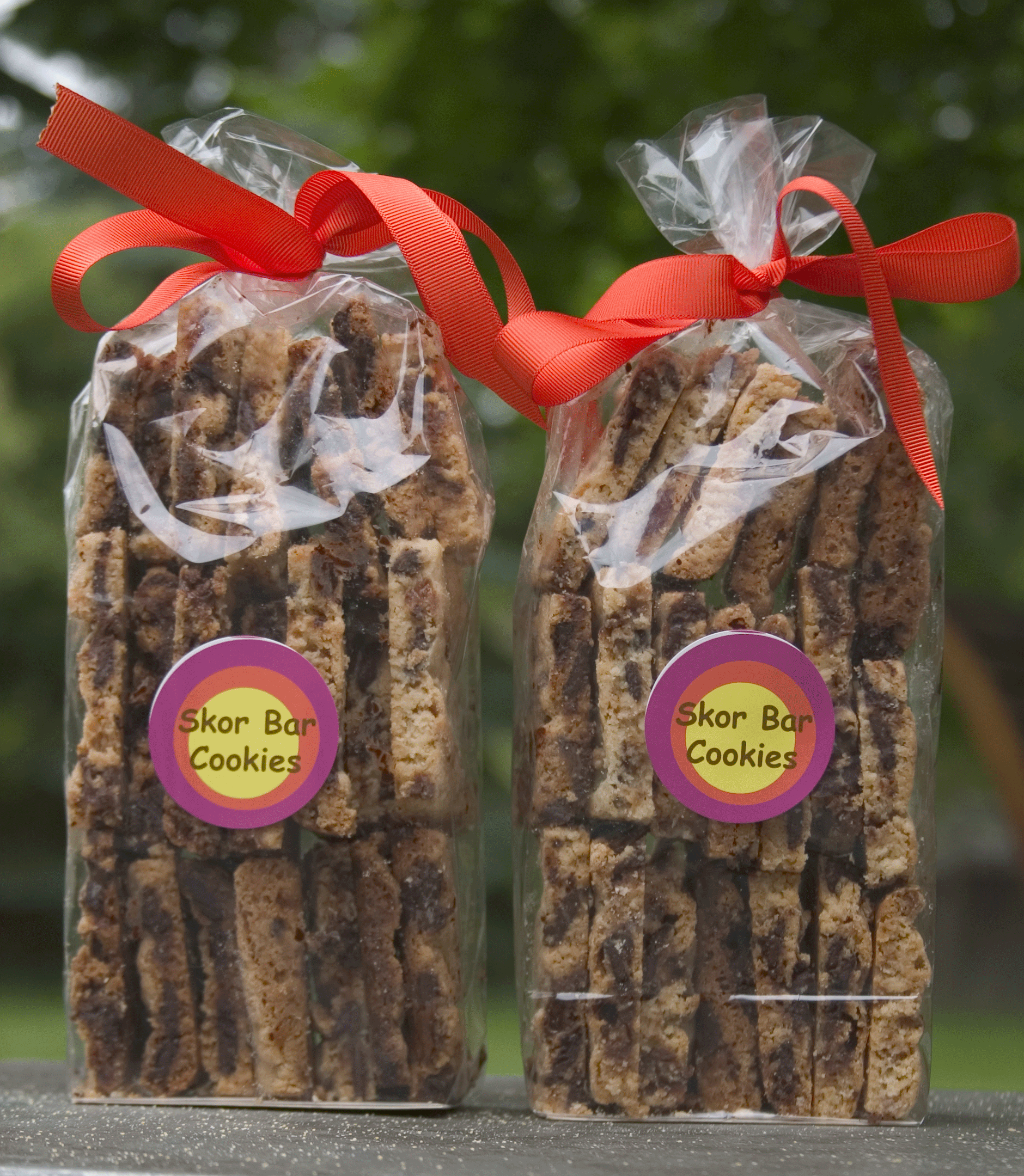
This recipe was created by Daphna Rabinovich, a talented baker I worked with at the David Wood Food Shop in Toronto. She used chocolate chips and walnuts in her version. I chop up bittersweet chocolate into chunks and omit the nuts. This is a very fast and easy recipe, great for those times when you want something decadent and homemade but don’t have alot of time.
What you need:
4 Skor Bars coarsely chopped
1 cup unsalted butter, at room temperature
1 cup sugar
1 teaspoon pure vanilla extract
½ teaspoon salt
2 cups all-purpose flour
1 cup chocolate chips or chunks
What you do:
1. Preheat oven to 325 degrees F. Line a 10 x 15 inch cookie sheet (with sides) with parchment paper. Set aside.
2. Using an electric mixer, cream the butter and sugar together until light and fluffy, about 5 minutes.
2. Beat in vanilla and salt. Add flour, Skor Bars and chocolate chunks. Mix briefly until just combined.
3. Dump dough into prepared pan.
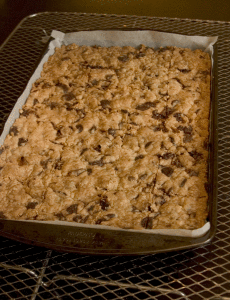
4. Press dough evenly into prepared pan. Bake for about 20 – 25 minutes until golden brown.
5. Remove from oven and while still warm, score dough with a sharp knife. I usually do 5 rows down and 7 rows across for 35 cookies. Put pan on a rack to cool.
6. When totally cool, turn out onto a cutting board, peel off parchment and finish cutting into squares.
At one time I subscribed to about 13 different magazines, most of them food related. However, over time I have let most of them lapse because I just never had time to read them. Now I only get Gourmet and Cook’s Illustrated. Even with just those two, I am still behind in my reading. However, in this instance being behind happened to be a good thing. Last week I picked up the March/April issue of Cook’s Illustrated and began to look at the Table of Contents. And there on page 22 was an article titled “Authentic Rustic Ciabatta”. How about that? In the very same week I was about to tackle the Bread Baker’s Apprentice version of ciabatta!As I read through both versions I began to compare and saw that these were two very different breads. The BBA bread used bread flour, while Cook’s called for all-purpose. Both recipes call for a starter of some type but the ratio of starter to flour in the final dough differs. In the BBA version, the ratio is approximately 2:1 (16 ounces biga: 9 ounces bread flour). In the Cook’s version, the ratio is about 1:1 (9 ounces biga: 10 ounces all-purpose flour). The shaping method in the Cook’s version is also quite different. They propose a method which reminded me of making puff pastry, where you fold and turn the dough about 16 times.
I was intrigued. I had never made Ciabatta before and was very curious to see which one I’d prefer. In order to make this as scientific as possible, I decided to make them at approximately the same time. This is where it got interesting. Note to self (and others who may try this), if you are testing two recipes, do them sequentially, not simultaneously. I got a bit mixed up in the instructions and ended up using the Cook’s instructions on the BBA dough.
Day One was a breeze! I made the Poolish for the BBA version and let it sit on the counter for 4 hours and then put it in the fridge overnight. I made the Cook’s Biga and let it sit overnight on the counter for 12 hours.
Day 2 was a sweaty marathon of baking. I made the BBA dough with just water and olive oil but used water and milk in the Cook’s version. The other big difference was the type of flour. BBA called for bread flour, Cook’s uses all-purpose.
BBA mise en place
Cook’s mise en place
The BBA dough is placed on a well floured counter and is stretched and folded into thirds, like a business letter. The dough rests for 30 minutes and is stretched and folded a second time.
Stretched BBA dough
Folded BBA dough
While the loaves were proofing I made the mistake of checking my e-mail. I discovered that the Theraputic Horseback riding association where my son rides, was having a fundraiser the next day and needed some baked goods. I decided to bake some Skor Bar Cookies. These are my go-to cookies when I have limited time but want to make a maximum impact. So I quickly whipped up a batch while my various ciabatta loaves were proofing. The counter looked like a war zone but the Skor Bar Cookies are idiot proof and didn’t let me down.
While the loaves were proofing I preheated my oven and baking stone and got my steam pan in place. The peel was dusted with cornmeal and I was ready. I thought I could only fit two of the three loaves in the oven at once so I left one loaf to continue proofing while I baked the first two.
This is where it all went wrong. In transferring the dough and shaping it, BBA says to gently tug the dough into a 9 inch length and gently dimple it with your fingertips if it bulges in the middle. Cook’s says to use your fingertips and poke the dough into shape. I used the Cook’s method on the BBA bread and I think I poked too hard for this dough and completely degassed it.
BBA dough stretched and poked
They slid into off the peel and onto the baking stone very easily. The spraying of the oven walls had me very nervous. Peter Reinhart warns us not to get any water on glass in the oven, as it could cause the glass to shatter. This was going to be tricky as there are glass lights on both sides of my oven walls. I covered the glass door with a towel, took a deep breath and sprayed and prayed. My spraying aim was good and I did not shatter any glass. After about 13 minutes the loaves were done. As you can see, they did not get very good oven spring. I suspect it was my overzealous finger dimpling!
First two BBA loaves done
However, mistakes are how we learn, as my sister Jody is fond of telling her kindergarten class, so on the third BBA loaf I was more gentle and did not do any dimpling with my fingertips when I shaped the dough.
Third BBA Ciabatta rose nicely
The shaping of the Cook’s ciabatta is conpletely different. Instead of stretching and folding on the counter, the Cook’s dough stays in the bowl for a series of 16 folds and turns. Using a bowl scraper, the dough is lifted and folded over itself and then the bowl is turned 90 degrees. This is repeated 7 more times for a total of 8 turns. The dough rests for 30 minutes and the process is repeated a second time. Cook’s Illustrated says that this helps with getting a higher rise. Then the dough is divided into 2 and each half is pressed into a 6 x 12 inch rectangle. Each rectangle is then folded into thirds, like a business letter. Each loaf is placed on a 6 x 12 inch sheet of parchment and left to rest for 30 minutes.
Cook’s dough pressed into rectangle
Cook’s dough folded into thirds, like a business letter
After the rest period, using floured fingertips, the dough is evenly poked to form a 6 x 10 inch rectangle.
Cook’s dough poked with fingertips into rectangle
Although the Cook’s recipe says to spray the loaf directly with water to help create steam, I used the BBA method and sprayed the oven walls instead as PR had warned us not to get any water directly on the bread because it will cause splotches on the dough.
Cooks dough in the oven
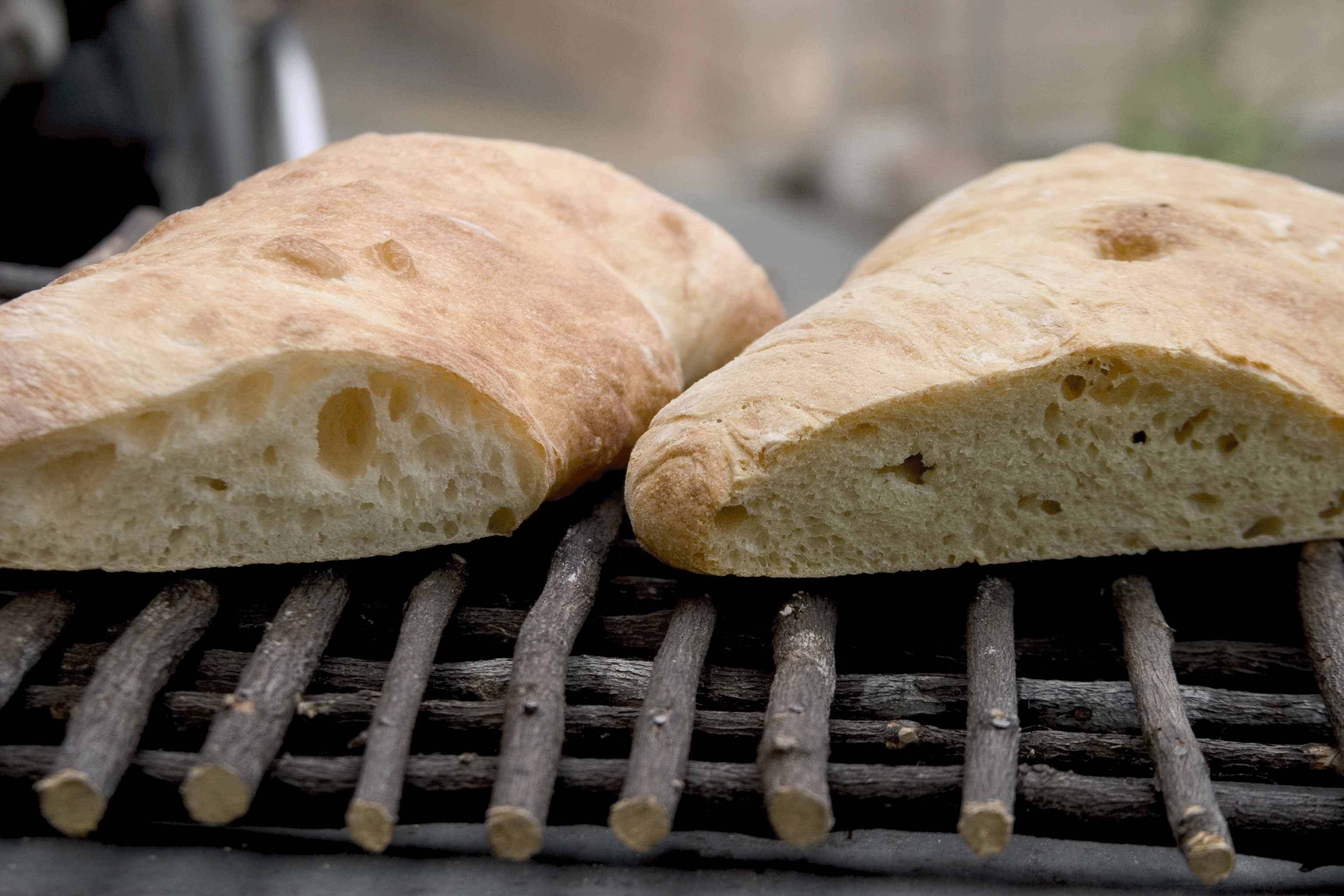
I baked them for 15 minutes until the internal temperature reached 210 degrees F. These were lovely loaves. When I allowed all the loaves to cool I sliced into them. The crumb on the BBA ciabatta was tight with no large holes that Ciabatta bread is known for. The crumb on the Cook’s ciabatta was more open and had afew of the large holes, but I was hoping for more. Then we tasted. Everyone in my family preferred the Cook’s version. It had more flavour and the texture was more reminiscent of great ciabatta we have eaten before. Would I make Ciabatta again? Perhaps. Ask me in a few days after I have recovered from my scientific baking marathon.
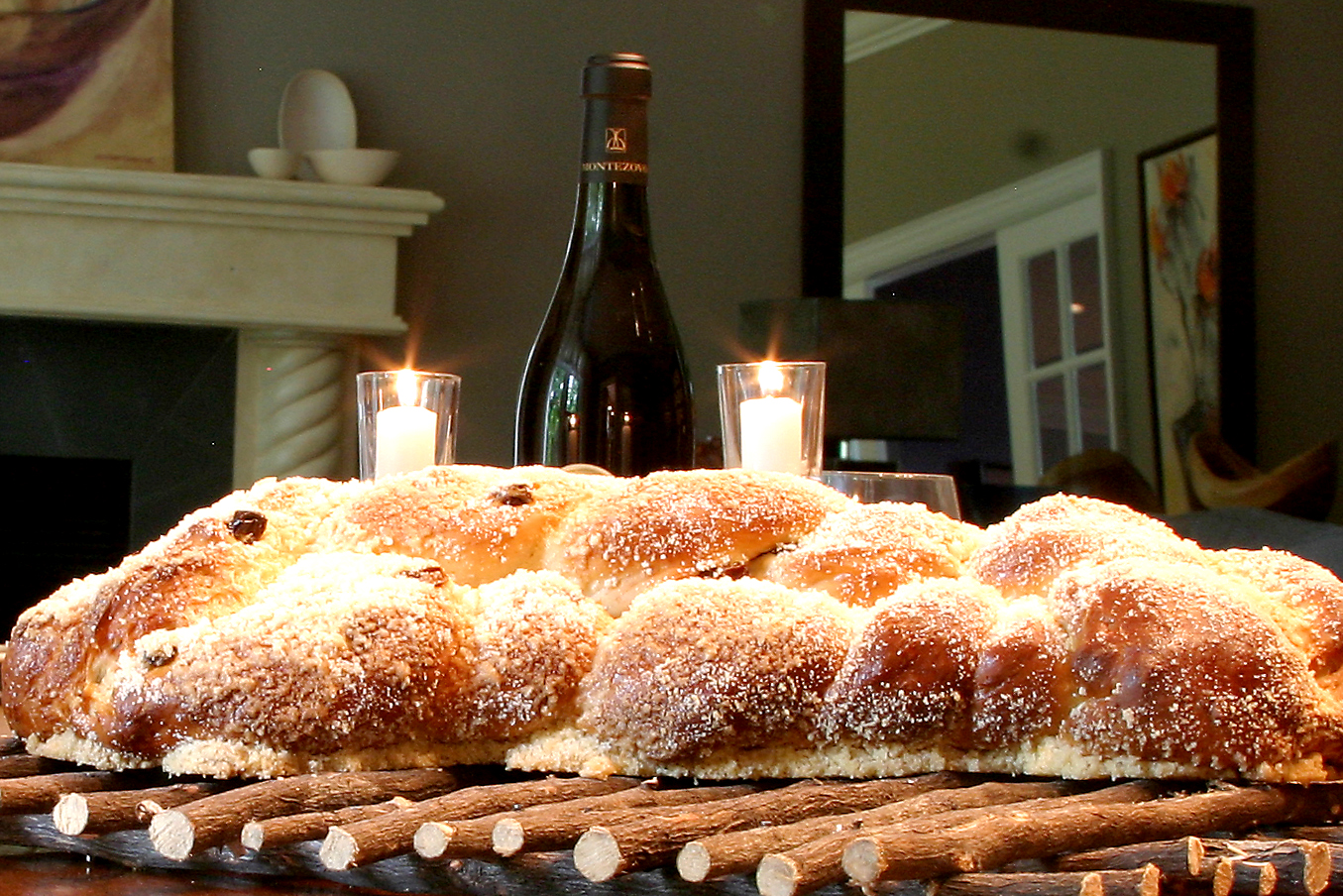
This is the most delicious challah I have ever eaten. Anytime I am invited anywhere for Shabbat dinner, I offer to bring my challah. It’s amazing how often I am invited back. This recipe is actually a marriage of two different recipes. The challah recipe comes from my friend Margo. The topping part of the recipe comes from my sister’s cousin’s friend, Elaine. Elaine and Margo have never met, as fas as I know. My sister would like to introduce them. She thinks they’s like each other. In my little cyber world, they are already great friends!
What you need:
1 package or 1 tablespoon traditional yeast
1 teaspoon sugar
1 cup warm water (115 –120 degrees F)
2 cups all-purpose flour
1 cup whole wheat flour
1/3 cup sugar
1 teaspoon kosher salt
1 large egg, lightly beaten
1/3 cup vegetable oil
1/2 cup raisins (optional)
1/2 cup all purpose flour
1/2 cup granulated sugar
4 tablespoons unsalted butter or margarine
1 egg, lightly beaten
What you do:
1. In a 2 cup liquid measuring cup, dissolve 1 teaspoon sugar in 1 cup warm water. Sprinkle yeast on top and let stand for about 4 minutes, until yeast gets all bubbly.
2a.To make the dough in a stand mixer: Place 1 cup white bread flour, sugar and salt in the stand mixer bowl, fitted with the dough hook. Mix briefly to combine. Pour dissolved yeast mixture into machine and mix for about 1 minute. Add egg and oil and mix again for about 30 seconds. Add remaining 1 cup white bread flour and 1 cup whole wheat bread flour and mix on low speed for about 10 minutes. If dough seems too sticky, add a bit more white bread flour. Dough should be soft and smooth but not sticky.
2b. To make dough by hand: Stir together both types of flour, sugar and salt in a large mixing bowl. In a separate bowl, whisk egg and oil together. Add dissolved yeast and egg/oil mixture to flour mixture. Using a wooden spoon, mix until all the ingredients come together and form a ball. Sprinkle a bit of white bread flour on the counter and dump out the contents of the bowl. Knead by hand for about 10 minutes. As you are kneading, if the dough seems too sticky, knead in a bit more flour. You want a soft but not sticky dough.
3. If using raisins, use your fingers to poke the raisins deep into the center of the dough. Knead for a minute and then form the dough into a ball and transfer it to a large oiled mixing bowl. Turn dough until all sides are coated. Cover the bowl with plastic wrap and let sit on counter until almost doubled in bulk, about 90 minutes, or you can cover and put it in the fridge overnight and continue the next day.
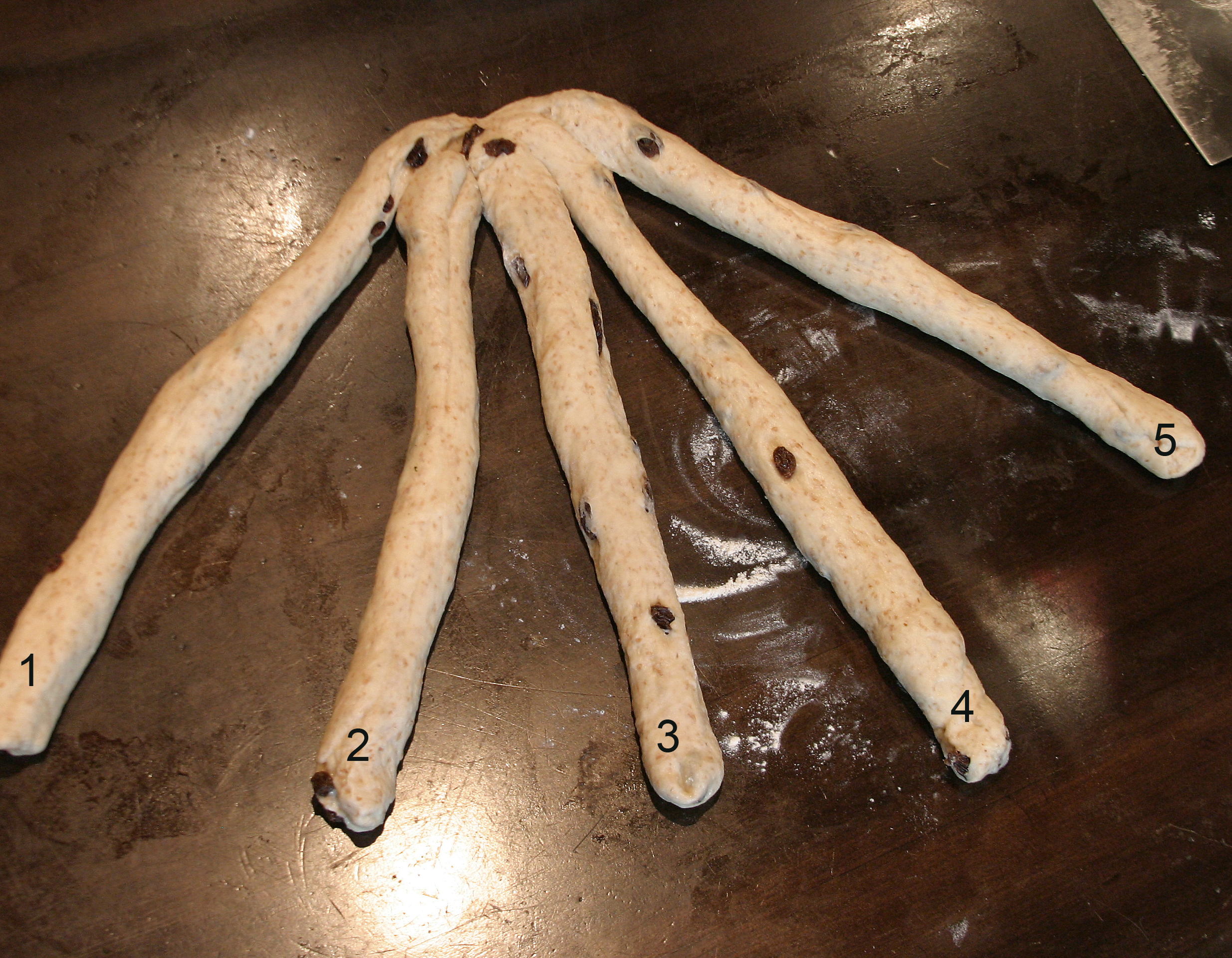
4. After the dough has risen , gently knead again, to punch the dough down. If you have a scale, weigh dough and divide into 5 equal pieces (or you can do 3 pieces for a simple 3 rope braid). Roll our each piece into a rope about 12 inches in length, making sure the ropes are slightly thicker in the middle and tapered at the ends. Lay the ropes out on the counter and attach them by pinching together at the top.
5. I learned how to do the 5 strand braiding method from Peter Reinhart’s book “The Bread Baker’s Apprentice.” I consider myself to have poor fine motor skills, so if I could master this, you can too! Here is the pattern to follow:
Strand 1 over Strand 3, Strand 2 over Strand 3, Strand 5 over Strand 2
6. Just keep repeating this pattern until you get to the end. Gently pinch tip together when you get to the end.
7. Place braid on a parchment lined baking sheet. Spray loaf with spray oil and cover lightly with plastic wrap. Let sit at room temperature until the loaf has almost doubled in size, about 60-90 minutes.
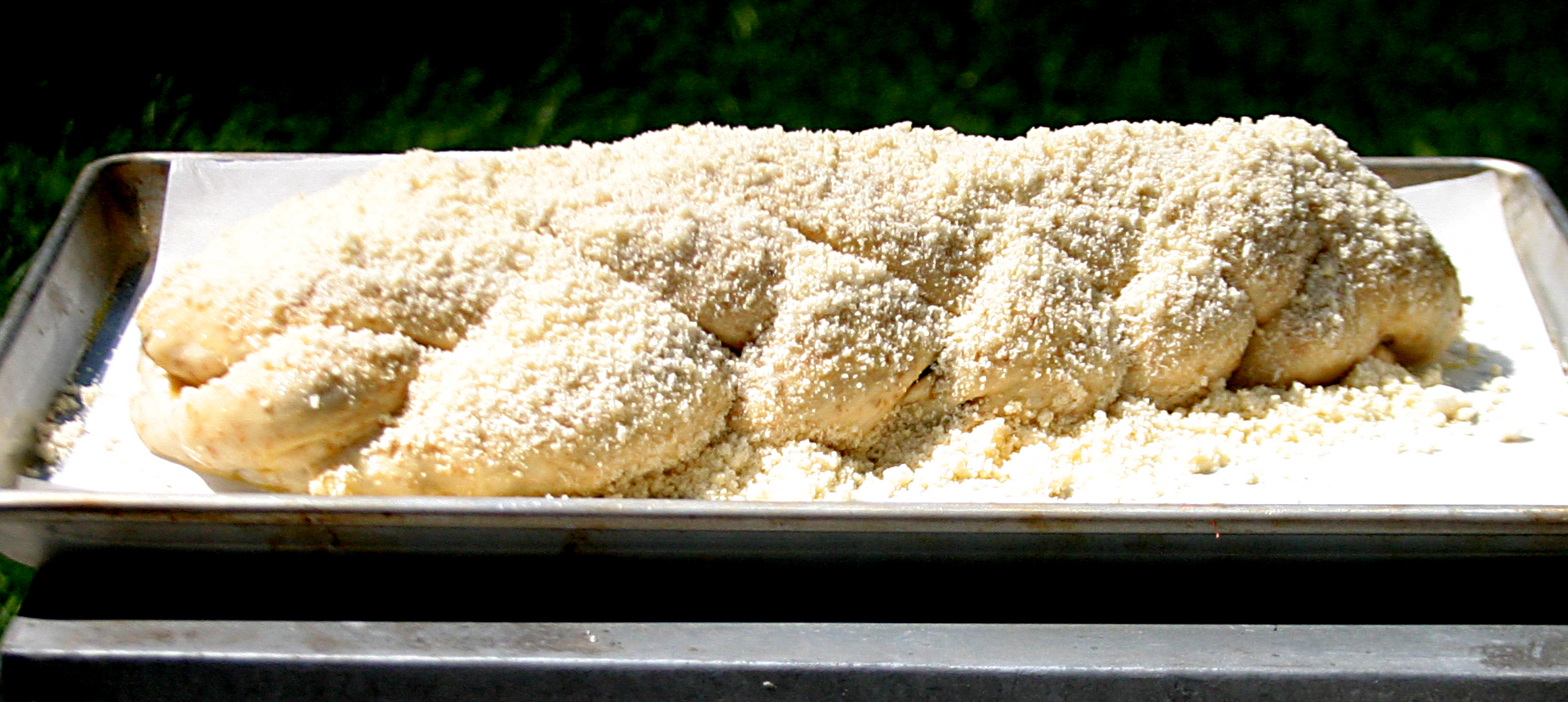
8. While loaf is proofing, make topping. In a bowl, using your fingertips, mix butter or margarine into flour and sugar until you have coarse crumbs. I usually make a double batch of this and keep it in the freezer in a zip-loc bag.
9. After challah has finished proofing, brush gently with beaten egg and then sprinkle topping all over top and sides of bread. Set aside about 1/2 cup of topping to use later. Don’t worry about any topping that doesn’t make it onto the loaf and falls on the parchment paper. Just use your fingers to sweep the excess topping under the loaf. When it bakes, it forms little sweet crusty bits on the bottom that you can pick off and eat before anyone comes home.
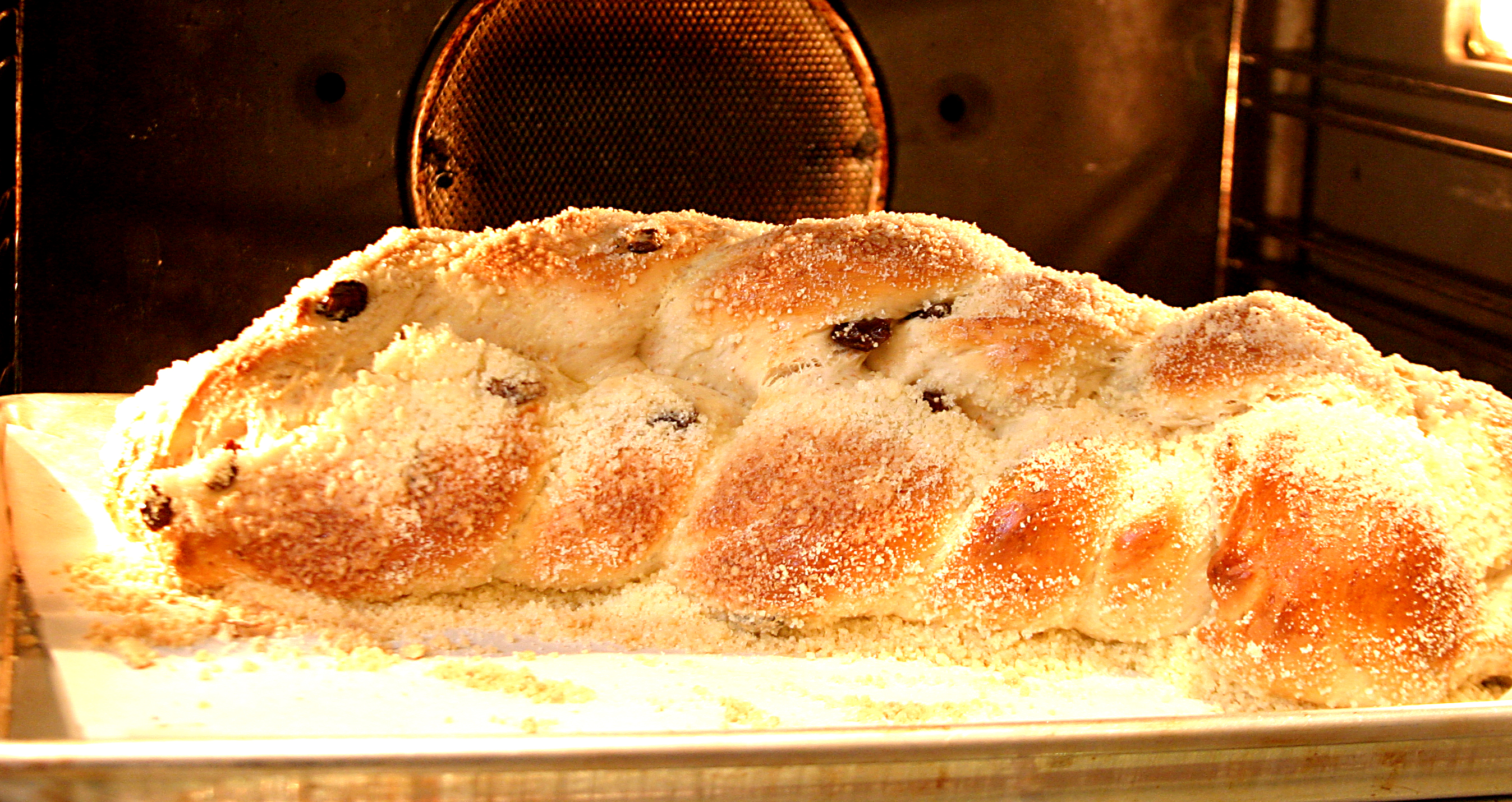
10. Bake challah at 350 degrees for about 20 minutes. Remove challah from oven and brush with egg and sprinkle with reserved topping at the seams where the challah has swelled and newly exposed dough is showing. Turn down temperature to 325 degrees F. If challah is getting too dark, tent with foil. Return challah to oven and bake for an additional 15-20 minutes, or until an instant read thermometer, inserted into the brerad registers 190 degrees F.
11. Remove challah to a wire rack and let cool at least one hour before serving.
I approached this week’s Bread Baker’s Apprentice Challenge with a bit of trepidation. I have been making challah once a week for about 12 years now. For the past five years I have been making the same recipe and my family loves it. As the old saying goes, “If it ain’t broke, don’t fix it.” However, sometimes you have to break with tradition and try something new. Besides, it really annoys my husband and kids when I change things up on them and it’s kind of fun to irritate them.
The recipe I have been making is actually a hybrid of two different recipes. The first recipe comes from my sister’s cousin’s friend Elaine. It is a very rich sweet challah topped with a crumble coating made from butter, floor and sugar. It’s more like eating cake than bread. I made it every week for about 2 years until I had Shabbat dinner at my friend Margo’s house and tried her challah. Margo incorporates about 1/3 whole wheat flour into her challah and uses less eggs and oil than Elaine. I decided to try Margo’s challah with Elaine’s topping and thus a succesful culinary marriage was made. Elaine lives in Toronto and Margo lives here in Ottawa. They have never met in person, although in my virtual world they are great friends!!
I decided to break from tradition and make Reter Reinhart’s challah this week and surprise my family. Once I made my challah with dried sour cherries instead of raisins and I almost had a revolt on my hands. This was going to be fun!! (I know, I need a life).
I followed Peter’s recipe exactly but I decided to do a slow overnight bulk fermentation in the fridge instead of at room temnperature for one hour. I always start my dough on Thursday and let it do the first rise overnight in the fridge and then form the braid, let it proof and bake it late Friday morning. Peter’s recipe contains less sugar and oil than mine but more eggs. The dough mixed up beautifully in my Kitchenaid in about 10 minutes.
Dough mixed and ready for fermentation
I decided to attempt the double celebration design (a little braid on top of a big braid). When I was a little girl, I had short curly hair and my mom would not let me grow it long. I never really mastered braiding until I grew up and started making challah. I never even braided my Barbie’s hair. I used to cut my Barbie’s hair all off , just leaving a fringe around the outside with a bald spot in the middle. I told my mom I gave Barbie a hairstyle just like daddy’s! She never got mad at me, perhaps because when she was a child, she cut the drapes in her living room to make clothers for her doll, so she understood my creative spirit. Thanks Mom!
The double braid requires a bit of math to properly construct. If you have a scale and calculator and half a brain, you can do this! Weigh the dough after the bulk fermentaion. Use one third for the top braid and the remaining two thirds for the bottom braid. Divide each into 3 equal weight pieces. For my bread the entire dough weighed about 900 grams. I rolled out three 100 gram ropes and three 200 gram ropes. I made the ropes for the top braid a little shorter than those for the bottom braid. I made my ropes a little fatter in the middle with tapered ends. For a three rope braid, Peter explains it is best to begin braiding in the middle and work your way down, braiding towards you. Then turn the loaf 180 degrees so that the unbraided end faces you and braid the second half. Once both braids are done, lay the smaller one on top of the bigger one. This is much easier to do than to write about.
After about 90 minutes the bread looked about doubled in size, so I checked to see if it was indeed finished proofing using a new tip I picked up from fellow BBA baker Phyl . Phyl calls this the poke test. Stick your fingertip into the bread and watch what happens next
“If the place you poked doesn’t fill back in, the dough is underproofed.
If it fills back in immediately, you have allowed the dough to overproof.
If, however, the poke hole fills in slowly, your dough is properly proofed and ready to bake.”
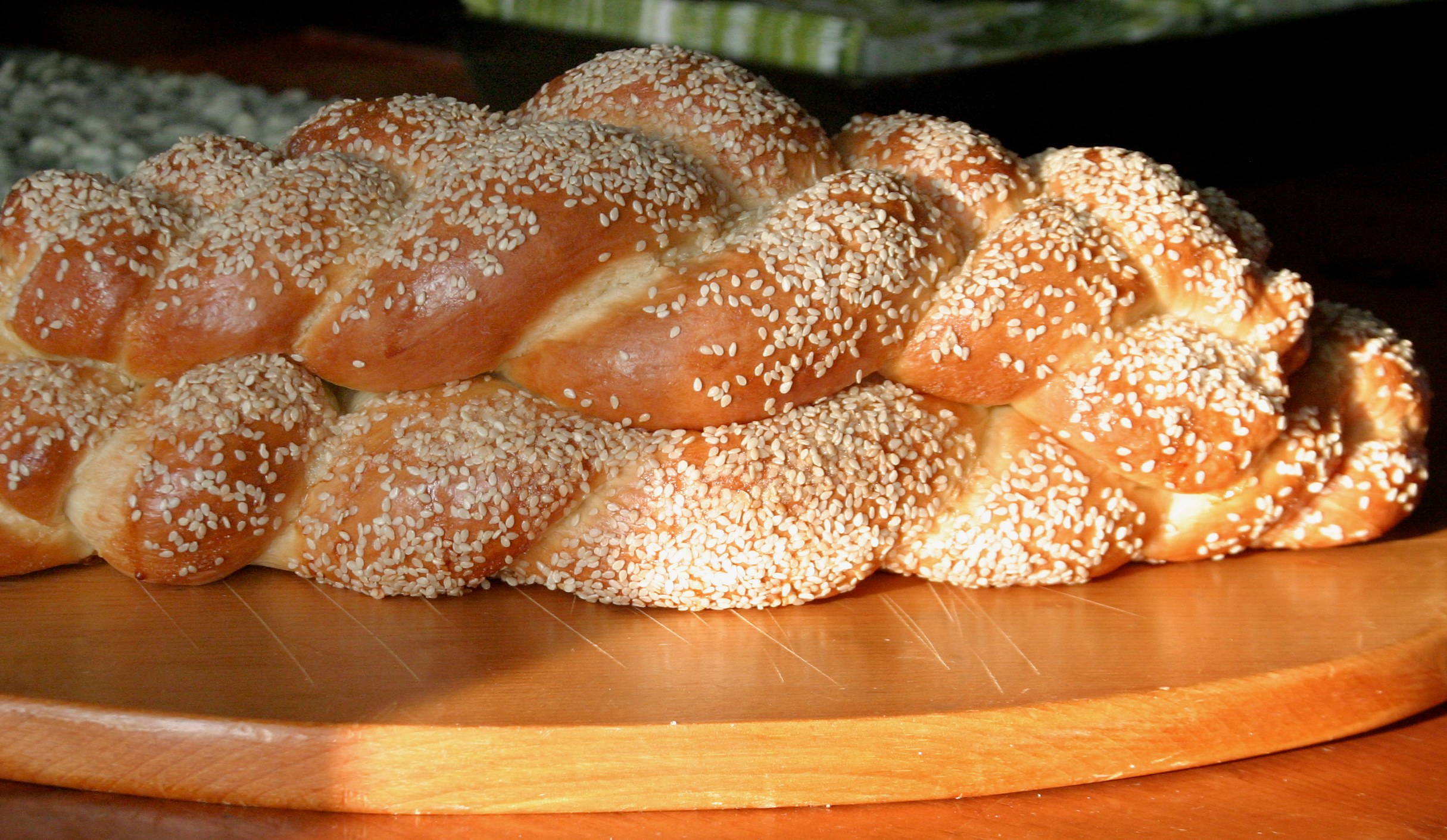
The poke hole filled in slowly, so I egg washed the challah and sprinkled it liberally with sesame seeds. Into the oven it went. I checked the challah after 20 minutes. I could see that the bread was starting to rise and open up. I brushed any new exposed spots with more egg and sprinkled the naked sections with more sesame seeds. I turned the loaf 180 degrees and baked for another 15 minutes until it registered 190 degrees F in the center of the bread.
Double celebration Challah, just out of the oven.
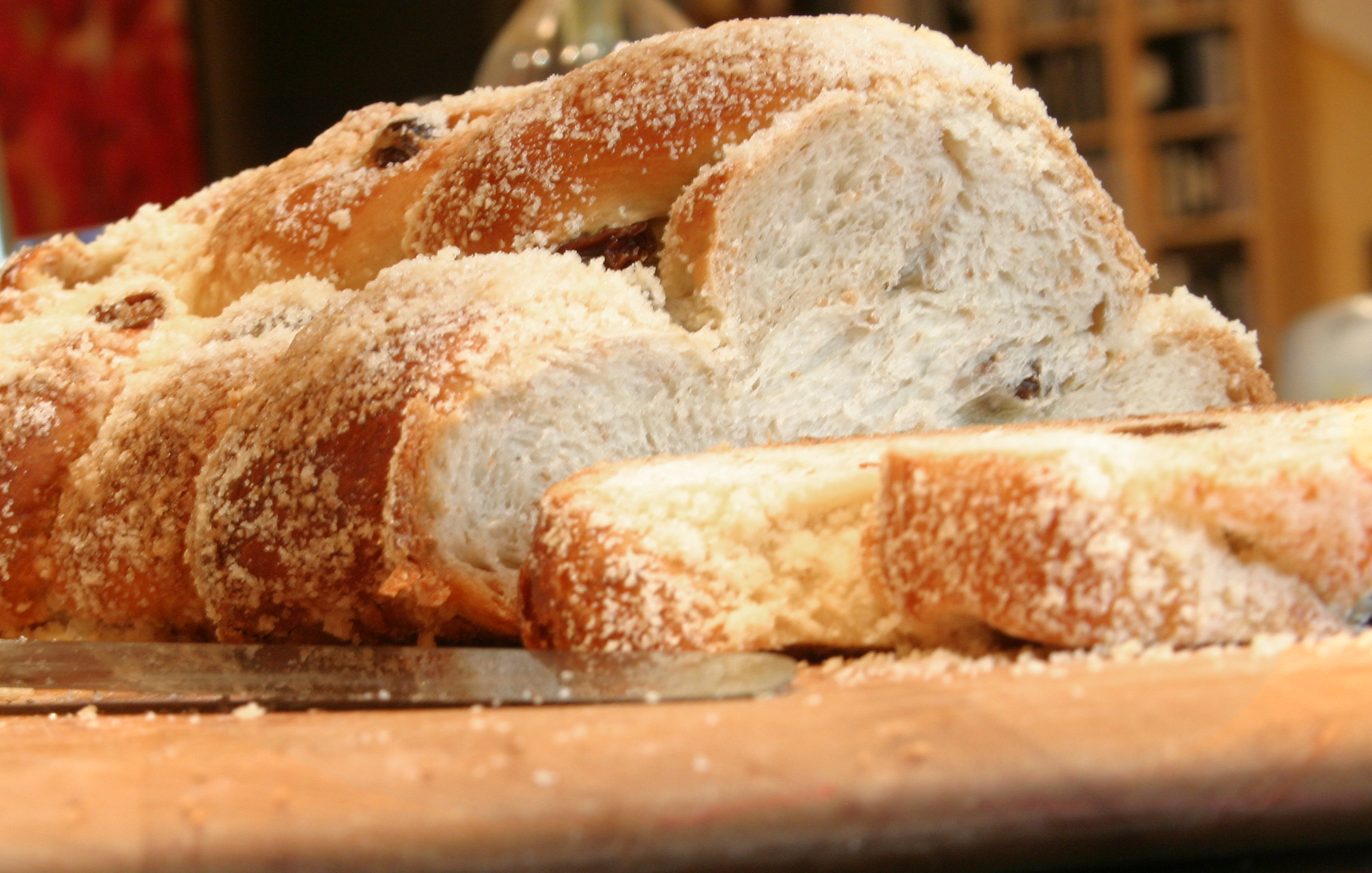
Double Celebration Challah, sliced into.
Although there was no uprising or outright revolt, the verdict was clear. Our family prefer’s the Margo-Elaine hybrid. We found the Peter Reinhart version a little too eggy and airy. My husband said it tasted exactly like Rideau Bakery challah. The Rideau Bakery is here in Ottawa and their challah is considered the gold standard for many here in Ottawa. So while it was a good challah, I won’t be making it again if I know what’s good for me. The Margo-Elaine version of challah can be found here for anyone interested.
There are some people that believe certain events occur in their life for a predetermined reason and others that believe that incidents are just determined by a random series of events. I have to admit that I usually flip flop between the two ends of the spectrum. Six weeks ago, I was surfing the net, doing research for an article I was writing for my column, and I happened to come across Nicole’s “Pinch my Salt” blog. She was talking about baking her way through the cookbook, The Bread Baker’s Apprentice”, and was wondering if anyone was interested in joining her. Without even hesitating, I signed up. At first I thought it was just a random series of events that brought me to her site. But after this week’s baking challenge, I’m not so sure anymore. Maybe there’s a reason why I’m supposed to be baking my way through this book.
When my daughter came into the kitchen on Sunday morning to find me mixing up the sponge for the Casatiello bread, her face fell. When I asked her what was wrong, she said, “Oh you’re just starting the bread now. I guess that means it won’t be ready until tomorrow.” Over the first four weeks of the Bread Bakers Apprentice Challenge, my family became aware that that good bread takes time, usually 2 days. When I told my daughter that this bread only takes 5 hours she was thrilled, “Oh good, it’s a fast one!” This from the mouth of a fast food generation babe! Maybe it was meant to be that I teach my children that good bread, like all things in life is hard work and patience will reap great benefits. including better tasting bread.
Casatiello is an Italian type of brioche enriched with cheese and meat, typically provolone and salami. Since we have a vegetarian in the family, the salami was out. Haley of Appoggiatura had suggested mushrooms but the ones I had in the fridge were too slimy to even consider so I opted to use Kalamata olives and Fontina cheese. In the very back of the cheese drawer I found some Yves spicy italian veggie sausages. I buy them for my daughter but have never tried them. So while my buttermilk sponge was doing its work I decided to dice up few, saute them and see how they tasted. I had my doubts. However, I was pleasantly surprised. They had a meaty texture and salty taste that I thought would be good with the olives and fontina
After about an hour the sponge was ready and it was time to mix up the dough. When I began mixing it seemed as if the ingredients would never come together. It was just a big shaggy sticky mess.
At the beginning of mixing.
However, Peter Reinhart (author of the BBA book) said the dough would eventually change from sticky to tacky and would finally come off the sides of the bowl. As usual, he was right.
After 12 minutes of mixing
I was very excited to mix in the olives, sausage and cheese by hand. I loved handling this dough. It was smooth and supple and so satiny.
Adding in olives and veggie sausage
Adding in Fontina cheese
Another minute of hand kneading and the dough was ready for fermentation.
I placed the dough into a well greased measuring cup and left it to do it’s magic.
After 90 minutes the Casatiello dough had doubled.
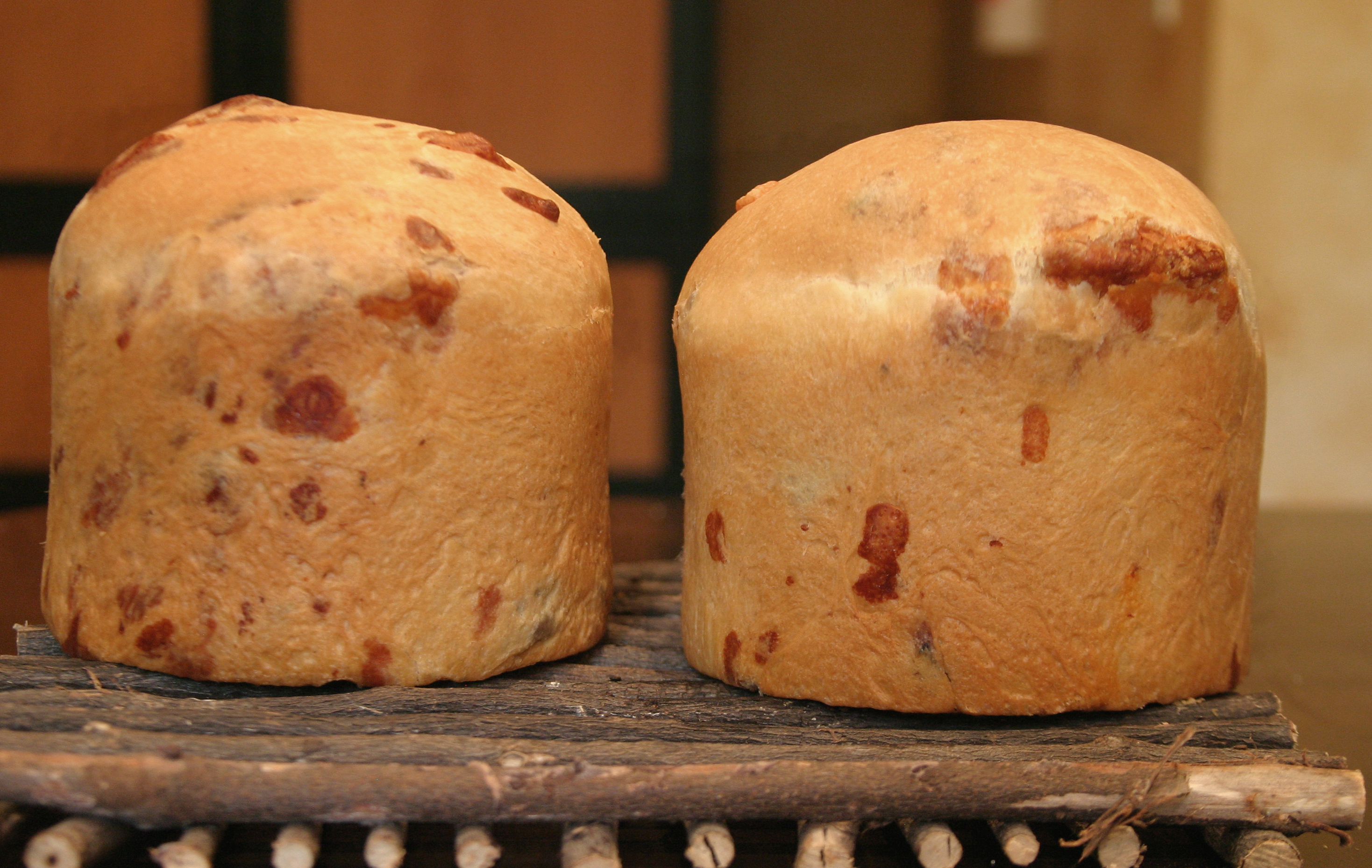
I weighed the dough, divided it in half and formed 2 round loaves (boules). Each loaf went into a greased 5 inch paper panettone pan.
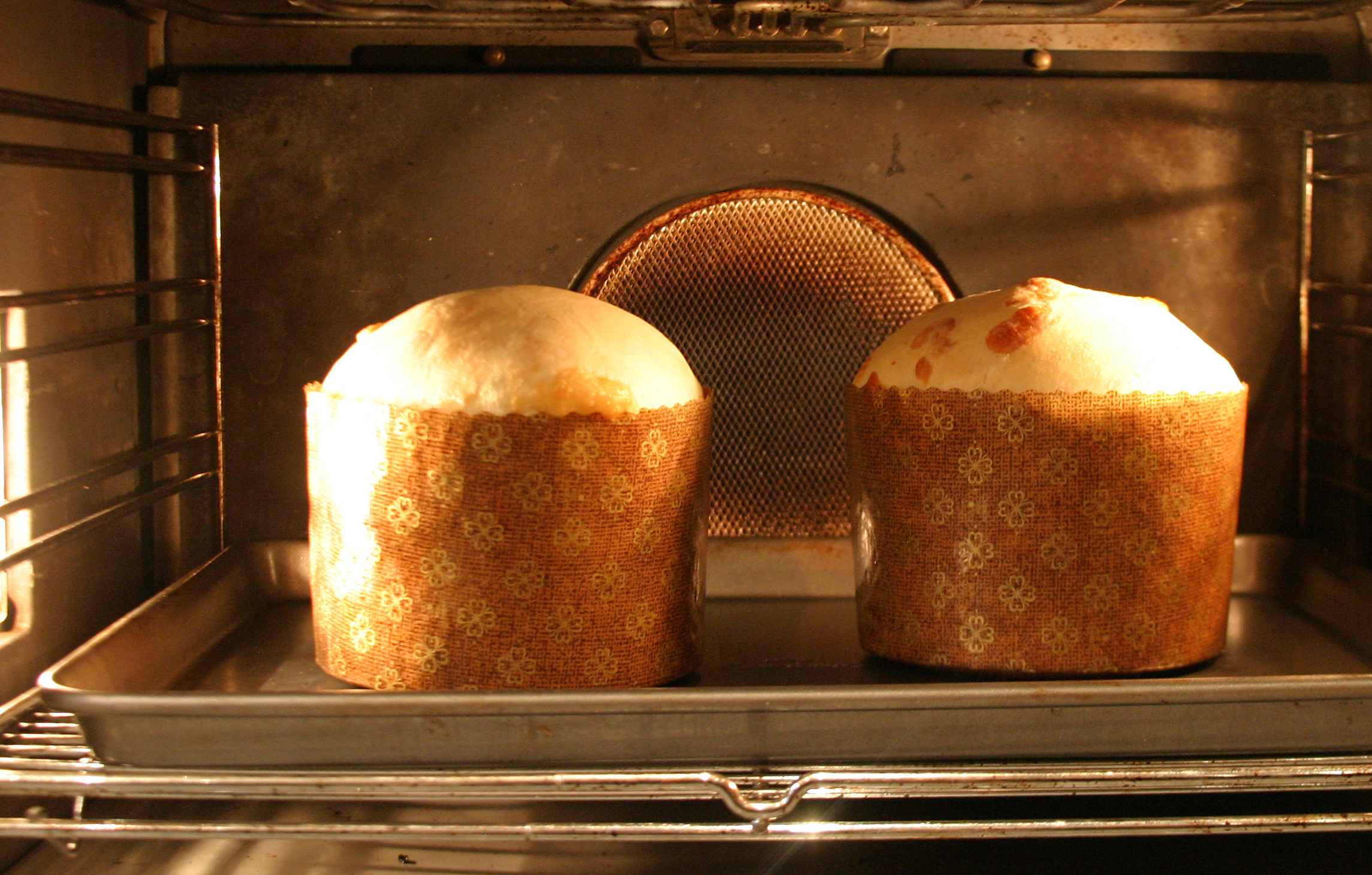
After 90 minutes the dough just peeked over the top of the paper. Oven time.
They took about 35 minutes to bake.
The book said to cut slits into the paper to allow the steam to escape but I was too impatient to see the sides of the bread, so I carefully peeled the papers off and let them cool naked.
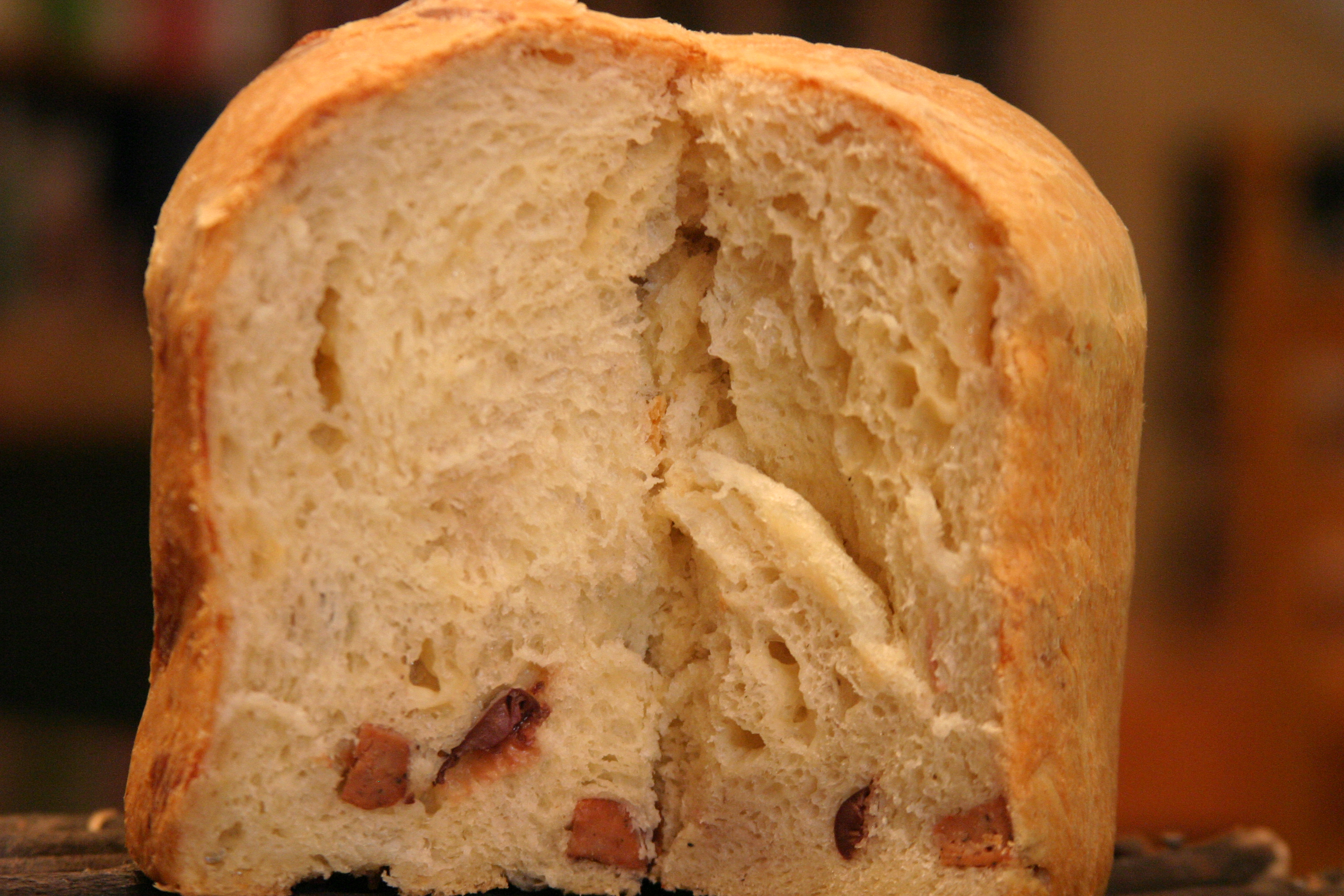
We tore into them after an hour . They were a unanimous success. The cheese inside was still warm and gooey. The little bits of cheese that had oozed out of the dough formed crunchy little nuggets on the outside. The sausage and olives added a salty tangy dimention only slightly tempered by the creamy cheese.
Now I’m wondering if my weight gain from eating all this bread is happening for a predetermined reason? If anyone has any insight into this, please share!
This recipe was inspired by my friend Linda. She is the one who introduced me to Imagine Organic soups in tetra-pack packaging. They come in several flavours (creamy corn, butternut squash, tomato to name a few) and are fantastic for making quick soups. It’s a great pantry staple.
The creamy corn does not in fact contain any cream or dairy products for that matter. I think of these soups as a blank canvas and add in my own ingredients. This is delicious in the summer when you can add fresh corn but I make it all year round using frozen corn too.
What you need:
3 tablespoons butter
3 small cloves garlic, finely minced
1 jalapeno pepper, seeded and finely minced
1 ½ – 2 teaspoons kosher salt
1 large onion, finely diced
2 ribs celery, finely diced
1 large sweet potato, peeled and diced into ½ inch pieces
1 teaspoon fresh thyme
2 litres Imagine Organic Creamy Sweet Corn Soup
2 cups fresh or frozen corn
freshly ground black pepper, to taste
What you do:
1. In a large pot, melt butter and add garlic, jalapeno, salt and onions and sauté over medium-low heat for about 2 minutes. Add celery and cook for about 5 more minutes. Add potatoes, thyme and Corn Soup. Bring to a boil, turn down to low, cover and let simmer for about 15 minutes, until potatoes are tender.
2. Add corn and cook for about 5 more minutes. Taste for seasoning, adding pepper and more salt if needed. Transfer one third of the soup to a blender and puree. Add pureed soup back to the rest of soup. Serve hot.
Wow, we’re closing in on a month of bread baking already. In week # 4 of the Bread Baker’s Apprentice Challenge we made Brioche. I have to say there was a lot of talk and questions leading up to this challenge amongst my fellow challengers. Peter Reinhart presents three options for this bread. Rich Man’s brioche, uses one pound of butter in the dough (quadruple bypass), the Middle-Class version uses half a pound of butter (double bypass)and the Poor Man’s variation uses only a quarter of a pound of butter (single bypass).
It was like being back in high school when all the girl’s would call each other before the dance to see who was wearing what. Only here we were all posting on our Google discussion page asking each other which version we were planning on making. Some like Phyl, of Cabbages and King Cakes, made all three. Most of the people who made the rich man’s version said the dough was really hard to work with, not to mention the calorie count. And yes, there was even a discussion thread going about how many calories hand kneading burns – although that was related to the bagel dough from last week. The poor man’s version didn’t seem quite decadent enough for all the effort that goes into this bread. So, I opted for the middle-class version.
I wanted to fall in love with this bread. So much so that I was prepared to add an extra 30 minutes of cardio to my already full one hour workout. I already had the brioche molds, or what I thought were brioche molds. They had been sitting on my basement storage room shelf forever. Can’t remeber why or what I bought them for. I soon realized that they are not proper brioche molds after I saw my fellow challenger’s photos of their proper molds. If anyone knows what these actually are, let me know.
Day one begins with making a sponge from warm milk, instant yeast and bread flour. It sits on the counter to get all active and bubbly for 2 hours. Then the fun begins. Time to mix the dough. I was going Kitchen Aid all the way with this dough, no hand kneading. I had been warned by my new “Bread Freak” friends (that’s what my son calls the BBA Challenge group) that it is a sticky soft mess. Boy they weren’t kidding.
I should also mention that there was a Bake-a thon going on in my kitchen that day. My 17 year old daughter had just decided to bake six different kinds of cookies as a year end gift for a favourite teacher. She invited three friends over to help her bake. One of the friends actually knew how to bake. The other two were there for moral support or comic relief, I’m not sure which. I have to say I was so proud of her. She really did most of it by herself with very little help from me. And the results were spectacular. Here is a photo of the dulce de leche biscotti cooling on the counter after their first baking.
After mixing the dough I put it on a baking sheet, stuck it in the fridge for an overnight rest and hightailed it out of the kitchen.
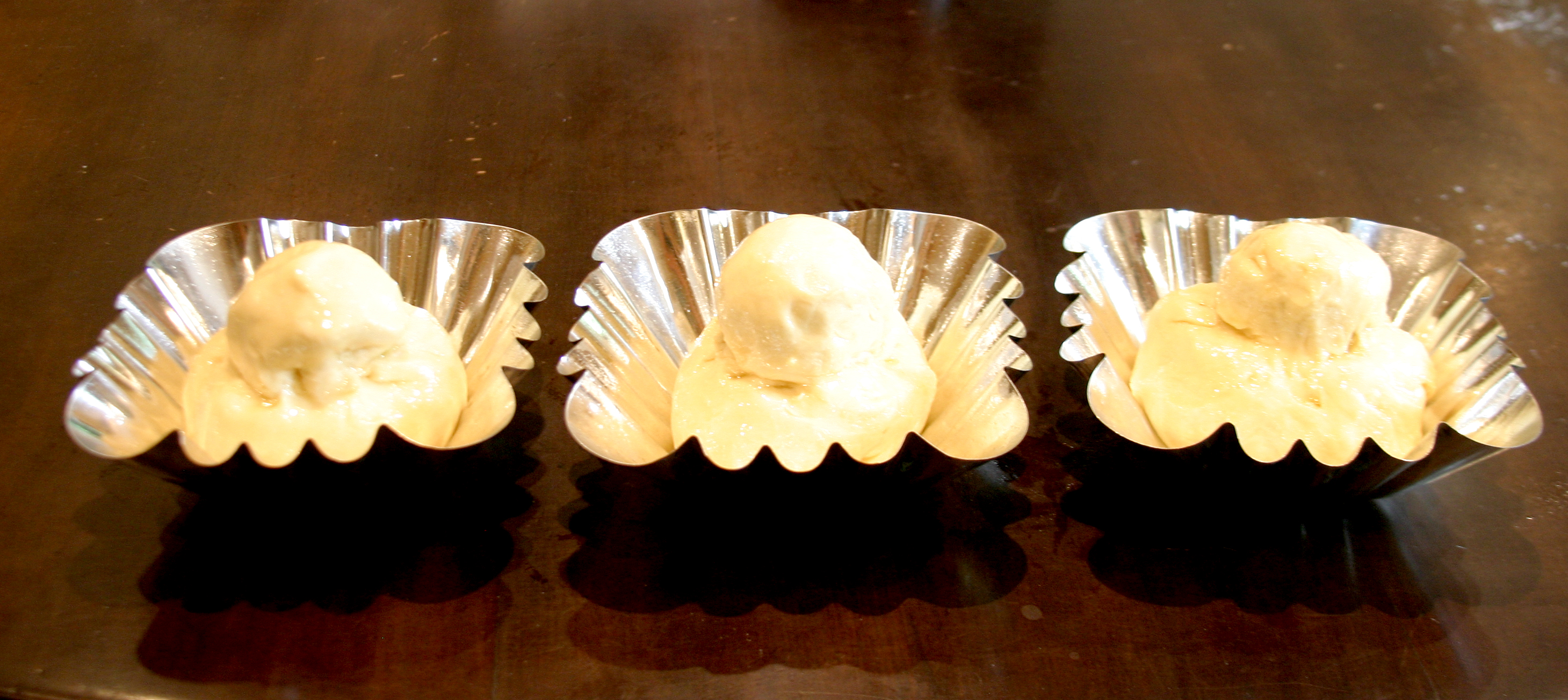
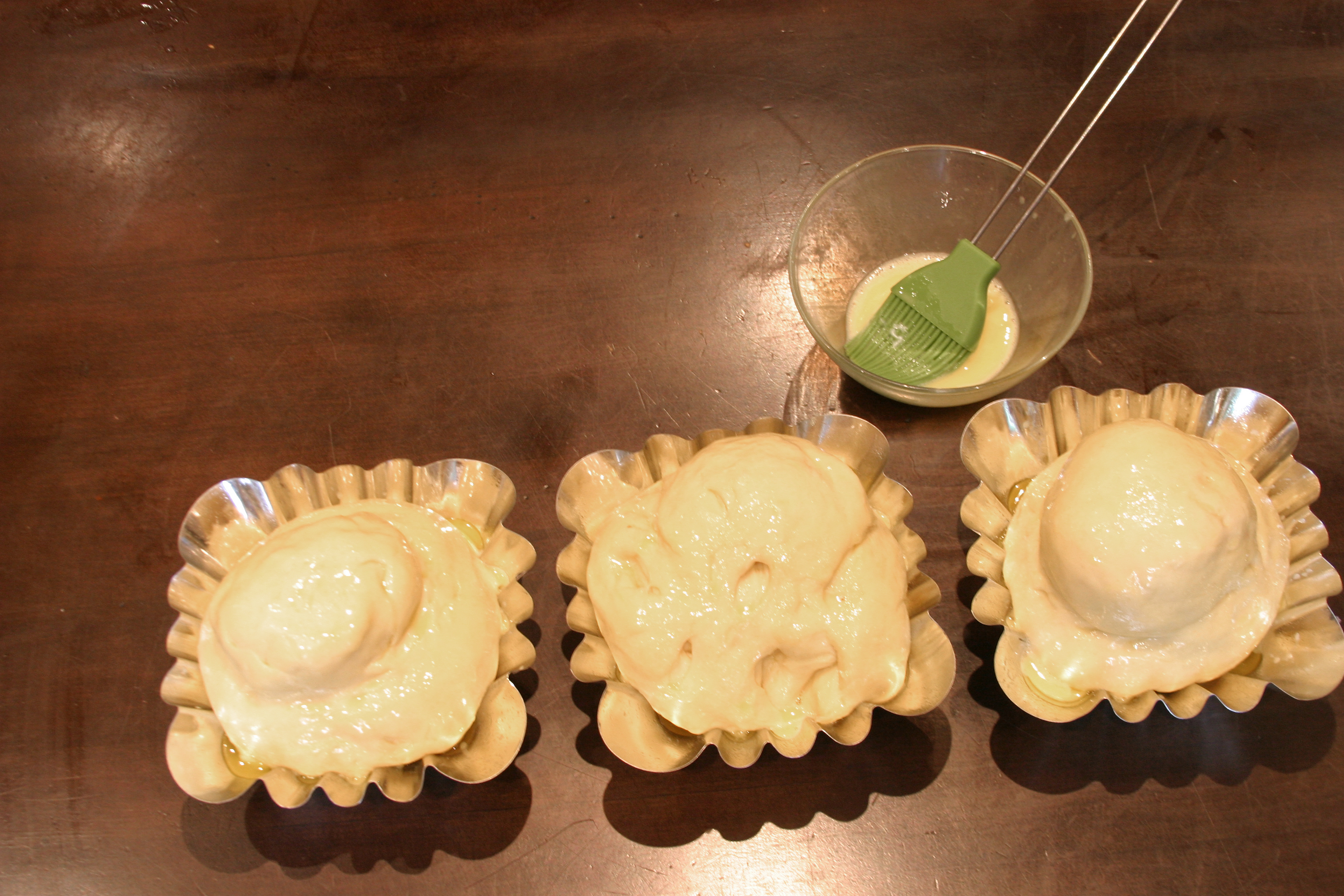
The next day I divided the dough into three equal parts and shaped my brioche. I used the boule method and using the back of my hand, I divided the ball into a large and small ball, rolling down but not going all the way through. Then very gently, I used my fingertips to round out the little ball on top. They looked like three identical little triplets going into their molds.
I carefully sprayed the tops of my brioche with spray oil and loosely covered them with plastic wrap. I left them to do their work on the kitchen sounter while I did my time on the treadmill and eliptical trainer. I had a shower after my workout and at the 2 hour mark they had risen but the dough had not quite reached the top of the molds yet. I brushed them with beaten egg and covered them up again. I checked back in an hour and discovered that the genetic mutation had begun it’s damage.
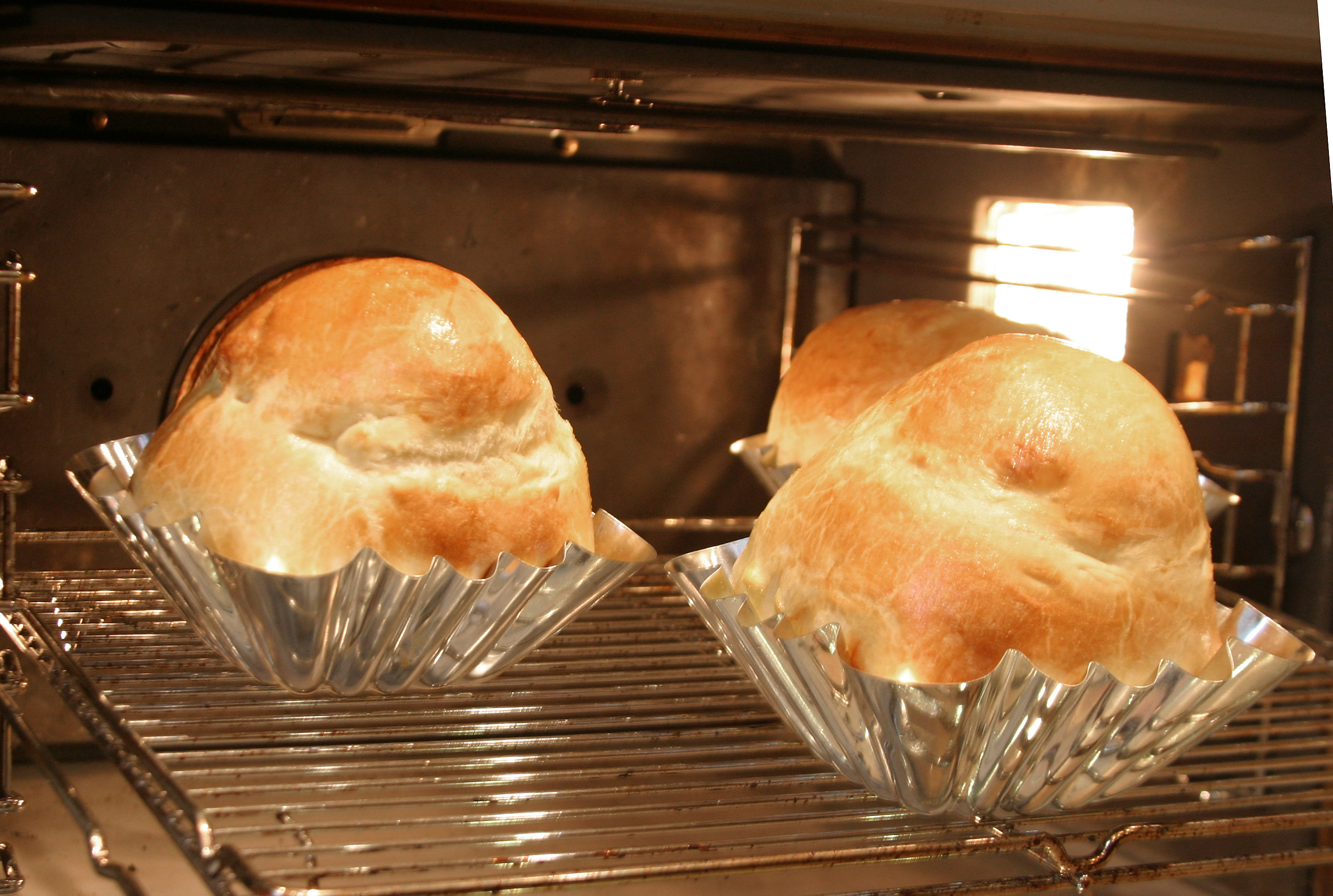
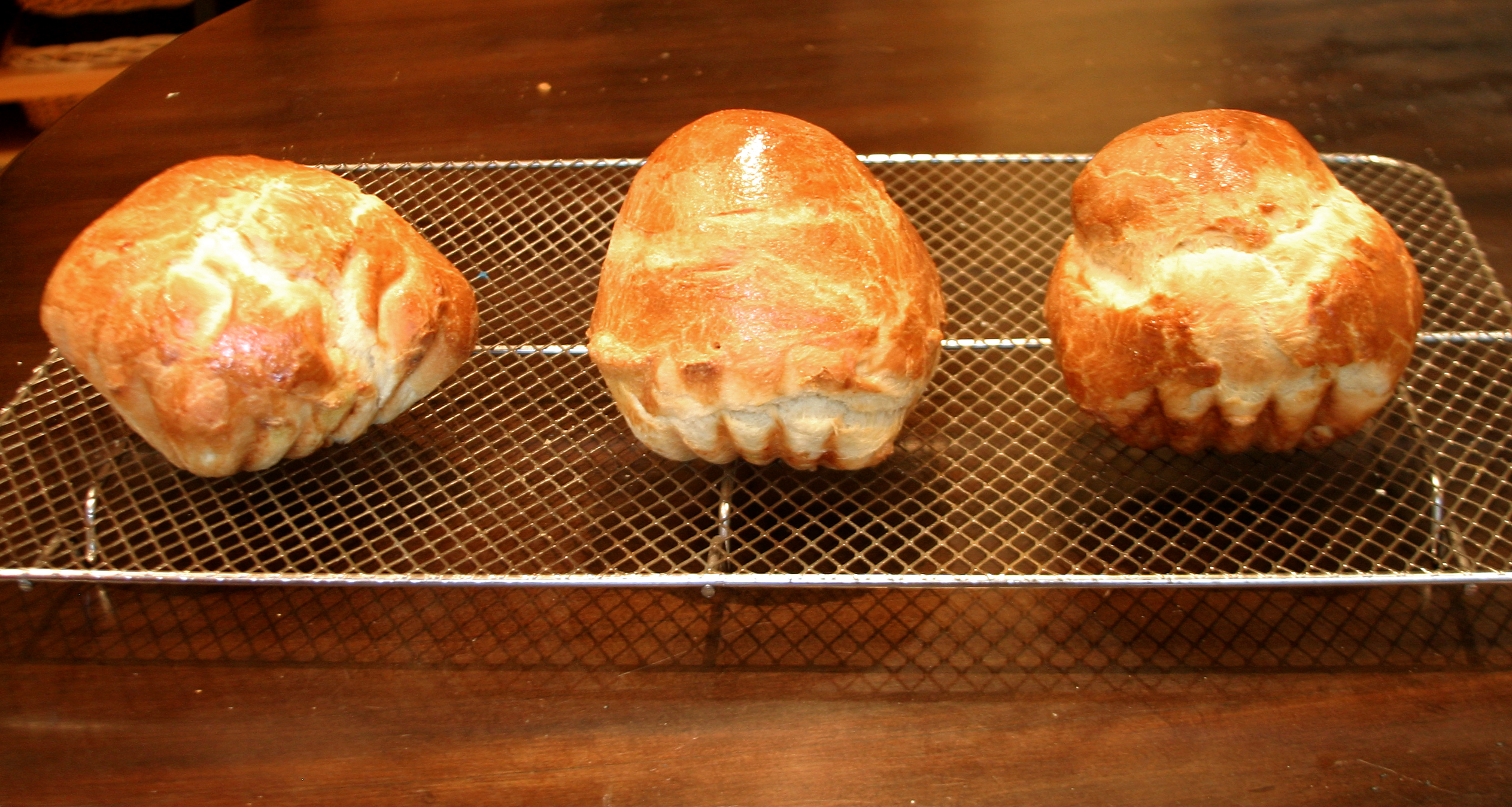
Although I had weighed the dough, divided it exactly into three and formed each one the same way, they were no longer identical in appearance. The one in the middle had completely lost it’s little tete. I was tempted to reform the little balls on top but decided I might do more damage than good, so into the oven they went. After 15 minutes I had great lift-off.
In 25 minutes they were ready to come out with an internal temperature of 195 degrees F. They were golden brown and quite lovely, even if they didn’t bear any resemblance to either each other or the photos in the book. I was immediately taken back to my days in Culinary School. In my baking course, after we finished the assignment of the day, we had to take our finished product up to the professor for grading. I always lost marks for non-uniformity. The teacher said that all items should be exactly the same size and shape. My response was, “If they all looked exactly the same then they look like they came from a factory. This way, they look like they were made with love.” He was not amused.
It got so bad that I had taken to cheating. I attended culinary school with my sister-in-law. She would hand in her work, get graded, and then we would wait for a few more students to have their turn. Then I’d take my sister-in-law’s items up for grading, presenting them as mine. Almost every time, I’d get 85 % and she’d get 80 %. We figured out pretty quickly that the teacher had a crush on me!
Here are my genetically mutated brioche. They were made with love.
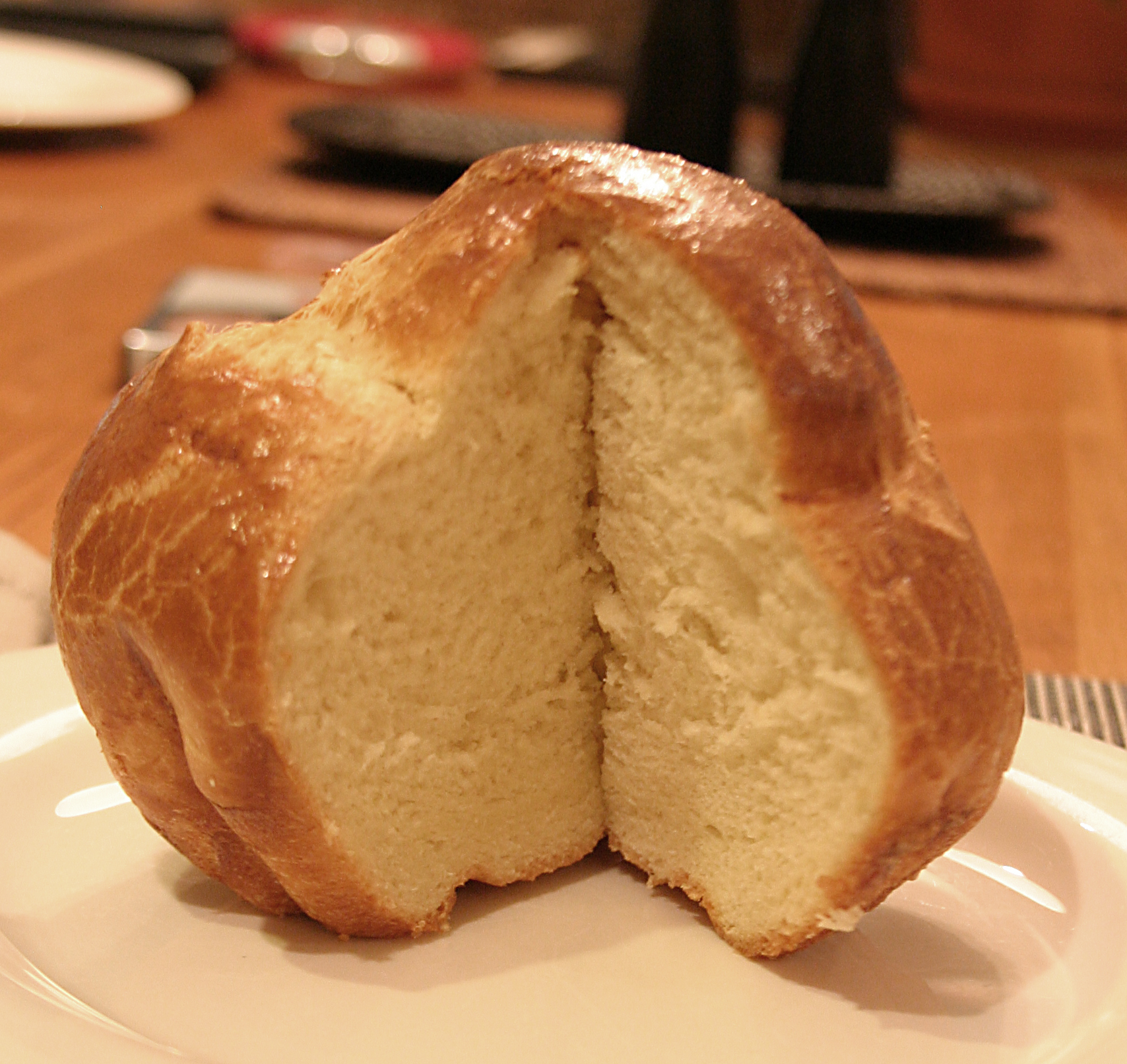
I was fully prepared to love this bread. But I was disappointed. I thought that with half a pound of butter and 5 eggs it would be dense and flaky but to be honest I found it kind of light and airy. It felt like I was eating a sponge. Maybe I overproofed it or baked it for too long but it just didn’t taste like I was expecting. Part of me was relieved that I was not tempted to have more than one piece. My husband agreed with my assesment but my kids loved it. The three brioche were gone in 2 days.
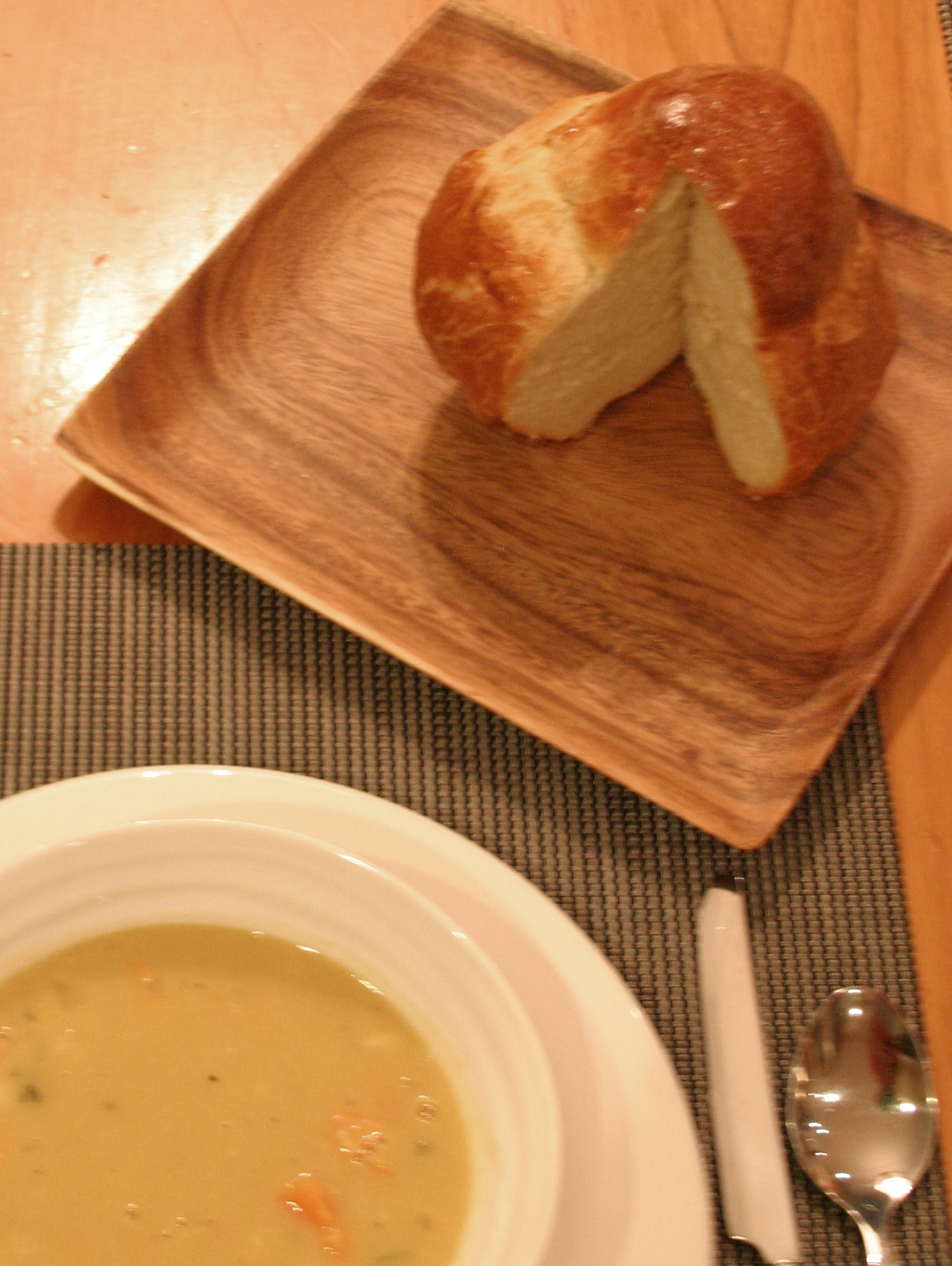
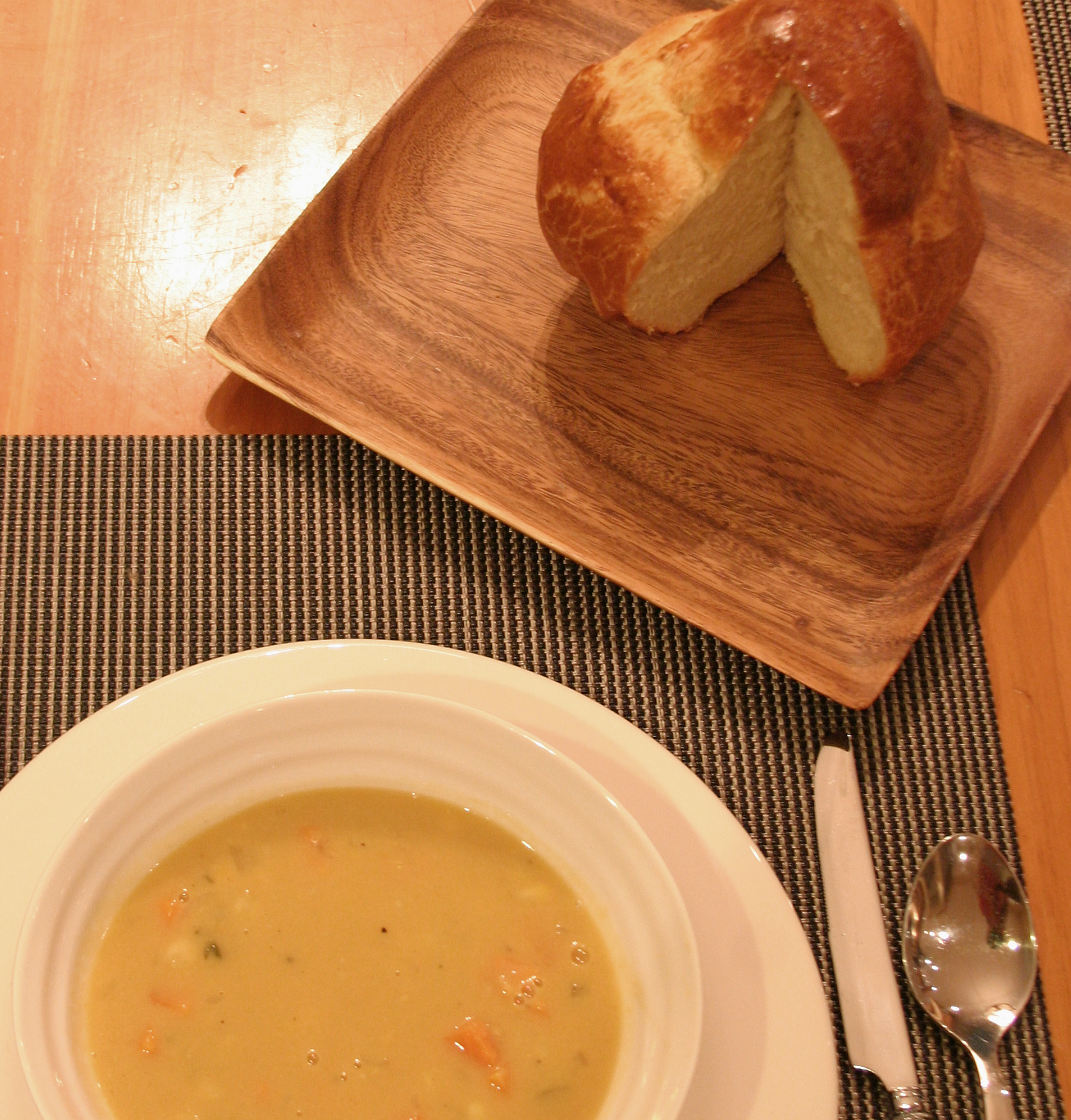
That night for dinner I served it with corn chowder. (Click for recipe)
Tune in next week when we’re baking Casatiello, an Italian version of brioche, filled with salami and cheese. My daughter is a vegetarian so I’m still working on what to use instead of salami. Let me know if you have any suggestions.
Just a quick post to update the bagel story. When I originally made the bagels last week my husband was out of town so he never got any fresh ones. I love him so much I wanted him to experience them right out of the oven. Actually, that’s not quite true. I do love him but I really wanted to try cheddar jalapeno ones. It was all I could think about after reading Joelen’s post last week. When I was finished hand kneading, I flattened the dough into a large square and pressed in half a finely diced jalapeno and 4 ounces of shredded cheddar. I folded the dough over and kneaded a bit more. Then I flattened it out again and added another half of finely minced jalapeno and 4 more ounces of cheddar. Folded and kneaded for another minute and then went ahead with dividing and forming bagels.
After a night in the fridge, they were ready for boiling and baking. I was a bit worried that the cheddar would leak out of the bagels during boiling but all that happened during boiling was that the water really bubbled up and a white foam formed. The cheese stayed inside. Not sure what the white froth was. I topped the bagels with a bit more cheddar before baking.
We were thrilled with the finished bagels. In the oven, some of the cheddar oozed out and created a cheese crust on the bottom that was unbelievable. The crusty cheese top and bottom and the little hit of heat from the jalapeno worked together to form one unfogettable bagel experience.