Daily Archives: June 13, 2009

Margo’s Challah with Elaine’s Topping

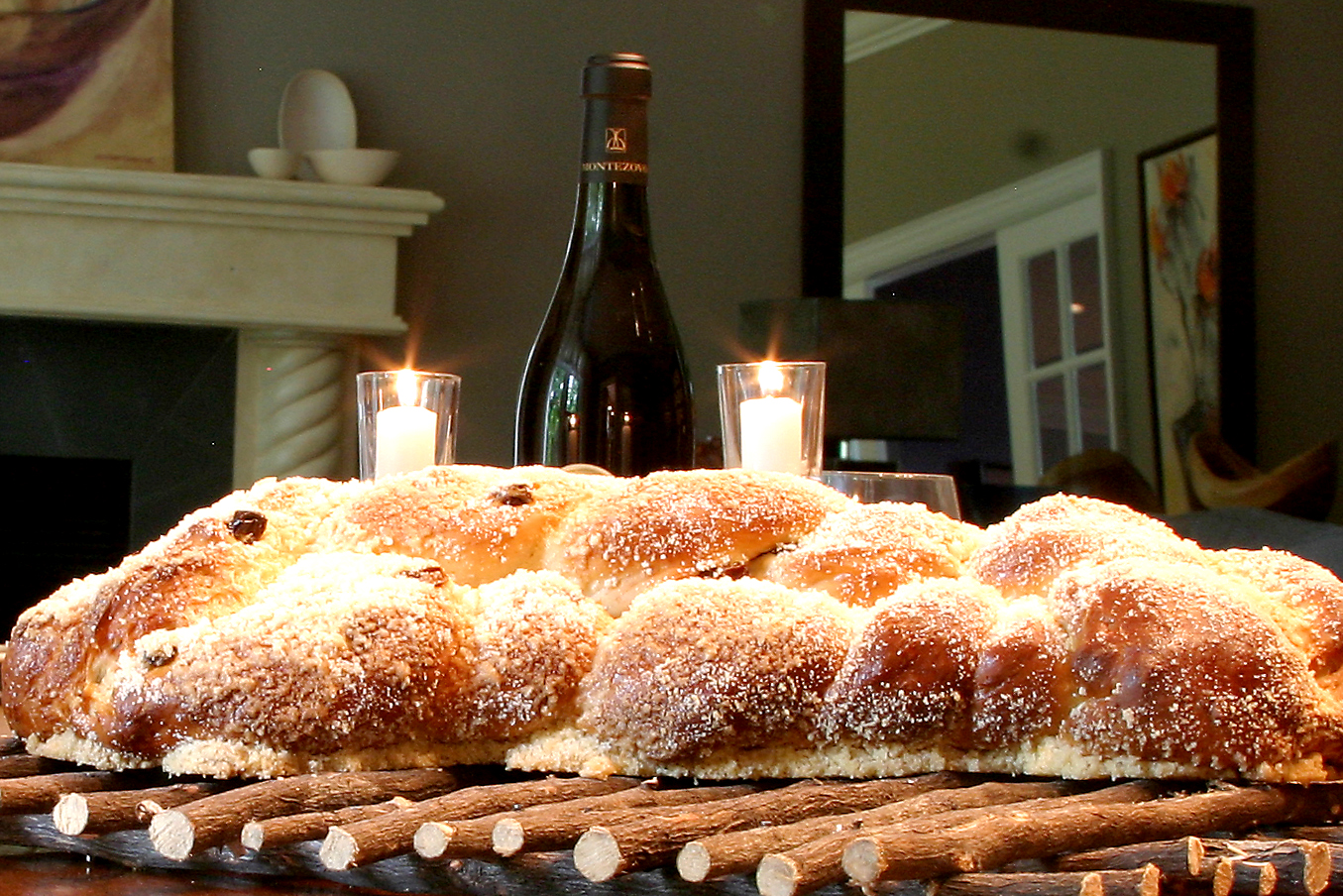
Challah at the table 4

This is the most delicious challah I have ever eaten.  Anytime I am invited anywhere for Shabbat dinner, I offer to bring my challah.  It’s amazing how often I am invited back.  This recipe is actually a marriage of two different recipes.  The challah recipe comes from my friend Margo.  The topping part of the recipe comes from my sister’s cousin’s friend, Elaine.  Elaine and Margo have never met, as fas as I know.  My sister would like to introduce them.  She thinks they’s like each other.  In my little cyber world, they are already great friends!

What you need:

1 package or 1 tablespoon traditional yeast
1 teaspoon sugar
1 cup warm water (115 –120 degrees F)
2 cups all-purpose flour
1 cup whole wheat flour
1/3 cup sugar
1 teaspoon kosher salt
1 large egg, lightly beaten
1/3 cup vegetable oil
1/2 cup raisins (optional)

1/2 cup all purpose flour
1/2 cup granulated sugar
4 tablespoons unsalted butter or margarine

1 egg, lightly beaten


What you do:

1.  In a 2 cup liquid measuring cup, dissolve 1 teaspoon sugar in 1 cup warm water.  Sprinkle yeast on top and let stand for about 4 minutes, until yeast gets all bubbly.

2a.  To make the dough in a stand mixer:  Place 1 cup white bread flour, sugar and salt in the stand mixer bowl, fitted with the dough hook.  Mix briefly to combine.  Pour dissolved yeast mixture into machine and mix for about 1 minute.  Add egg and oil and mix again for about 30 seconds.  Add remaining 1 cup white bread flour and 1 cup whole wheat bread flour and mix on low speed for about 10 minutes.  If dough seems too sticky, add a bit more white bread flour.  Dough should be soft and smooth but not sticky.

2b.  To make dough by hand:  Stir together both types of flour, sugar and salt in a large mixing bowl.  In a separate bowl, whisk egg and oil together.  Add dissolved yeast and egg/oil mixture to flour mixture.  Using a wooden spoon, mix until all the ingredients come together and form a ball.  Sprinkle a bit of white bread flour on the counter and dump out the contents of the bowl.  Knead by hand for about 10 minutes.  As you are kneading, if the dough seems too sticky, knead in a bit more flour.  You want a soft but not sticky dough.

3. If using raisins, use your fingers to poke the raisins deep into the center of the dough. Knead for a minute and then form the dough into a ball and transfer it to a large oiled mixing bowl. Turn dough until all sides are coated. Cover the bowl with plastic wrap and let sit on counter until almost doubled in bulk, about 90 minutes, or you can cover and put it in the fridge overnight and continue the next day.

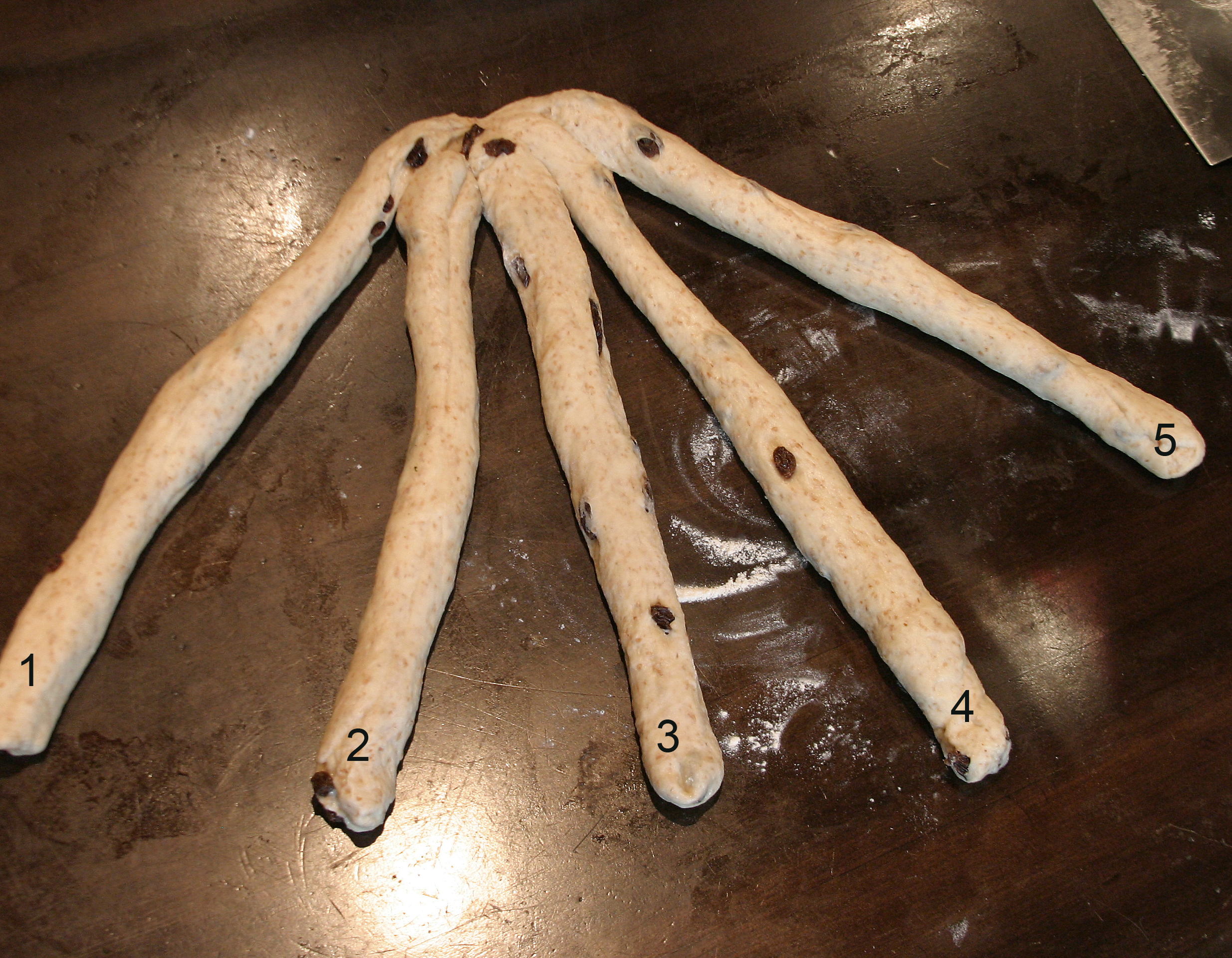
4.  After the dough has risen , gently knead again, to punch the dough down.  If you have a scale, weigh dough and divide into 5 equal pieces (or you can do 3 pieces for a simple 3 rope braid).  Roll our each piece into a rope about 12 inches in length, making sure the ropes are slightly thicker in the middle and tapered at the ends.  Lay the ropes out on the counter and attach them by pinching together at the top.
5 strand numbered

5.  I learned how to do the 5 strand braiding method from Peter Reinhart’s book  “The Bread Baker’s Apprentice.”  I consider myself to have poor  fine motor skills, so if I could master this, you can too!  Here is the pattern to follow:

Strand 1 over Strand 3, Strand 2 over Strand 3, Strand 5 over Strand 2

5 strand braid 2

5 strand braid 3

6.  Just keep repeating this pattern until you get to the end.  Gently pinch tip together when you get to the end.

7.  Place braid on a parchment lined baking sheet.  Spray loaf with spray oil and cover lightly with plastic wrap.  Let sit at room temperature until the loaf has almost doubled in size, about 60-90 minutes.

8. While loaf is proofing, make topping.  In a bowl, using your fingertips, mix butter or margarine into flour and sugar until you have coarse crumbs.  I usually make a double batch of this and keep it in the freezer in a zip-loc bag.

9.  After challah has finished proofing, brush gently with beaten egg and then sprinkle topping all over top and sides of bread.  Set aside about 1/2 cup of topping to use later.  Don’t worry about any topping that doesn’t make it onto the loaf and falls on the parchment paper.  Just use your fingers to sweep the excess topping under the loaf.  When it bakes, it forms little sweet crusty bits on the bottom that you can pick off and eat before anyone comes home.
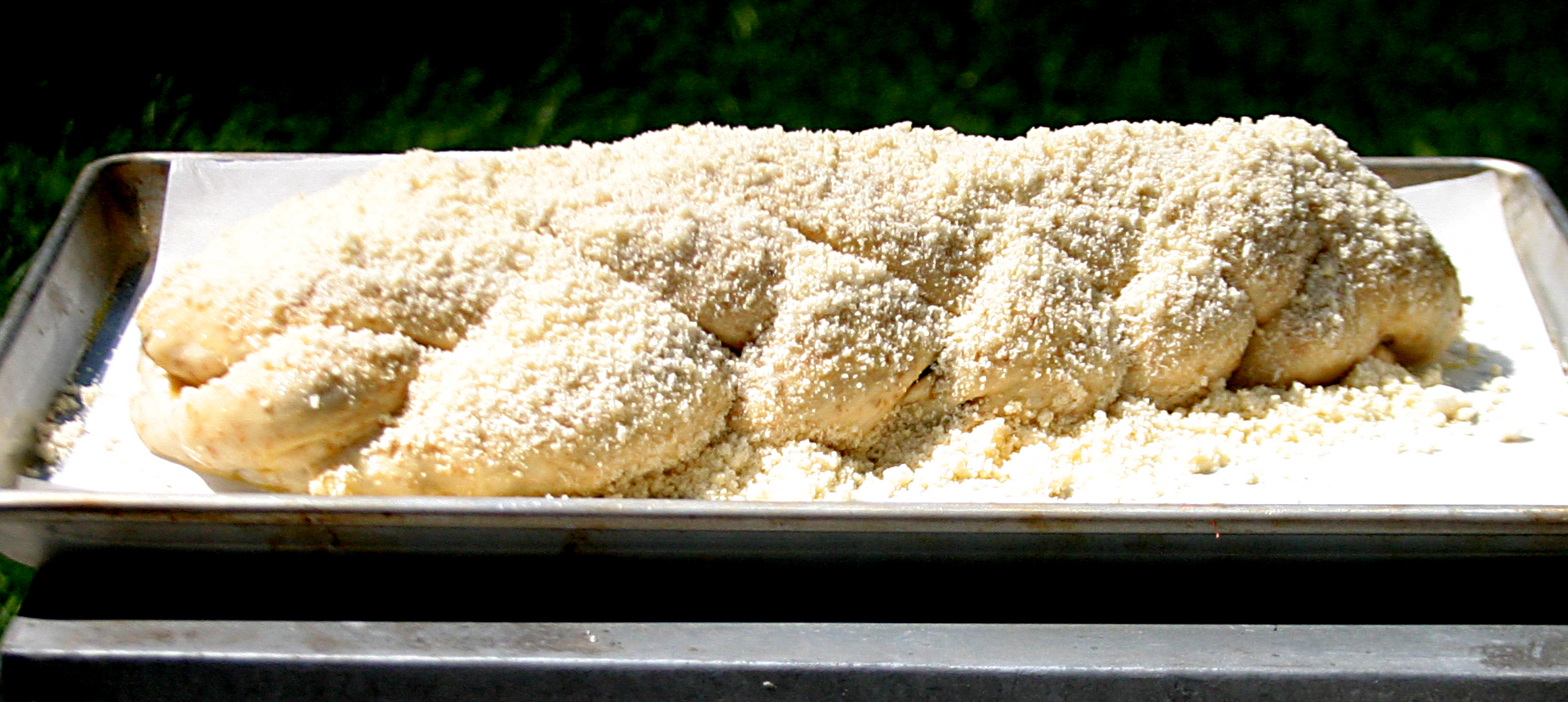
with topping before baking 2

10.  Bake challah at  350 degrees for about 20 minutes.  Remove challah from oven and brush with egg and sprinkle with reserved topping at the seams where the challah has swelled and newly exposed dough is showing.  Turn down temperature to 325 degrees F.  If challah is getting too dark, tent with foil.  Return challah to oven and bake for an additional 15-20 minutes, or until an instant read thermometer, inserted into the brerad registers 190 degrees F.
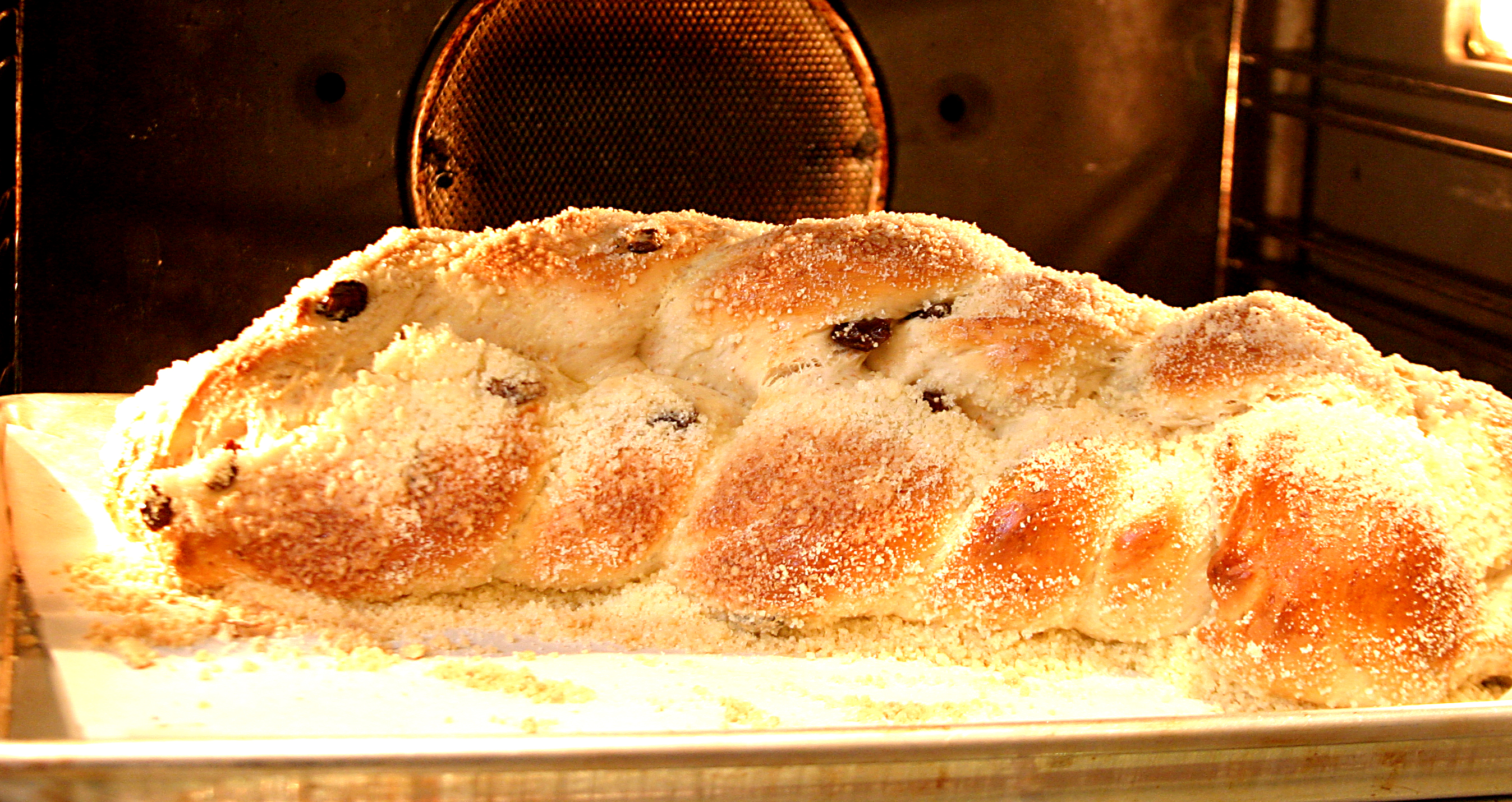
In oven after 20 minutes

11.  Remove challah to a wire rack and let cool at least one hour before serving.
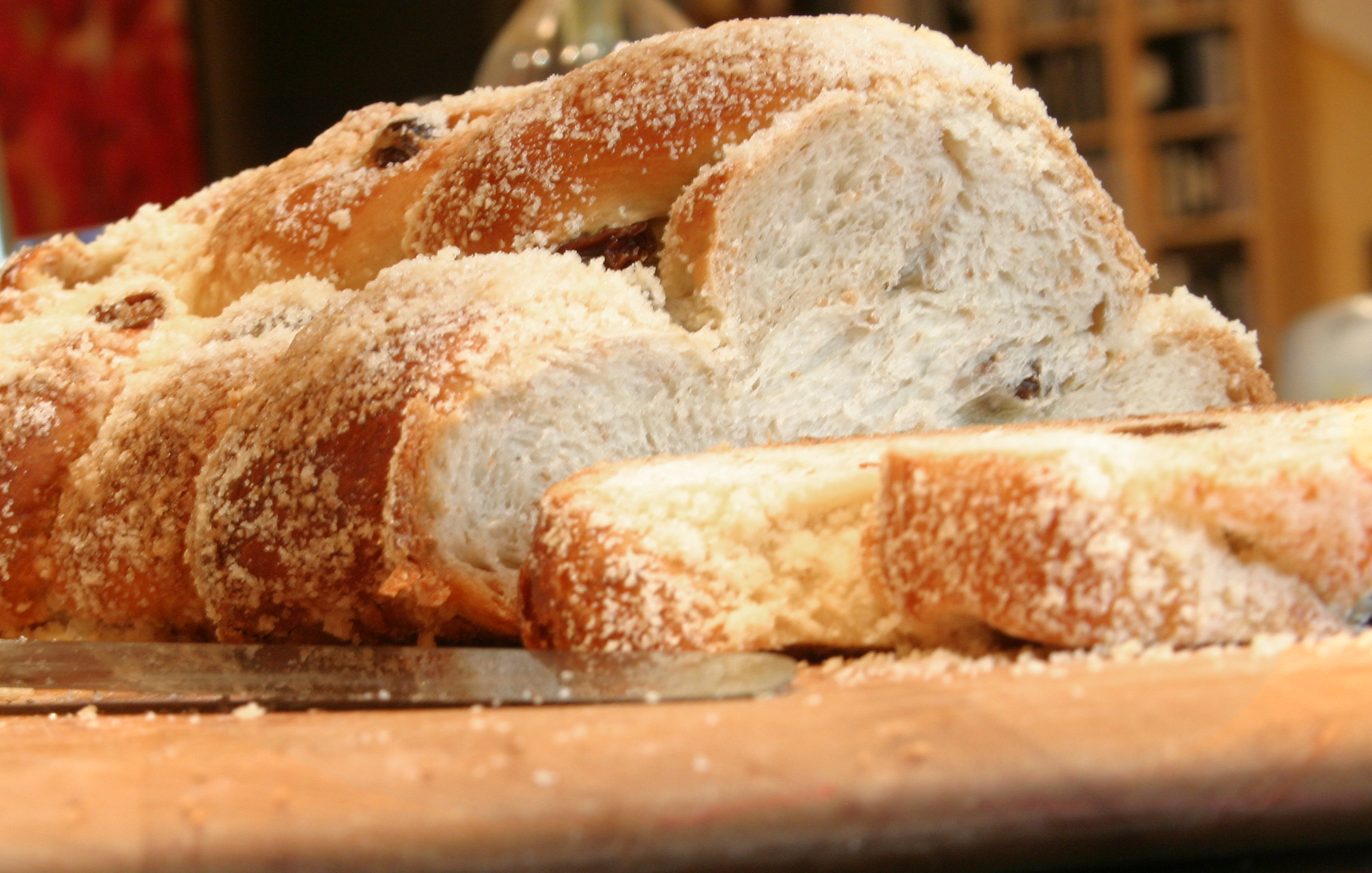
My Challah sliced open

Week # 6 Peter Reinhart’s Challah

finished double challah

I approached this week’s Bread Baker’s Apprentice Challenge with a bit of trepidation.  I have been making challah once a week for about 12 years now.  For the past five years I have been making the same recipe and my family loves it.  As the old saying goes, “If it ain’t broke, don’t fix it.”  However, sometimes you have to break with tradition and try something new.  Besides, it really annoys my husband and kids when I change things up on them and it’s kind of fun to irritate them.

The recipe I have been making is actually a hybrid of two different recipes.  The first recipe comes from my sister’s cousin’s friend Elaine.  It is a very rich sweet challah topped with a crumble coating made from butter, floor and sugar.  It’s more like eating cake than bread.  I made it every week for about 2 years until I had Shabbat dinner at my friend Margo’s house and tried her challah.  Margo incorporates about 1/3 whole wheat flour into her challah and uses less eggs and oil than Elaine.  I decided to try Margo’s challah with Elaine’s topping and thus a succesful culinary marriage was made.   Elaine lives in Toronto and Margo lives here in Ottawa.  They have never met in person, although in my virtual world they are great friends!!

I decided to break from tradition and make Reter Reinhart’s challah this week and surprise my family.  Once I made my challah with dried sour cherries instead of raisins and I almost had a revolt on my hands.  This was going to be fun!!  (I know, I need a life).

I followed Peter’s recipe exactly but I decided to do a slow overnight bulk fermentation in the fridge instead of at room temnperature for one hour.  I always start my dough on Thursday and let it do the first rise overnight in the fridge and then form the braid,  let it proof and bake it late Friday morning.   Peter’s recipe contains less sugar and oil than mine but more eggs.  The dough mixed up beautifully in my Kitchenaid in about 10 minutes.

Dough mixed and ready for fermentation

Dough mixed and ready for fermentation

I decided to attempt the double celebration design (a little braid on top of a big braid).   When I was a little girl, I had short curly hair and my mom would not let me grow it long.  I never really mastered braiding until I grew up and started making challah.  I never even braided my Barbie’s hair.  I used to cut my Barbie’s hair all off , just leaving a fringe around the outside with a bald spot in the middle.  I told my mom I gave Barbie a hairstyle just like daddy’s!  She never got mad at me, perhaps because when she was a child, she cut the drapes in her living room to make clothers for her doll, so she understood my creative spirit.  Thanks Mom!

The double braid requires a bit of math to properly construct.  If you have a scale and calculator and half a brain, you can do this!  Weigh the dough after the bulk fermentaion.  Use one third for the top braid and the remaining two thirds for the bottom braid.  Divide each into 3 equal weight pieces.  For my bread the entire dough weighed about 900 grams.  I rolled out  three 100 gram ropes and three 200 gram ropes.  I made the ropes for the top braid a little shorter than those for the bottom braid.  I made my ropes a little fatter in the middle with tapered ends.    For a three rope braid, Peter explains it is best to begin braiding in the middle and work your way down, braiding  towards you.  Then turn the loaf 180 degrees so that the unbraided end faces you and braid the second half.  Once both braids are done, lay the smaller one on top of the bigger one.  This is much easier to do than to write about.

double challah

double challah 2

After about 90 minutes the bread looked about doubled in size, so I checked to see if it was indeed finished proofing using a new tip I picked up from fellow BBA baker Phyl .  Phyl calls this the poke test.  Stick your fingertip into the bread and watch what happens next

  • “If the place you poked doesn’t fill back in, the dough is underproofed. 
  • If it fills back in immediately, you have allowed the dough to overproof. 
  • If, however, the poke hole fills in slowly, your dough is properly proofed and ready to bake.”

proofed and ready for oven 2

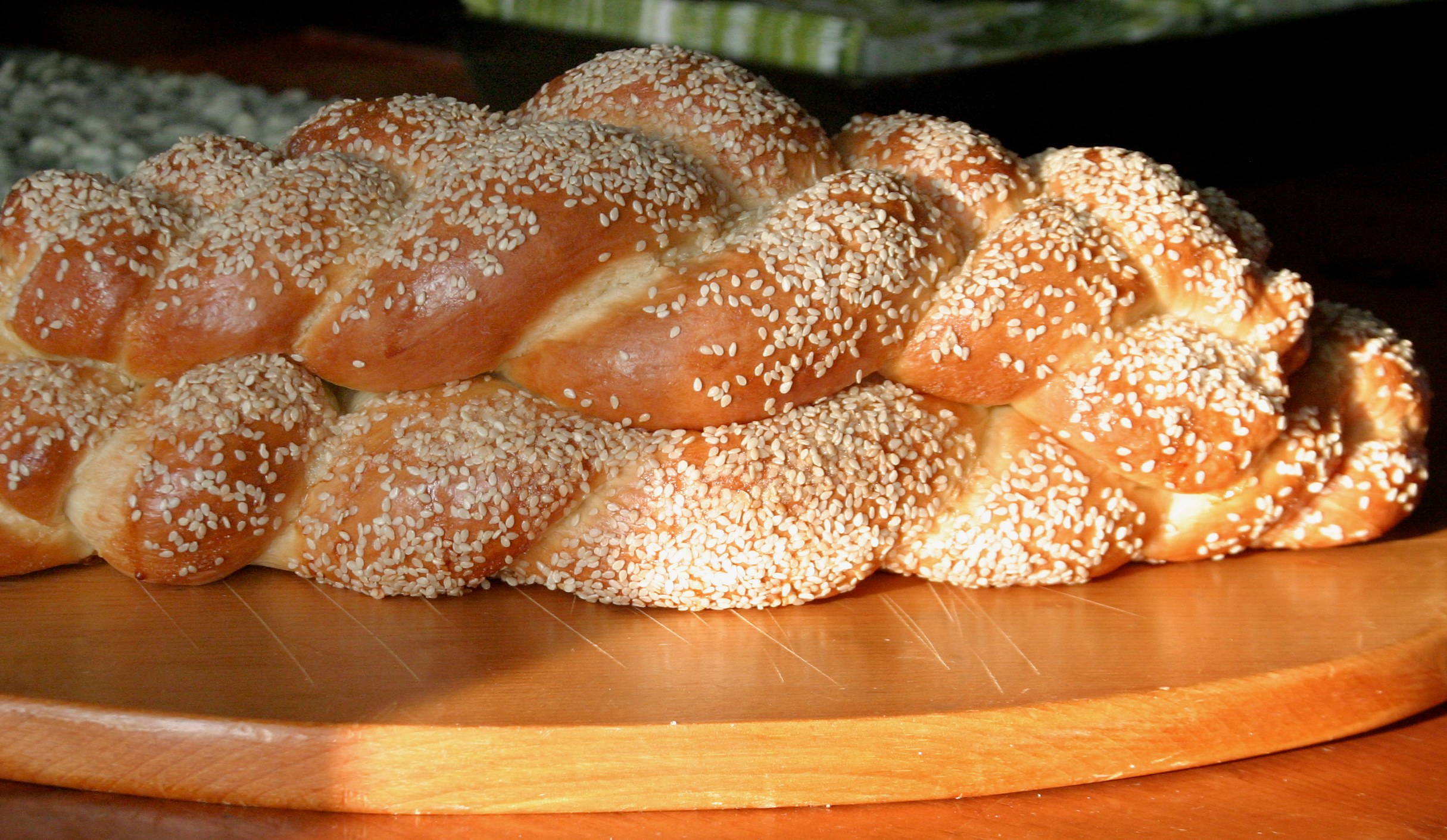
The poke hole filled in slowly, so I egg washed the challah and sprinkled it liberally with sesame seeds.  Into the oven it went.  I checked the challah after 20 minutes.  I could see that the bread was starting to rise and open up.  I brushed any new exposed spots with more egg and sprinkled the naked sections with more sesame seeds.  I turned the loaf 180 degrees and baked for another 15 minutes until it registered 190 degrees F in the center of the bread.

Double celebration Challah, just out of the oven.

Double celebration Challah, just out of the oven.

Double Celebration Challah, sliced into.

Double Celebration Challah, sliced into.

Although there was no uprising or outright revolt, the verdict was clear.  Our family prefer’s the Margo-Elaine hybrid.  We found the Peter Reinhart version a little too eggy and airy.  My husband said it tasted exactly like  Rideau Bakery challah.  The Rideau Bakery is here in Ottawa and their challah is considered the gold standard for many here in Ottawa.  So while it was a good challah, I won’t be making it again if I know what’s good for me.  The Margo-Elaine version of challah can be found here for anyone interested.