#15. How Italian bread lead me to infidelity.


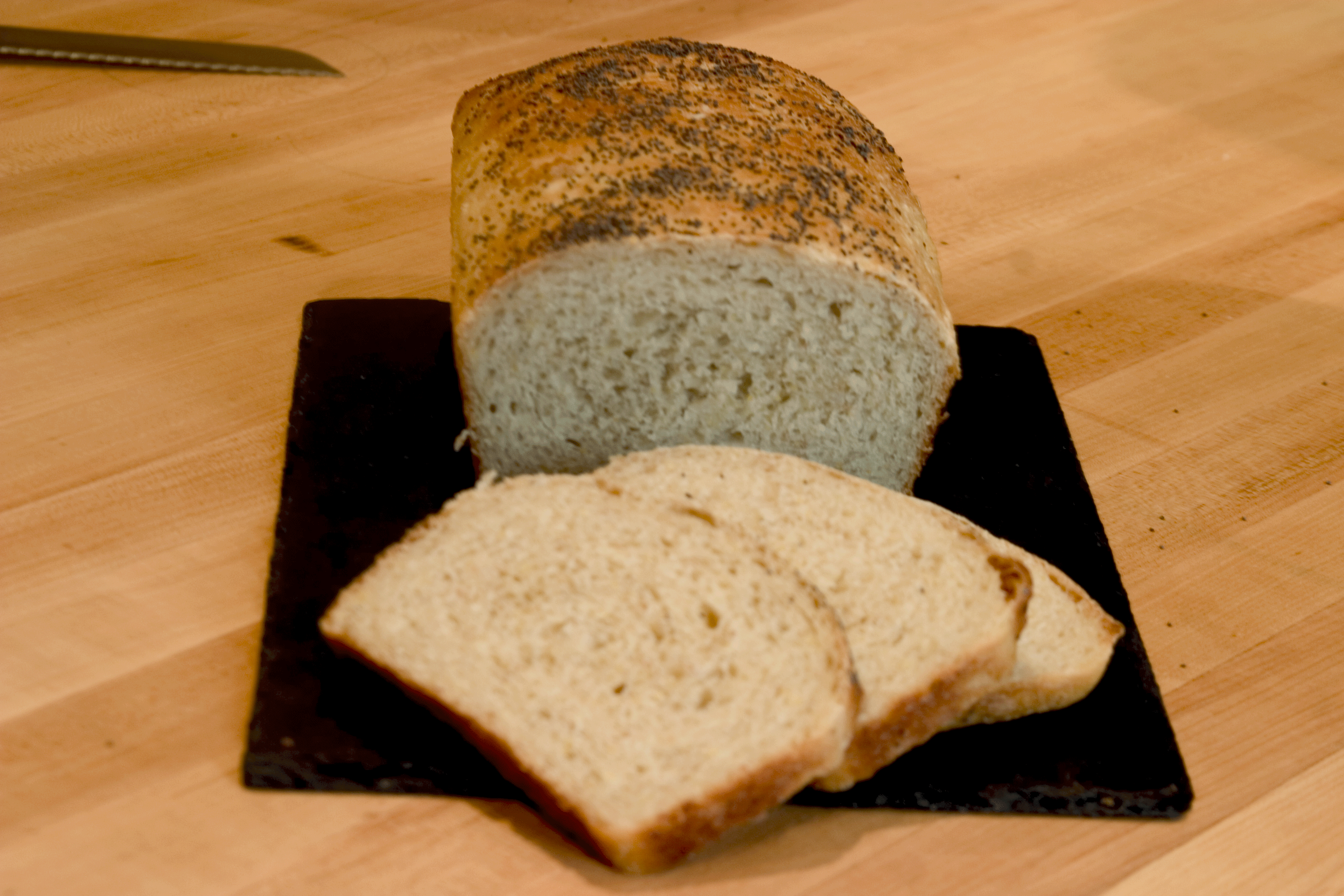
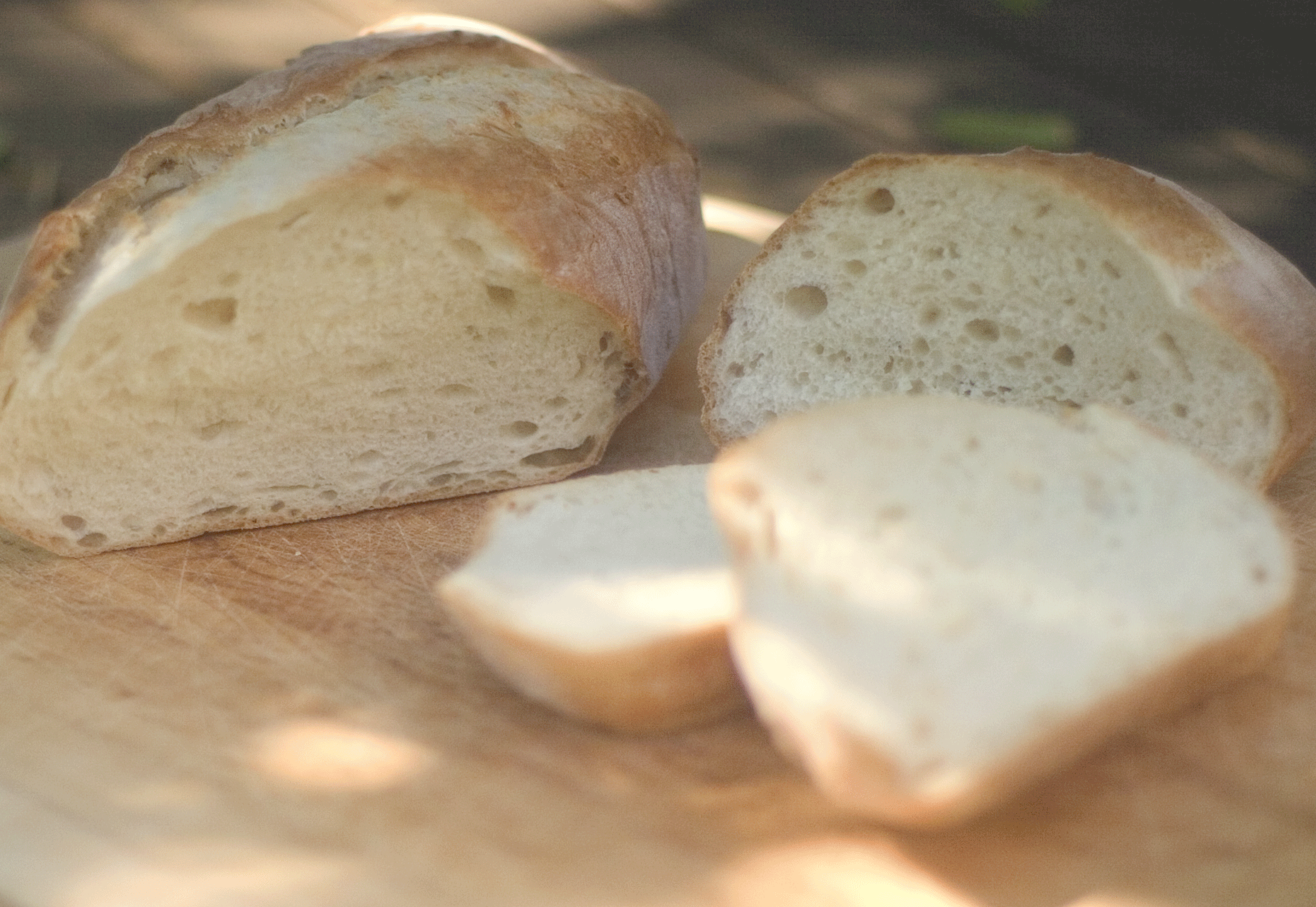
the-crumb-shot

I have a confession to make.  I cheated on Peter Reinhart.  Last week’s bread in the Bread Baker’s Apprentice Challenge was the ultimate French Bread, baguettes.  My results were mediocre and truthfully I was a little disappointed.  I really struggled with shaping and scoring the baguettes.  This week’s bread is Italian Bread and the shaping and scoring of the loaves is somewhat similar to French Bread.

I thought that if I could actually watch someone do it, rather than just read instructions in a book, I may have a better chance of success this week.   I surfed the web and came upon a video of Chef Danielle Forrester on Julia Child’s PBS series, making baguettes.  As I watched the video, I have to admit I was somewhat shocked to see how roughly she handled the dough.  She slapped it with her palm and really pressed hard on the seams as she formed her loaf. 

This was surprising to me because Peter Reinhart emphasizes handling the dough gently, lest we accidentally degas the dough.  But Chef Danielle just exuded power and confidence, and frankly, I was seduced.  I wanted to try slapping my dough around too.  So while I used Peter Reinhart’s recipe,   I followed Chef Danielle’s method for shaping my Italian bread.  The shape for an Italian bread, incidentally is called a Batard, (literally “Bastard”)  which is a torpedo shaped loaf, measuring 6-12 inches in length

This is a two day bread, where we make a starter on Day 1 and let it rest overnight in the fridge.  On day 2 the starter is incorporated into the new dough and the loaves are formed . This recipe made either 2 large torpedo shaped loaves (batards) or 9 smaller hoagie sized rolls.  I opted for the 2 large loaves.  After the dough fermented at room temperature I began forming my loaves.  

Dividing the dough into 2 pieces I formed each into a batard.  First the dough is flattened into a rough rectangle and then it is folded into thirds, letter style.  The flattening and folding is repeated 2 more times for a total of 3 times in Chef Danielle’s method, whereas PR only does this once.  Then a groove is formed down the center of the dough, using the side of your hand.  The top edge of dough is folded two thirds of the way down and the seam is sealed with the heel of your hand. The folding and seaming is repeated two more times for a total of 3 seals.  Peter Reinhart’s method only calls for 2 seals.  I must admit the surface tension of my Italian loaves seemed greater using Chef Danielle’s method. 

After forming the batards, the dough proofed for about one hour while I preheated the baking stone and oven to 500 degrees.

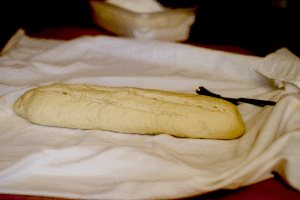
in-the-couche

After an hour the loaves had grown to almost 1 1/2 times their original size.  They were ready to be scored.  After watching Chef Danielle’s sure and steady scoring method one more time, I slashed swiftly and with purpose. 

loaf-2-slashed

I decided to transfer my loaves into the oven one at a time rather than both at the same time.  Loaf one went onto the peel and slid easily onto the baking stone, retaining its shape.  I felt like a pro.

loaf-1-successfully-made-it

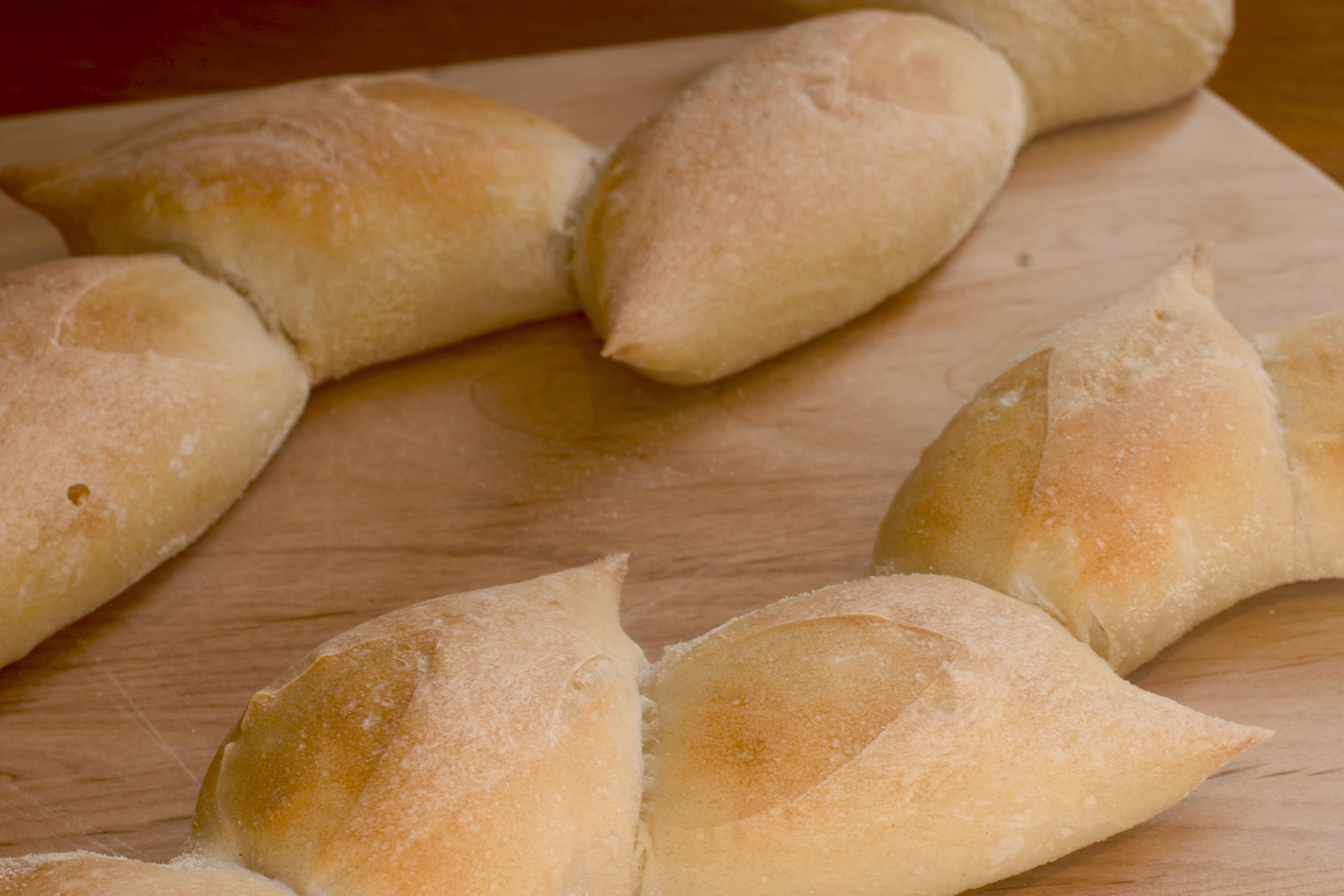
The second loaf slid in alongside the first and I added boiling water to the steam pan and quickly shut the oven door and turned down the temperature to 450 degrees.  The loaves were golden brown and crusty after about 15 minutes.  The slashes opened up beautifully and I was so impressed with my artistry!

loaf-1-done

loaf-2-done

While the outside was crusty and golden, the inside crumb was tender and soft.  After the loaves had cooled we sliced them up and toasted them on the BBQ and devoured them with diced tomatoes from the farmer’s market, garlic, olive oil, basil and salt.

#14. This week’s bread is brought to you by the letter S

standing-at-attention

In Week #14 of the Bread Baker’s Apprentice, we tackle the ultimate French Bread, the baguette. In the introduction to this bread, Peter Reinhart says, “As with most hearth breads, another key to the success of this bread is handling it gently, retaining as much gas as possible during shaping in order to promote large, irregular holes in the crumb…. This large, open crumb is one of the signs of a properly handled artisan loaf.” 

The novice bread baker might read this and think, “Hmm, that’s interesting.”  However, those of us on Week #14 of the Bread Bakers Apprentice Challenge will start sweating, with memories of our old nemisis the Ciabatta bread, still fresh in our minds.  My finished Ciabatta bread was good but did not have those characteristic holes that bread freaks live for.  The baguette is another challenging bread.  It is not for the faint of heart. 

If you are planning to make baguettes, I highly recommend watching this video.  It is from the PBS video series Julia Child: Lessons with Master Chefs and it features Chef Danielle Forestier making baguettes.  While Peter Reinhart’s instructions are good, I am a visual learner so the video was very helpful for me.  It was interesting to watch and then compare her method for forming the baguettes with PR’s .  She was way less gentle with the dough.  Unfortunately, I only discovered the video the day after I made my baguettes, but it will be helpful for when I form my Italian loaves.

To make a proper artisan baguette, you need to start with a pre-ferment.  A pre-ferment is a dough or batter made beforehand and used in bread dough.   Pre-ferments enhance the taste of bread by extending the fermentation time, creating more complex flavors and enhancing the texture of the final product. There are several types of pre-ferments.  In the baguette we make a “pate fermentee.”  Basically we make the dough on day one, let it ferment overnight in the fridge and on day 2 make a second batch of dough, adding the first batch as the pre-ferment.  So far so good. 

Here is my pate fermentee, cut up into small pieces to hasten the process of bringing it to room temperature after spending all night in the fridge.

Pate-fermente

Next we make the dough one more time, and this time we add the pate fermentee to the new dough so that we have a double batch of baguette dough, enough to make 3 large baguettes.  Several times, in the recipe we are warned against working too roughly with the dough, lest we “degas” it too much.  The first step is to form each piece into a batard (torpedo shape).  This basically involves patting each piece of dough into a rough rectangle and then folding it letter style, into thirds, to form the batard.  The edge of your hand is used to form a seal.  Then the batards rest for 5 minutes.  

forming-into-batards

Here are my 3 batards.

3-batards

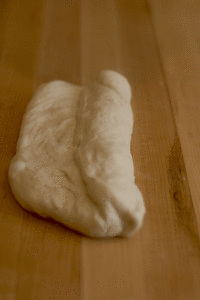
Next the baguettes are shaped by using the side of your hand to make a trough down the center of the dough. 

indentation

The dough is folded again, letter style and a seam is formed.  Then the dough is rolled, gently back and forth until the desired length is reached.  I got a little carried away with my rocking and rolling and rolled out my baguettes to an impressive 20 inches.  Then I realized that my oven only measures  16 inches across.  Ooops!  I gently compressed my loaves down to 16 inches.  Then I carefully transferred them to my homemade couche.  A couche is a piece of cloth that is used to support the baguette during it’s final proofing.  I used an old cotton apron and it worked perfectly.

into-the-couche

I covered the baguettes and let them rest for 45 minutes. While they were proofing I had a momentous decision to make.  Do I chance transferring the baguettes to a peel and slide them into the oven onto a baking stone or do I play it safe and bake them on a sheet pan, thus eliminating the scary slide into the oven.  Daredevil that I am, I decided to go for the baking stone and attempt the slide.  I set up my oven as shown in the book, with the baking stone on the bottom floor of the oven and the steam pan on the rack above.

baking-stone-and-steam-pan-

Then came the scary part.  Slashing the dough!  I had purchased a french lame (a special slashing blade).  Peter Reinhart is very detailed in his instructions about slashing the bread.  He instrusts us to cut on an angle, not straight down so that the blade is held almost parallel to the bread, much like slitting open an envelope.  I was so nervous to do it that I think my slit was too tentative and not forceful enough.  It was more like a gash than a slit.  Plus, I discovered the next day that I was holding the lame upside down.  The curve should face down, not up.

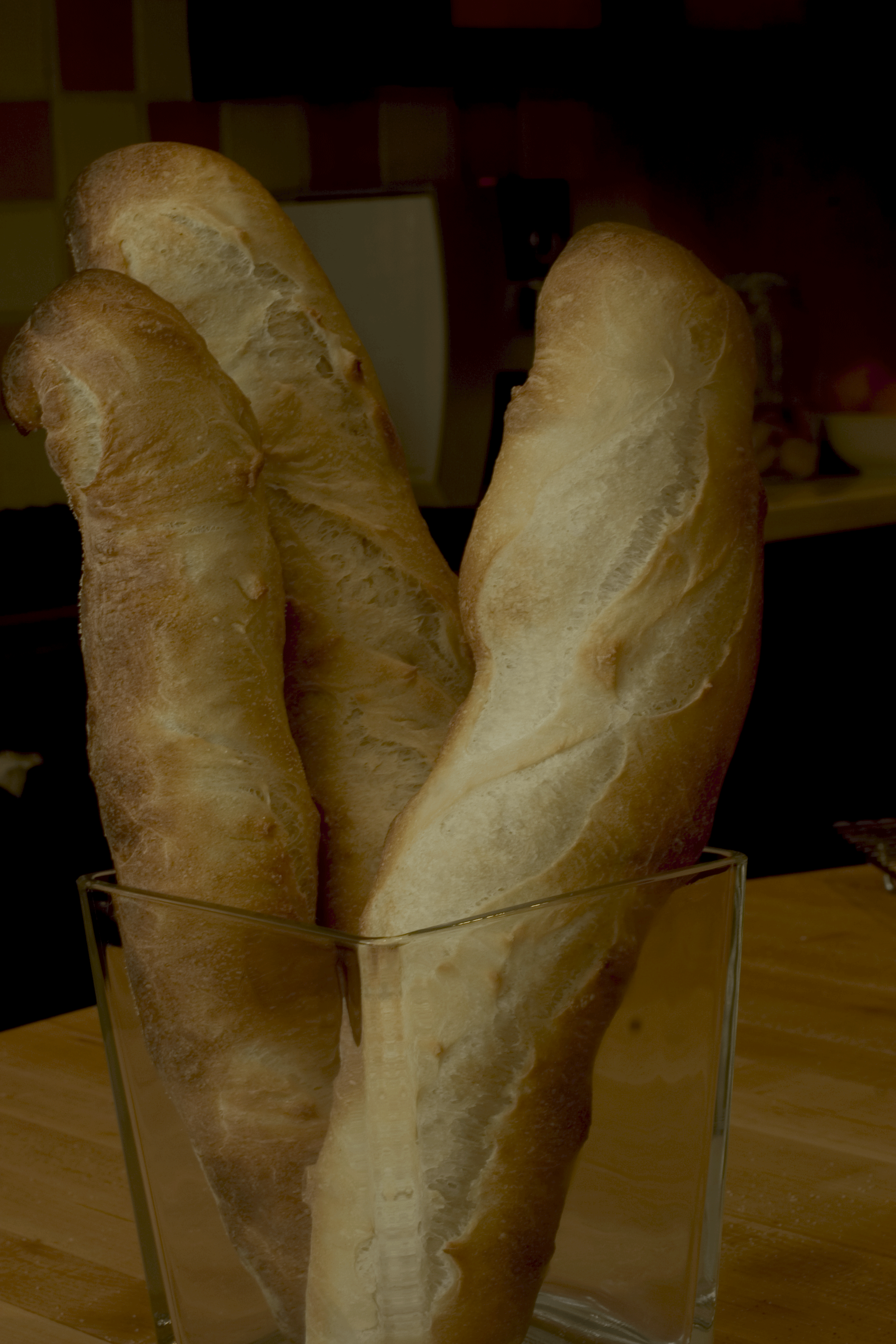
I prepared my peel with cornmeal, carefully transferred the baguettes to the peel, opened the oven, closed my eyes and gave a short jerk with my arm to get the baguettes from the peel onto the baking stone.  When I opened my eyes, I was horrified to see 3 “S” shaped baguettes staring back at me.  I tried as best I could to straighten them out but they were odd looking baguettes.

into-the-oven---a-little-cr

I added hot water to the baking pan to create steam in my oven and sprayed the oven walls twice, at 30 second intervals to create even more steam.  I forgot to turn the oven temperature down and as a result, my baguettes got way too dark on the bottom before the top was sufficiently browned.  In hindsight, I think I should have had the steam pan on the bottom of the oven and the baking stone on the middle rack for more even browning. 

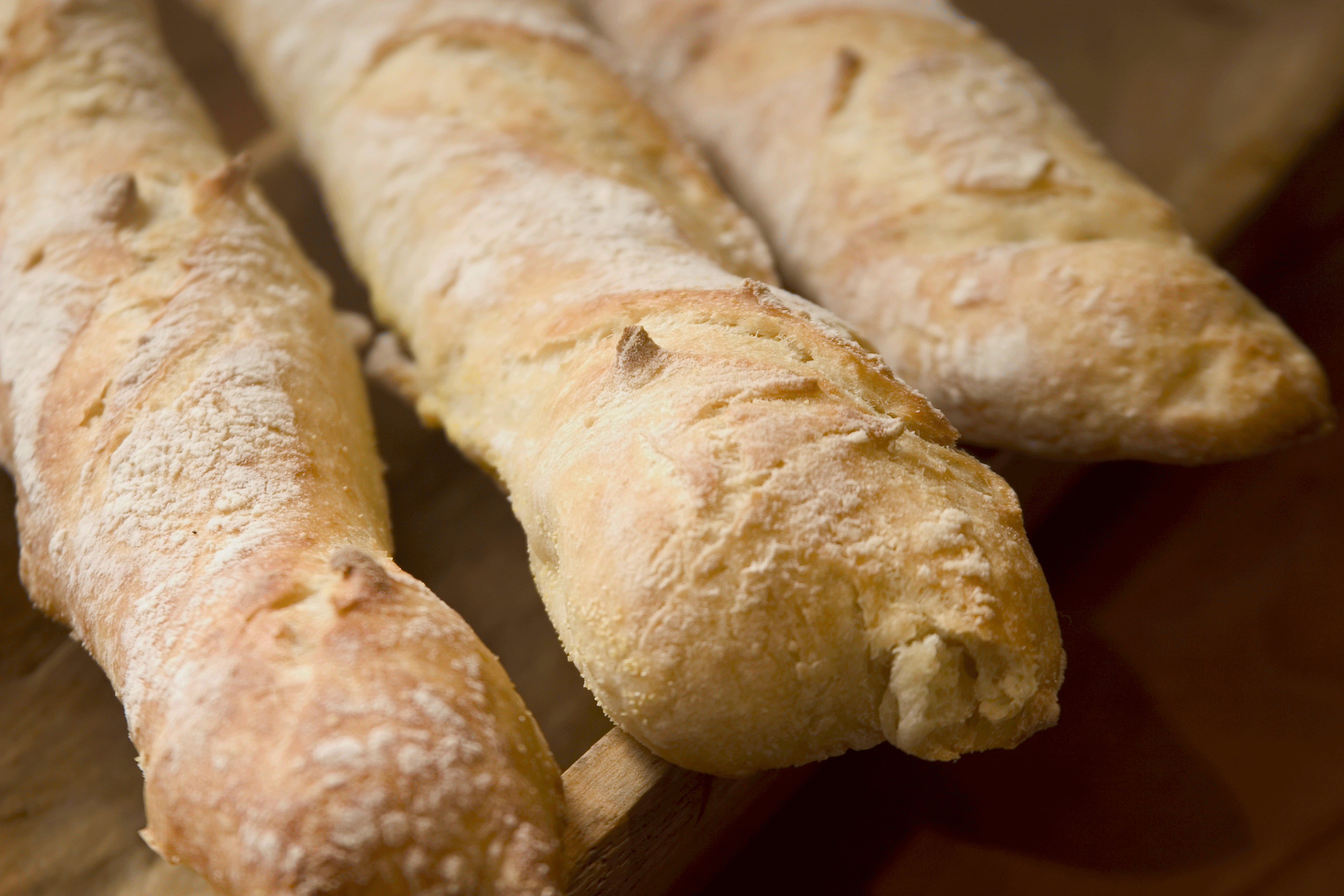
finished-2

bottom-crust-burned

My baguettes definately had personality.  However, they the lacked large irregular holes in the crumb that are the hallmark of a stellar baguette.  Oh well, something to strive for.  They made delicious sandwiches for dinner with grilled lemon-rosemary chicken and chipotle mayo.

crumb-shot

 chicken-sandwiches

#13. Foccacia Baked on the BBQ.

tuna-cans-and-baking-stone-


This week in the Bread Baker’s Apprentice Challenge I baked Foccacia Bread, on my gas BBQ!  I could try to impress you and say that the reason I baked it on the BBQ is because I wanted to challenge myself, culinarily speaking.  And you just might believe me.  However, I can not tell a lie, (well, actually I can lie, and quite coinvincingly too, but I guess that’s not something one should brag about!) I made the Foccacia on the BBQ because my oven died.  Well to be more accurate, I wore my oven out.  Before I get to the baking of the foccacia, here is the story of how I wore my oven out.

I am  up at my cottage on the lake.  Last weekend we hosted a family reunion for my side of the family.  This is the fourth one we have held here.  We try to do it every three years.  The first was in 2000, followed by 2003, 2006 and then again this summer.   With parents, siblings, spouses, children, cousins and aunts and uncles we numbered 41 this year.  It was a 4 day extravaganza, complete with our own version of the Amazing Race, a spaghetti eating contest, two swim marathons, bonfire with s’mores, and lots of games and activities organized by various family members.  I had arranged to have the meals catered as I did not want to spend the entire time in the kitchen cooking and cleaning.  However, we have many talented bakers in the family, so we did the desserts ourselves.

We have a “Family Cookie”, originally made by my paternal grandmother (Bubbe).  She never wrote the recipe down and so her daughter (my Auntie BeBe) watched her make the cookies one day in the 80’s.  She wrote down everything her mom did and measured all the ingredients to get as accurate a recipe as possible.  Since that time, my sister Bo and I have been making the cookies at least twice a year.  Although we have the same recipe, our Bubbe Cookies turn out completely differently.  The Bubbe Cookie is a poppy seed cookie.  These are not  thin delicate poppy seed cookies.  They are thick and hard, much like a mini hockey puck.  They are not too sweet and are perfect with a cup of tea.  They are also fantastic for long driving trips as each cookie takes a long time to eat and they’ll keep you alert while driving.  Our family and everyone who I have introduced them to over the past 30 years, loves them.

Bubbe-Cookies-4

Of course I had to bake Bubbe Cookies for the family reunion.  I baked 1000 Bubbe Cookies.  I made little gift bags with a dozen Bubbe Cooies in each to give to every family member when they arrived.  That accounts for about 500 of the cookies.  The other 500 were piled high in a jar and left on the coffee table for snacking.  I also baked 60 lemon coconut cookies, 75 oatmeal toffee sour cherry cookies and 60 skor bars.  I made all these the week before the reunion and froze them.
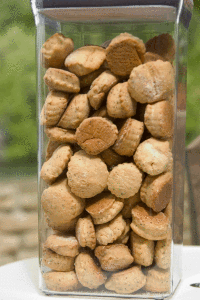
Bubbe Cookies
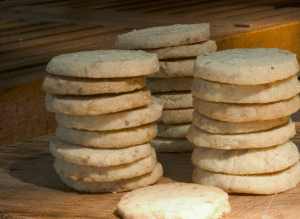
Bubbe Cookies

 
Lemon Coconut Cookies

Lemon Coconut Cookies

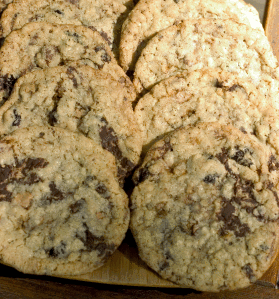
Oatmeal Toffee Sour Cherry Cookies
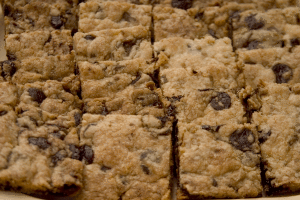
Oatmeal Toffee Sour Cherry Cookies

Skor Bar Cookies

Skor Bar Cookies

Most of my family knows about my participation in the BBA challenge. Some casual requests from various family members about cinnamon buns and bagels had me wondering how I could produce them, fresh and hot from the oven without having to spend the day before covered in flour and elbow deep in dough.  I decided to make the cinnamon buns and bagels the week before and freeze them, unbaked. The cinnamon buns were on the menu for Saturday breakfast, so I removed them from the freezer on Friday night, placed them in baking pans and left them to proof on the counter overnight. I fell fast asleep and in the morning, all I had to do was bake and glaze them.  Needless to say they were devoured within minutes of coming out of the oven despite my screaming that the Bread Freaks Bible (The Bread Baker’s Apprentice Cookbook) says that the cinnamon buns must cool for at least 30 minutes before eating.

The bagels were planned for Sunday brunch so on Saturday night I removed them from the freezer, transferred them  to parchment lined baking sheets, covered them with plastic wrap and let them proof all night in the fridge.  Come Sunday morning they were ready for boiling and baking.  I made 24 poppy, sesame and salt and 24 cheddar jalapeno.  They were a huge hit. 

So, to recap, in one short week  my oven produced 1000 Bubbe Cookies, 60 Lemon Coconut Cookies, 75 Oatmeal Toffee Cookies, 75 Skor Bar Cookies, 24 Cinnamon Buns, 24 Sticky Buns, 24 Poppy-Sesame-Salt bagels, 24 Cheddar Jalapeno Bagels and 3 large challahs.  A lesser oven would have died right in the middle of the family reunion weekend.  My considerate oven waited to die until the day after everyone left.  I had planned to use this week to catch up on my BBA baking as I’m a little behind (I wonder why?).  When I preheated the oven to make dinner it would only heat to 125 degrees F.  I think I heard it say, ” I’m on strike.” 

Somewhere, deep in the recess of my brain I recall a fellow BBA challenger talking about baking bread on their BBQ.  I remembered that they used empty tuna cans, turned upside down, to raise the baking stone off the BBQ.  I went back over old posts and found the reference.  Heather of Bodacious Girl  saved the day.  (http://www.bodaciousgirlblog.com/2009/06/bringing-your-kitchen-outdoors.html).  

The Foccacia recipe in the book is a two day procedure, making and shaping the dough on day one, followed by a night of fermentation in the fridge to allow the wonderful flavours to develop.  It is quite a wet and sticky dough but I resisted the temptation to add more flour. Memories of screwing up my ciabatta loaf by adding too much flour were still fresh in my mind.  After forming the dough it is placed on the counter for a 5 minute rest.
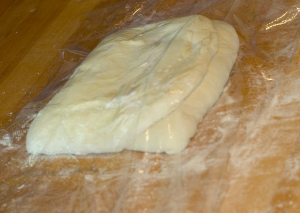
Dough resting for 5 minutes before stretching

Then the dough is gently stretched from each end, to twice it’s original length.
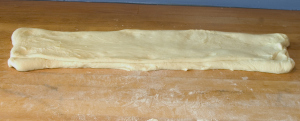
dough stretched to twice it's size

Then the dough is folded into thirds, letter style and allowed to rest for 30 minutes.
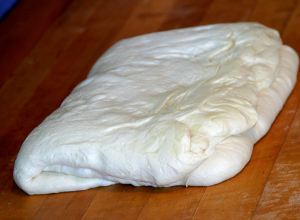
foccacia folded letter style

This stretching and folding procedure is repeated twice more, followed by an hour rest on the counter.  While the dough rested, I prepared an herb oil to top the Foccacia with.  I heated about a cup of olive oil in the microwave for about 45 seconds, just until it was warm.  I aded 2 cloves grated garlic, and about 1/2 cup fresh chopped mixed herbs (basil, italian parsley, thyme, oregano and rosemary).  After an hour of resting, the dough is transferred to a parchment lined baking sheet, coated with oil. 
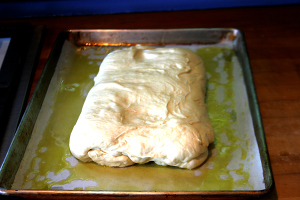
foccacia on pan

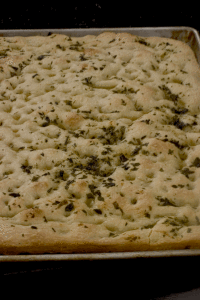
Then the fun part begins.  About half of the herb oil is poured on top and then, using your fingertips, dimple the dough and spread it to almost fill the pan.  Then the dough is covered with plastic wrap and refrigerated overnight (or up to 3 days).  Mine was left in the fridge for 2 days.
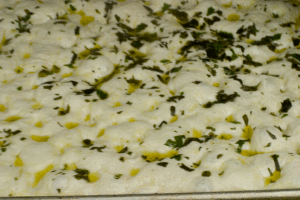
dimpled-dough

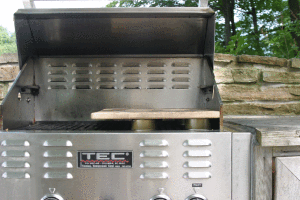
To prepare the BBQ for baking, I turned 4 empty tuna cans upside down and placed my baking stone on top of the cans.  The tuna cans act as protection for the baking stone, raising it up off the direct flame.  I turned on both burners of the BBQ and let it pre-heat on high for 30 minutes. 

tuna-cans-and-baking-stone-

I do not have a thermometer on the BBQ so I was really guessing about temperatures.  I turned down both burners to medium heat and placed the foccacia (still on the baking sheet) onto the stone.  I closed the lid and waited.  After 5 minutes, I could not stand it anymore, so I lifted the lid for a peek. 
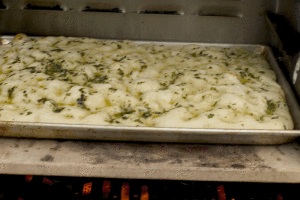
After 5 minutes of baking.

After 5 minutes of baking.

Not much was happening, so I closed the lid and waited another 5 minutes.  Then I checked again and the bottom was beginning to brown while not much had changed on top.  I was concerned that the crust would burn before it was cooked through so I turned down the heat to low on  both burners, rotated the pan 180 degrees and closed the lid for another 10 minutes.  After a total baking time of 20 minutes, the Foccacia was done.  Internal temperature registered 200 degrees.
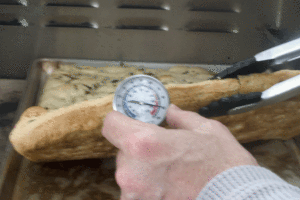
check-the-temp

done-1

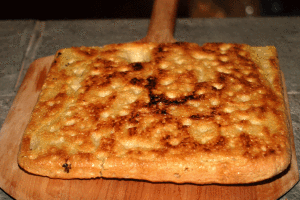
bottom-foccaccia-crust

A peek at the bottom crust revealed crispy goodness.  While the foccacia cooled, I decided to go for a run as I realized I would be doing more than tasting this bread.  We sliced into it and had our first piece with a glass of Proseco and peach nectar.  The crumb was not as open as I was expecting but the crunch from the bottom crust was addictive.  The aroma and flavour from the herb oil were unbelievable.  I love this bread.
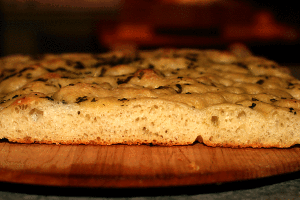
crumb-2

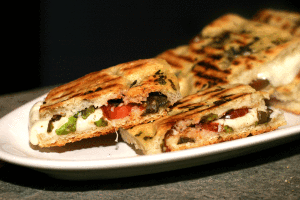
The remainder of the bread was sliced horizontally and we made fresh mozzarella, tomato and basil panini sandwiches for dinner.
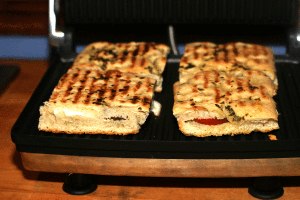
caprese-panini-2

caprese-panini

Memories of Bubbe Cookies


Bubbe-Cookies-in-jarEvery spring, when I was little, my parents would fold down the last two rows of our station wagon and line it with blankets and pillows.  Then they would wake my sisters and me at midnight and pack us into the back of the wagon, like sardines (this was before the days of seatbelt laws). Through the night we drove, to Philadelphia, to visit my dad’s family. 

We loved those annual trips to Philadelphia.  My older sister and I got to stay at my Auntie BeBe and Uncle Sammy’s house.  We slept in my cousin Bonnie’s room.  She was 3 years older than me and the most glamorous pre-teen I knew.  I loved her American accent, her clothes and her friends. I was very jealous of her pierced ears and adorable earring tree which housed all her beautiful earrings.  The rest of my family stayed at a hotel.    When my little sisters got older, they were allowed to stay at the house too, in my younger cousin David’s room. 

Our days had a definite structure to them.  We’d get up in the morning and have “Tastykakes” for breakfast, followed by a chaser of Diet Pepsi.  Tastykake has been baking in Philadelphia since 1914 and their signature product is a cream filled cupcake, much like a Hostess Ho Ho.  Then we’d set the dining room table for lunch.  At about 10:30 a.m. my parents and siblings would arrive and all the kids would go upstairs and start rehearsal for the play we’d put on that night.  Our performance each night followed a fairly similar formula, some variation of dressing my little cousin David up in girl’s clothes.

Morning rehearsal was followed by lunch, always cold cuts, coleslaw and potato salad, Wise’s potato chips and of course the ubiquitous Pepsi and Diet Pepsi.  My Uncle Sammy is a definite member of the Pepsi generation.  No Coke in that house!!  I never made a sandwich with bread for lunch.  I just rolled slices of roast beef around Wise’s potato chips.  Depending upon your perspective, you may either be amazed or horrified that this is what I remember most vividly about that time in my childhood.

Lunch was followed by cleanup and setting the table for dinner.  The afternoon usually involved some shopping for the girls.  Back in the day my mom was a marathon shopper.  What she could accomplish in 2 short hours was astonishing.  Fortunately that gene has been passed down to several of her daughters and at least one granddaughter!  Then back to the house for dinner, clean up, setting the table for lunch the next day and the evening performance.  For dessert there were always Bubbe cookies. 

My grandmother made poppy seed cookies. They are not thin delicate poppy seed cookies. They are thick and hard, like little hockey pucks.  During the rest of the year she would mail them to us in a shoebox. When that little box would arrive in the mail there was much joy in our house. (Perhaps that explains my shoe addiction!)  Saying goodbye at the end of the visit always took at least 2 hours.  There were lots of tears and promises to visit again very soon.

As we grew older, the visits were less frequent and once my cousins and siblings and I got married and had families of our own, our lives got increasingly busier.  In 1992, two years after my Bubbe passed, a family reunion was planned.  We all drove to the Neville Hotel in the Catskills.  It was a wonderful weekend.  There was lots of talk that this should be an annual event but all the busyness of life got in the way.  In early 2000, my husband and I decided to host a family reunion at our cottage that summer.  Although it was a Feingold-Gordon (my dad and his sister) family reunion, several other branches of the family were included, namely my mom’s sister, Susie, and her family and my Cousin Bonnie’s mother-in-law, Yetta.  Over the years whenever an additional guest was added, the joke became, “Yetta nother guest!!” 

That first reunion was a resounding success. (Despite E-Coli in our well, but that’s a story for another time!)  Of course I had to bake Bubbe cookies for the reunion.  Although it had been 10 years since my grandmother died, luckily my aunt had watched her mom make the cookies and copied down what she observed.  When I read the directions I thought there must have been a misprint.  It said to bake the cookies for 70 minutes!  But that’s correct.  The cookies are rolled out to about 1/2 an inch thick so they bake at a low temperature for a long time. 

While we have not been holding annual reunions since 2000, we have managed to do them every 3 years.  We held one in 2003, 2006 and again this year, last month in August. This summer there were 41 of us.  Everyone is better than the last.  I feel proud that I am carrying on my parent’s tradition of making memories for their children.  Now it’s our generation’s turn to do the same for our kids.

Bubbe Cookies

Makes 125 cookies

6 large eggs
1 ¼ cups granulated sugar
1 cup vegetable oil
1 cup warm water
2 tablespoons Crisco vegetable shortening
2 tablespoons poppy seeds
1 teaspoon baking powder
½ teaspoon salt
8 ¼ cups all-purpose flour

 ½ cup granulated sugar (for sprinkling on top of cookies before baking)

  1.  Preheat oven to 300 degrees F.  In an electric mixer, mix together the eggs and sugar for about 5 minutes, until light and fluffy.

 2.  Add oil, water, Crisco and poppy seeds and continue to mix for another 3 minutes.

 3.  Add baking powder, salt and flour and mix just until the dry ingredients are incorporated.

4.  Divide dough into 4 sections.  Roll out one section at a time, to a ½ inch thickness and cut out cookies using a 1 ½ inch round cookie cutter.  A small juice glass works very well for this. (That’s what my Bubbe used, although in her later years, she just used a knife and cut the cookies into squares.)   Save the scraps and reroll and cut out more cookies.

5.  Place the cookies on parchment lined cookie sheets.  The cookies can be placed fairly close together as they do not spread during baking.  Sprinkle the cookies with sugar and bake.  You can put 2 trays in the oven at once; just switch positions of the trays halfway through the baking time.  The cookies will take about 60-70 minutes to bake.  They should be golden brown and firm to the touch.

These cookies keep very well for several weeks in an airtight container and travel very well in a shoebox.

#12. How are making english muffins like a visit to the optometrist?

one-bite-gone

 In week 12 of the Bread Baker’s Apprentice Challenge we visit English Muffins.  I have long been a fan of Thomas’ english muffins, famous for their nooks and crannies, which are excellent at storing lots of melted salted butter.  I figured that homemade english muffins would beat the Thomas’ version hands down.  Peter Reinhart promised big holes, like the professionals get, if we can work with the soft dough and grill them at just the right time, catching them on the rise. I was up for the challenge.

This dough came together very easily, but I have to admit I was surprised that the recipe only makes 6 english muffins.  All the other recipes from the book have  yielded gargantuan breads.  The dry ingredients, (bread flour, sugar, salt and yeast) are mixed with a bit of butter and some milk and kneaded in the mixer for about 8-10 minutes.  Then the dough is set aside to ferment, until it doubles in size, about 60-90 minutes.

dough-ready-for-primary-fer

dough-more-than-doubled

It was a very warm day and as usual, I was multi-tasking and didn’t quite catch the dough at the ” just doubled” stage.  It looks like it tripled!  Oh well, no harm done, or so I innocently thought.  I weighed the dough and divided it into 6 equal pieces, and formed the little boules.

The balls of dough are then lightly oiled and sprinkled with cornmeal, covered with plastic wrap and left to rest until nearly doubled in size.  I have to admit, this was an instruction I struggled with.  I had a really hard time knowing when they were nearly doubled.

It reminded me of going to the optometrist and getting your eyes examined.  My very first optometrist was my dad.  He’d put those lenses in front of my eyes and say, “Is this better, or is this better?”, while he changed the magnification only infinitesimally.  I could never tell which one was better but I was always too embarrassed to say so.   Truthfully, I just thought he didn’t know what he was doing but I never wanted to make him feel bad, so I just lied and picked one.  It was only after he died, and I had to go to another optometrist that I realized that my dad wasn’t a bad optometrist after all.  I experienced this inability to tell the difference at my new optometrist too.  Sorry dad, it was me not you!!

Now you look at these two pictures and see if you can tell if they are nearly doubled in size.  The one on top  is just after I formed the boules and the one below is after 90 minutes of proofing, when I figured that, they looked almost doubled.

6-muffins-ready-for-proofin

  after-proofing

Then it was time to cook the muffins.  English muffins are baked in a frying pan or cooked on a griddle and then finished in the oven.  I gently transferred them to the pan and cooked the first side over medium heat for about 5 minutes until they were golden brown.  They are supposed to spread out on their own but mine still looked like little balls so I helped matters along and squished them gently with a spatula.  Then I flipped them over and cooked the second side.

in-the-frypan

Once the second side was done they went into a preheated oven for an additional 5 minutes, to finish cooking the inside.  After letting them cool for 30 minutes, we split them open with a fork.  Fork splitting, apparently gives english muffins their characteristic nooks and crannies.  The moment of truth…

fork-split


crumb-shot

Even with the fork splitting, the nooks and crannies were absent.  I’m not quite sure where I went wrong.  I suspect that I over fermented (first rising) as well as over proofed (second rising) them.  Peter Reinhart says that if you catch them “on the rise” you will be rewarded with the nooks and crannies.  I think my muffins went past the rise and I missed my opportunity.  I also suspect that since my little balls did not spread out on their own, that my dough was not wet enough and if there were any air holes inside, I may have squished them when I pressed down with my spatula.  However, I toasted them and slathered them with salted butter and American Spoon sour cherry preserves and they were very tasty, but not as good as Thomas’.

one-bite-gone

Although I was a little disappointed with the results, it was still a worthwhile exercise as  I was reminded the other day of one of the reasons I began this challenge.  I was reading a book review of Marion Cunningham’s “The Breakfast Book” on epicurious.com.  In the book Marion says, “Cooking is one of the legacies we can leave to the future, and I would like to be remembered for my baking. We all know we’re not immortal, but after I’m gone, I would like my son and daughter to be able to say, ‘Our mother made real yeast bread for breakfast.”  I couldn’t have said it better myself!

P.S.  My sons and daughter loved the english muffins.

#11. Not feeling much like celebrating but I made Cranberry Walnut Celebration Bread anyways

sliced-1

The day I made bread # 11 in the Bread Baker’s Apprentice Challenge, in late July, I was expecting 12 guests for the weekend at my cottage.  It’s not quite as daunting as it sounds, as I learned a long time ago, that when weekend guests ask what they can bring, assign them a meal.  So I was going to make Friday night dinner and Sunday brunch and had assigned Saturday lunch to one friend, Saturday cocktails, hors d’oeuvres and dinner to two other friends.  So all in all, I was in good shape.  Or so I thought, until I woke up Friday morning with a headache, fever and canker sores in my mouth.  Luckily I had my niece here visiting from New York and she rolled up her sleeves and helped me bake.

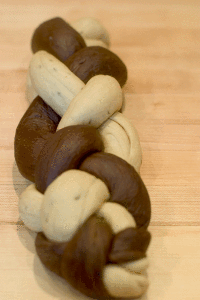
First we tackled the challah dough that I had made the day before and fermented in the fridge overnight.  We needed to braid 2 loaves for Friday night’s dinner.  My niece was keen to tackle the 6 strand challah I had seen on a youtube video.  So we brought the laptop into the kitchen and after several attempts, braiding and then unbraiding, she mastered it. 

I must say, you learn a lot about a person when you braid bread with them.  What my niece lacks in the way of fine motor and visual perception skills (sorry Sam), she more than makes up for in determination.  She was not about to let this bread get the best of her and after about 30 minutes, she had successfully braided it.  I have to admit, that I have tried to do the 6 strand braid myself, about 3 times now and each time I failed, gave up and did a basic 3 strand braid.

braiding-2


braiding-1

braiding-3

braiding-4

After the challah was in the oven, we made the cranberry walnut celebration bread.  To be perfectly honest, I was not that keen on making this bread.  We have been doing so many enriched breads and I was kind of tired of them.  From reading fellow BBA challenger’s blogs, I gathered I was not alone in feeling this way.  Oggi at “I Can Do That” talked about “celebration fatigue” and I know just what she means.  However, I signed on to this challenge and I’m committed to bake each bread, in order.

I decided to incorporate some whole wheat flour into this bread.  I used about 4 ounces whole wheat bread flour and the balance (9.5 ounces) was white bread flour.  Although the recipe called for orange extract, I used orange zest instead.  I also toasted my walnuts first.

mise-en-place2

The dough comes together fairly easily.  Dry ingredients are put in the mixer bowl and wet ingredients are added and kneaded for about 5 minutes on medium speed with the dough hook.  It is a soft and pliable dough.  I decided to knead in the cranberries and walnuts by hand.  it seems as though you will never incorporate them all, but finally, they are all crammed into the dough.

crammed-in-all-the-walnuts-

Then the dough is set aside to ferment and double in size, about 2 hours.  While it was fermenting I prepped the rest of my dinner.  (For anyone interested, I made London broil on the BBQ, dilled green bean salad, roasted potatoes and a tomato, basil and purple onion salad with a balsamic vinaigrette.)  The directions in the book call for doing one large braid and then topping it off with a smaller braid, sort of a double decker braid.  My head was pounding and I did not have the brain capacity to do the math necessary for getting the proportions correct, so I just did a 3 strand braid and coiled it into a circle.

all-coiled-up

The loaf proofed for about 90 minutes and grew quite large.  I egg washed it and baked it for about 50 minutes.  I set it out to cool and after about an hour my guests started arriving.  I had planned to serve the bread toasted for breakfast on Saturday morning but everyone who came in smelled and then saw the bread and wanted to taste it.  Slice by slice, it disappeared.  My mouth was so sore, I did not even taste it, but everyone said it was delicious!

sliced-2

I can’t leave you wondering about  how the rest of the weekend turned out.  I spent the entire day in bed on Saturday, knowing that lunch and dinner were taken care of.  By Sunday morning I hade a sore throat and no voice but had 24 bagels, proofing in the fridge, waiting patiently to be boiled and baked.  I wisely decided that I should not handle any food as I was so filled with germs.  I wrote out the instructions and had my friends do the work.  They were thrilled to be making the bagels and marveled at how simple it was and how delicious they were.  I think I may have sold a few more copies of the book!

margo-biting-bagel

#10. Girl’s Week Cornbread

slice

I have to admit, I didn’t go into this week’s challenge with high expectations.  I have been making the same cornbread recipe since 1987, when my friend Pam shared her recipe with me.  I love her cornbread.  It combines cornmeal and corn flour and makes for a very tender cornbread.  I add canned corn to it which enhances the sweetness and finely diced jalapeno which helps to temper the sweetness.  All in all a wonderful recipe.  I was never tempted to stray from this perfection.  However, the Bread Bakers Apprentice Challenge called for making Peter Reinhart’s cornbread recipe this week.

This is the only bread recipe in the book that does not call for yeast.  In baking terminology, it’s what is known as a “quick bread” which relies on chemical leavening, typically baking soda and/or baking powder.  While classified as  a quick bread, this version of cornbread takes 2 days to make.  However, day 1 just consists of 5 minutes of time to make the cornmeal soaker.  Coarse cornmeal (also known as polenta) is given an overnight bath in buttermilk.  I did not have any buttermilk, and as I am at the lake at my cottage, I did not feel like driving 20 minutes to the store, so I just added a bit of lemon juice to the milk to sour it.
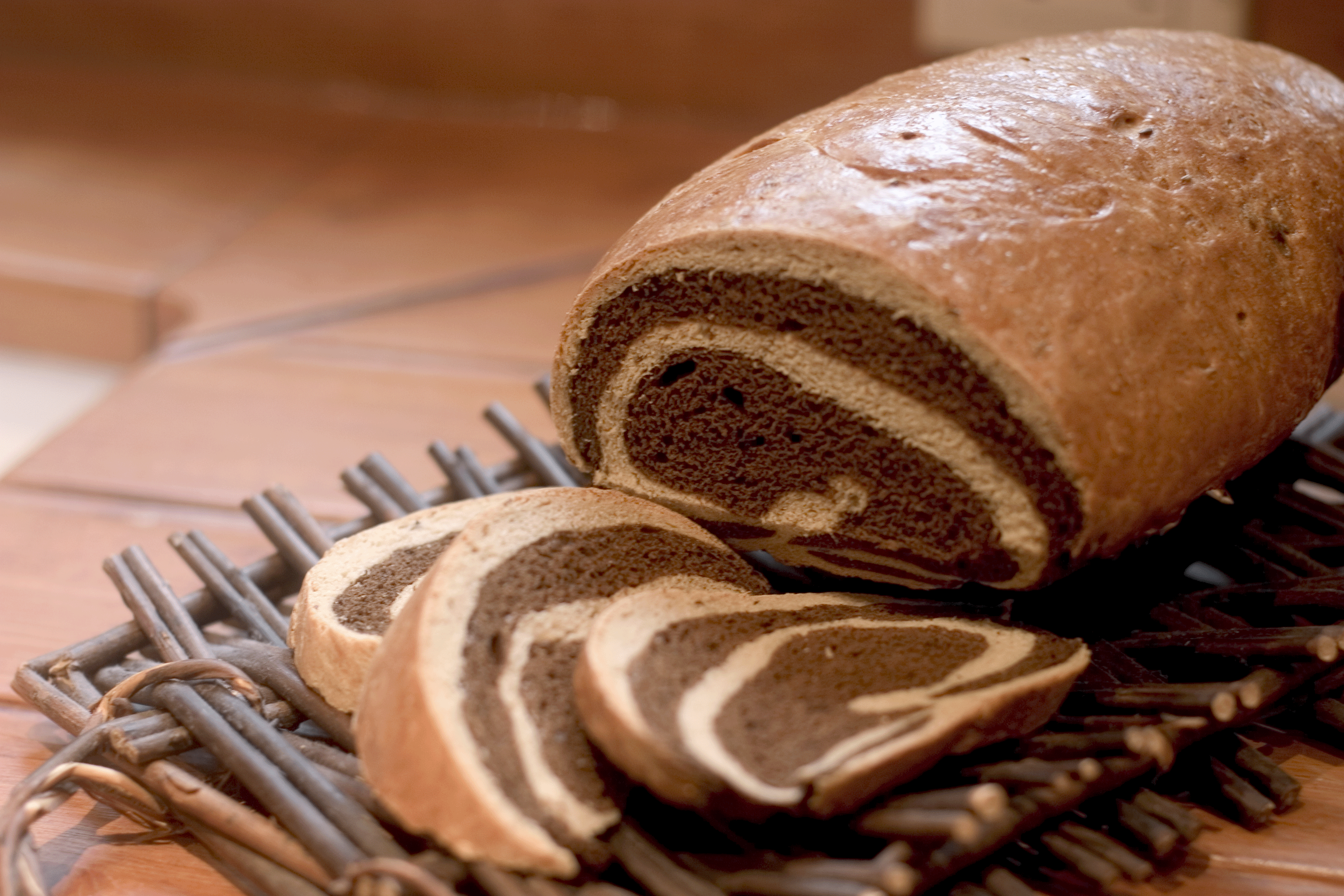
The next day assembling the rest of the bread is simple.  Sift flour, baking powder, baking soda and salt into a mixing bowl.  Stir in brown and white sugar.  In a separate bowl, the eggs are beaten and honey and melted butter are mixed into the eggs.  This whole mixture then gets combined with the buttermilk soaked polenta.  Dry and wet ingredients are combined and some frozen corn is mixed in.  I also added a finely diced jalapeno.

The cornbread is baked in a 10 inch pan.  I only had a 9 inch pan so I also used some mini loaf pans.  The baking dishes are coated in bacon grease and heated in the oven for 5 minutes before the cornbread batter is added.  This gives the cornbread a crisp crust.  I was not using bacon so I just brushed the pans with vegetable oil and heated them.

I was a bit distracted as I baked the cornbread and did not take my usual step by step photos.  For this you can blame my friends Lynnie and Paula.  They came up to my cottage to spend a few days with me and we were very busy laughing and drinking wine while I made this.  Lest you think I totally slacked off, I did make them cheddar jalapeno bagels on day two of their visit, cornbread on day three and for a final send off on day four I rolled them out the door with tummies full of sticky buns.  We also collaborated on an amazing spinach, watermelon, strawberry and halloumi cheese salad.  Halloumi cheese is a delicious cheese from Cyprus, somewhat like feta but it is served fried.

The finished cornbread was delicious.  I was surprised at how much I loved it.  It had a coarse crumb and crunchy crust and was denser than the cornbread I usually make.  I will be revisiting this cornbread again, but not too soon.  I’m still coming down from my carb loading week with my friends.

cornbread-in-pans

I won’t be publishing the cornbread recipe from the Bread Baker’s Apprentice Cookbook as all the challengers have agreed that out of respect to Peter Reinhart, we will only promote his wonderful book and not give away his recipes for free.  For an equally delicious cornbread, try my friend Pam’s recipe.

Pam’s Cornbread

This recipe comes from my cooking school friend, Pam.

What you need:

1 1/3 cups all-purpose flour
2/3 cup cornmeal, can use medium or coarse grind
½ cup corn flour
2/3 cup sugar
5 teaspoons baking powder
½ teaspoon salt
1 1/3 cups whole milk
2 ½ ounces melted butter
1 large egg, beaten
1 can corn, drained
1 jalapeno pepper, seeded and finely diced

What you do:

1.  Preheat oven to 350 degrees F.  In a large bowl, combine the first six ingredients.  In a separate bowl, combine  milk, egg and melted butter, add to dry ingredients and mix until just combined.  Gently mix in drained corn and jalapeno.

2.  Pour batter into a greased 8-inch square cake pan or a 9 x 5 loaf pan.  Bake on middle rack of oven for about 45 – 50 minutes.

3.  Let cornbread cool in the pan, on a rack for about 45 minutes.  Turn out onto a rack to finish cooling or eat warm.

Watermelon and Halloumi Cheese Salad

halloumi-salad-for-web

I first learned about Halloumi cheese last summer when I watched Jamie Oliver prepare it on his TV show, “Jamie at Home”. Halloumi is a traditional cheese from Cyprus, an island in the Mediterranean Sea. It is made from a mixture of goat and sheep milk, although some halloumi can be bought that also contains cow’s milk. Halloumi can be fried until brown without melting due to its higher-than-normal melting point. The resistance to melting comes from the fresh curd being heated before being shaped and placed in brine. When sliced and fried in a bit of olive oil, Halloumi is a wonderful treat. It goes all crispy on the outside and soft and slightly chewy on the inside. It makes a great squeak when you chew it, sort of like fresh cheese curds.

This salad was inspired by an empty bagel platter.  After a lunch of homemade bagels all that was left was the poppy seeds, sesame seeds and fleur de sel that had fallen off the bagels.  My girlfriend speared a piece of watermelon and dipped it into the bagel topping.  She loved how the salt balanced the sweet of the watermelon.  That got me thinking about combining these flavours.  The next day I decided to pair it with Halloumi cheese because it has a great salty taste.  Fried halloumi cheese with watermelon, strawberries, and spinach is an inspired flavour combination!

watermelon-with-bagel-toppi

What you need:

1 quart strawberries, washed, hulled and sliced
1/4 seedless watermelon, cut into 1 inch chunks
5 ounce box of baby spinach, washed and dried
2 tablespoons balsamic vinegar
3-4 tablespoons extra virgin olive oil
kosher salt
freshly ground black pepper
2 tablespoons extra virgin olive oil
8 ounces Halloumi cheese, sliced into 8 thin slices

What you do:

1.  Place baby spinach on a large platter.  Scatter strawberries and watermelon over spinach.  Drizzle with olive oil and balsamic vinegar.  Sprinkle with salt and pepper.

2.  Heat 2 tablespoons olive oil in non-stick skillet.  Fry halloumi cheese for about 3 minutes on each side until golden brown. 

3.  Place halloumi slices around edge of salad platter.  Serve.

#9 Living on a Cinnamon Cloud

sliced-1

I am only just now beginning to come down from that cinnamon cloud I have been living on for the past two weeks.  I have gone through an entire jar of cinnamon in just 13 days.  Usually a jar will last about 4 months in my house.  I used about 2/3 of the jar making cinnamon and sticky buns, (okay I confess to making them four times!!) and the rest of the jar was used making this week’s Bread Bakers Apprentice Challenge,  Cinnamon Raisin Walnut Bread. 

The next statement I am about to make may shock and surprise you.  This bread actually improves with age.  That’s not a phrase normally associated with bread but with this loaf, it happens to be true.  While it was delicious fresh and warm from the oven, the next morning, thickly sliced, lightly toasted and slathered with (salted!) butter, it was sublime.

This bread came together beautifully, although not for the first time I silently cursed Peter Reinhart (PR) for putting the measurements in imperial rather than metric. Trying to measure out .31 ounces of salt is impossible. Weighing 9 grams of salt (the metric equivalent of .31 ounces) is easy. This rant has been brought to you by the “Cookbooks Go Metric” committee (me).  Anyways, forgive this aside, back to the Cinnamon Raisin Bread. 

It begins by combining the dry ingredients (bread flour, sugar, salt, yeast, and cinnamon) in the bowl of the mixer. 

Dry-ingredients


Next the wet ingredients (egg, melted butter, milk, and water) are combined and added to the dry.

wet-ingredients


I mixed the dough on medium speed for about 8 minutes.  I needed to add an additional 3 tablespoons of flour.  The final dough was “soft and pliable, tacky but not sticky”, exactly as RP prescribed.  I learned from fellow BBA challenger  Phyl at “Of Cabbages and Kings“, that “the easiest way is to tell if your dough is tacky or sticky is to press your hand onto the dough and then lift it up. If the dough pulls up with your hand and then releases (so your hand comes away clean), the dough is tacky. If you end up with dough stuck to your hand, it’s sticky.”

The raisins and walnuts are kneaded in by hand at the end of the mixing period so they don’t get too crushed.  I toasted my walnuts first to really bring out their nutty essence.

mixing-in-walnuts-and-raisi


The next step is to let the dough ferment (the first rising) for at least 2 hours or until doubled in bulk.  I have always had trouble with the instruction, “doubled in bulk”.. I used to let my dough rise in a bowl and could never judge when it had exactly doubled.  I learned a tip from my fellow challengers on how to easily tell.  They let their dough rise in a square plastic container and put a rubber band around the outside at the top of the dough.  As the dough rises you can easily judge that moment when it has doubled.  So simple but brilliant!

dough-ready-for-fermentatio


Here is the dough after 3 hours.  Easy to tell it has doubled.  Actually it more than doubled because I went to exercise, got distracted and forgot about it.

after-2-hours

Next the dough is divided in half and each piece is rolled out to an 8 x 5 inch rectangle.  For an extra burst of cinnamon flavour the whole surface is sprinkled with a cinnamon sugar mixture.

sprinkle-on-cinnamon-and-su

Then the dough is rolled up into a tight log and placed in a small (8 1/2 x 4 1/2 inch) loaf pan for the second rising (proofing).

into-the-pan-for-proofing

Once the dough “crests above the lip of the pan”,  about 2 1/2 hours later, they’re ready for the oven.

after-2.5-hours-2

They go into a 350 degree oven for about 30-40 minutes until an instant read thermometer, inserted into the center of the bread, registers 190 degrees F.  The bread will be golden brown all over.

just-baked-2

I thought that the  bottom of the loaf was quite beautiful so I shot that to show you as well!

the-underside

To really boost the cinnamon flavour PR suggests brushing the loaf with melted butter and then sprinkling the top with cinnamon sugar.  Is it any wonder I have used an entire jar of cinnamon this month?

Brushed with melted butter.

Brushed with melted butter.

Topped with cinnamon sugar.

Topped with cinnamon sugar.

After an agonizing 90 minute wait (I sent impatient angry husband on a bike ride as the aroma was driving him wild!!), we sliced into it and had a few slices with a glass of sauvignon blanc.  Interesting flavour combo.

sliced-2

While this bread was delicious stilll warm from the oven, it really shone the next morning, toasted with butter and a latte!!  I’ll definately be making this one again.  Thanks Mr Reinhart for another keeper!