Author Archives: saltandserenity

Meneinas (yummy little nuggets)


In my continuing quest to uncover dried fruit and nut desserts for my Tu B’Shvat cooking class, I uncovered this little gem.  These adorable little cookies are called “Meneinas” (pronounced Meh-NAY-nas) and they may be singly responsible for making me reverse my former position on not liking dried fruit desserts.  I feel like Sam in “Green Eggs and Ham.”  Say,…. I do like dried fruit and nut desserts.

I discovered this cookie recipe in my new book, “Chewy, Gooey, Crispy, Crunchy Melt in Your Mouth Cookies.” by Alice Medrich.  I am just a little obsessed with this book and am tempted to bake my way through this one too.  When I bought this book in late December, I promised myself that I would not bake from it in January.  I swore I would only use it for bedtime reading.   Come on now, who am I kidding?  I am so weak!  My New Year’s resolution broken in only 2 weeks.  But to be fair, I was giving a cooking class on dried fruit desserts and this little cookie was just perfect.

Alice says that this is a cherished family recipe from Alexandria, Egypt, given to her by artist Jeannette Nemon-Fischman.  The traditional filling is made with date and walnut, but in typical Alice Medrich fashion, always one to gild the lily, she offers us 4 alternate fillings: Spiced Fig, Apricot Vanilla with Cinnamon and Almonds, Pear Almond and Sour Cherry with Black Pepper.  Of course, being the keener I am, I had to make all 5 fillings.  Just for research purposes of course.  My favourites were the Pear Almond and the Sour Cherry with Black Pepper.  The cooking class students loved them all but their favourites were the date walnut and the spiced fig.

These cookies were so much fun to make.  Actually, I had the best time making the fillings.  Alice suggested that a potato masher would be the best tool for making the dried fruit fillings.  I somehow lost my potato masher so I had to get a new one.  Look what I found!  It is a pogo stick potato masher.  It is spring-loaded and so much fun to use.  No wonder I made 5 fillings.

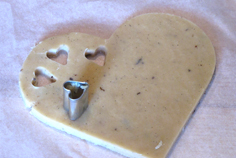
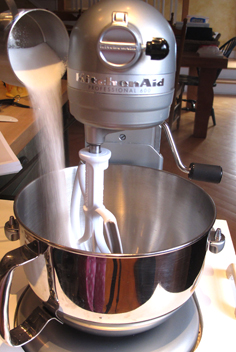
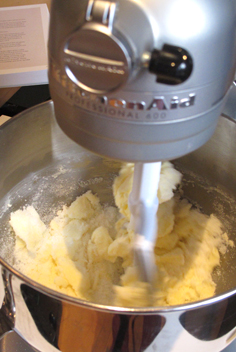
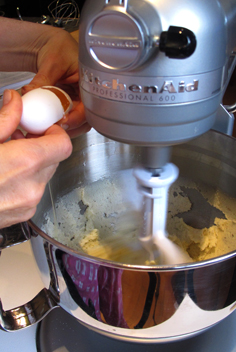
Once the filling cooled, I added some chopped almonds.  The dough comes together quite easily in a mixer.  It’s enriched with butter, milk and orange blossom water.  I’m just warning you, when you open the orange blossom water be prepared.  It smells like a cheap hooker, but once incorporated into the dough, the flavour and aroma are very subtle.  You can find the orange flower water at middle eastern stores.  Just use some orange zest if you can’t find it.  The dough has the consistency of play-doh and the little cookies are so easy to form.  It’s best to set up an assembly line process.  First, scoop out the filling.  A heaping teaspoon is a good size.  Then scoop out tablespoon sized nuggets of dough.  Then form little cups and fill and seal.

Once the cookies have cooled, I rolled them in icing sugar.  Alice recommends coating them when they are warm and then coating them a second time once they have cooked.  I found they got a bit gummy, so I just coated them once, when cool. I think you could freeze them, uncoated and then thaw and coat them before serving.


To print recipe, click here.
To print filling recipes, click here.
Tu B’Shvat Cake

I  have been very busy the past few days testing dessert recipes with dried fruits and nuts.  This has been challenging on several fronts.  In the first place these are not exactly my type of desserts.   I typically answer to the calls of chocolate, mint, coconut or caramel.  Secondly, we are trying to eat a bit lighter this month in order to make up for our December cookie gluttony.  Why, you may be asking, is she doing this?  Well, it’s all for a good cause.

There is an organization here in Ottawa known as the Friendship Circle.  They pair volunteer teens and children with special needs for hours of fun and friendship.   This organization envisions a world in which children with special needs and their families experience acceptance, inclusion and friendship.  My youngest son, who has Cerebral Palsy and Autism, has been a benefactor of this program for almost 4 years now.  Every Sunday, his friend comes over for a visit.  Sometimes they go bowling, sometimes to a movie, but mostly they just hang out at home playing Nintendo Wii or watching a DVD. This has been a life enriching experience for both my son and his friend.

A secondary goal of the organization is to provide some respite for the moms of these special needs children.  They started a “Mom’s Night Out” program last year.  When they asked me to give a cooking class for the moms last year, I happily accepted.  I was in the middle of my Bread Baker’s Apprentice Challenge, so I wowed them with challah, bagels and cinnamon buns.  In the fall, they asked me if I would do it again this January.  Of course I accepted.  When the organizer called me last week to discuss the evening I suggested we do a class on how to incorporate more whole grains into your life.  I thought this would be  perfect for January.  She said that the moms really wanted a class on Tu B’Shvat desserts.  There was a momentary pause and then I said, “Sure, no problem.”  After I hung up the phone I ran to my computer and Googled  “Tu B’Shvat.”

Although I am Jewish, and have heard of Tu B’Shvat, it is not one of the major Jewish holidays.  (The big 4 being Rosh Hashanah, Yom Kippur, Chanukah and Passover).  A little research was in order here.  Tu b’Shvat, which begins sundown on January 19 this year,  celebrates the New Year for Trees.  In essence, it is a celebration of nature and the fruits of the land of Israel.  Jewish tradition marks this date as the day when the sap in the trees begins to rise, signaling the earth’s awakening from its winter slumber and heralding the beginning of spring.  Say what??  Beginning of Spring?  Anyone looked out the window today?

Yes. I realize most of us are still digging out from the last snowstorm and bracing for the next onslaught of white stuff.  But trust me, in Israel, last time I checked, it was 15º C (59º F) in Tel Aviv.  Next week, on Tu B’Shvat, Jews in Israel, and all over the world will mark this day by planting trees and eating dried fruit and nuts.  Of course it’s not all about planting trees and gorging on dried fruit.  Rabbi Naphatli Hoff, at torah.org, makes an interesting observation on how the seasons often parallel our own lives.

Of all of the yearly seasons, there is perhaps no greater disparity than the one that exists between the seasons of winter and spring. Winter represents stagnation and unrealized potential, when all signs of growth lie hidden inside of the trees. There are no external signs of development, no expressions of vitality. All we see is an empty tree trunk; the fruit and leaves of last season have long since fallen away.

Spring, on the other hand, symbolizes burgeoning vitality. Everything is new and exciting. Trees that have remained dormant for the past few months start to show new signs of life. Buds begin to sprout, flowers start to open. Nature once again reveals its true beauty.

 This contrast is true in human life as well. Circumstances sometimes force us into our own personal “winter,” when struggles and challenges strip us of our innate vitality. There are other times in which we seemingly experience only joy and excitement in our lives. Everything points towards growth and accomplishment.

We must realize, however, that there are two distinct ways for a person to approach the winter-like situations in his own life. The aforementioned contrast between winter and spring is only true if one views winter as the death-knell of summer. The beauty of the seasonal cycle, however, is that one can alternatively view winter as ushering in the upcoming spring. No matter what challenges a person faces, there are always better days awaiting him. Such a person knows no limitations, no dormancy. Life is a continuous cycle pointed in the direction of growth.

This is the message of Tu B’Shvat. In the middle of the winter, when everything around us seems so cold and bleak, think of spring. Eat fruit. Sing joyous tunes. Plant new trees. Always look for the good.Tu BShvat provides us with many essential, real-life lessons. We celebrate Tu B’Shvat knowing that we will continue to weather the storm of life, no matter what that particular “season” has in store. “

So, back to my original mission, dried fruit and nut desserts. I have come up with 3 wonderful recipes that fruit and nut lovers will be thrilled with.  I have to admit, even I thought they were delicious.

I started my research with Janna Gur’s book, “The Book of New Israeli Food.”  Janna didn’t disappoint.  In the index I found a recipe for Tu B’Shvat cake.  Perfect.  As I read through the recipe I started to think, “It’s beginning to look a lot like Christmas.”  This was a fruitcake recipe.  Almost a pound of assorted dried fruit and nuts, held together with miniscule amounts of flour, sugar and eggs.  Well, I am all for Culinary Co-existence.  No reasons Jews can’t bake fruitcake.

At this point I looked at the cake and wondered how this dense gooey mixture would transform itself into a cake.  It does not rise very much and resembles a fruit and nut brick when you turn it out of the pan.  But once I waited for it too cool and sliced it, I was in for a surprise.  Crunchy around the edges and chewy in the middle, this cake is chock full of goodness.  It is even better the next day.  In my effort to abstain from sugar this month, I had just half a slice and sent the rest off to my husband’s office.  Come back tomorrow and Friday for more dried fruit and goodness!

Click here to print recipe for Tu bi’Shvat Cake.


SaveSave

SaveSave

SaveSave

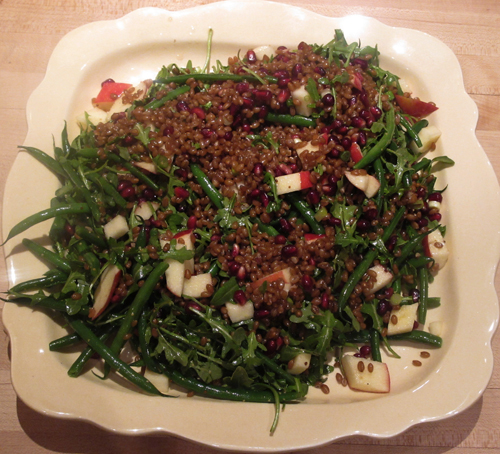
Farro Pilaf with Apples and Raisins


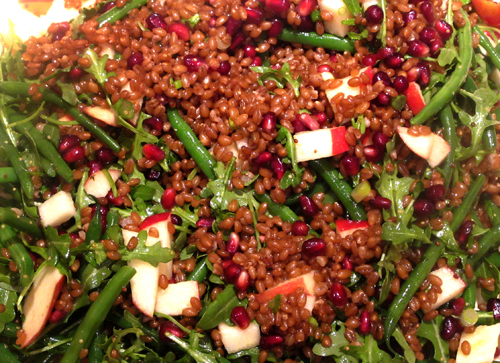
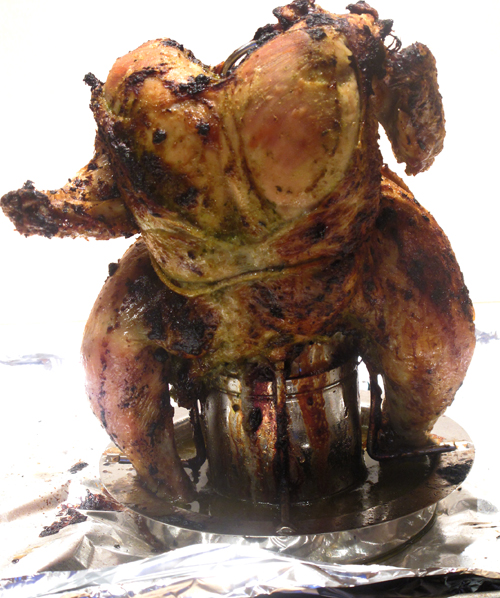
Let me begin by apologizing.  Usually when you open up a new post from me you are greeted with a mouth-watering photo of something delicious to eat.  We have a problem here.  This Farro Pilaf with Apples and Raisins is not the most photogenic thing I have ever made.  But do not stop reading here!  I beg of you to be patient and continue on.  Farro-Apple pilaf combines my two newest food obsessions.

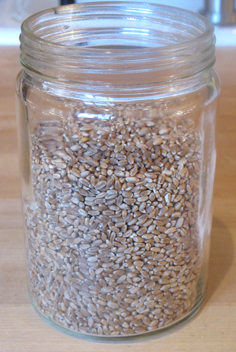
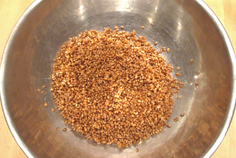
First we have farro.  I have fallen hard for Farro!  No, not the Egyptian Pharaoh!  Farro is a Roman grain, cultivated originally by European farmers as far back as 5000 B.C.  Although it is ancient, it seems to be the new darling of the culinary world and is making a big time comeback.  I accidentally stumbled across it when I was doing a search for Tabbouleh on epicurious.com.  I found a recipe for Farro and Pine Nut Tabbouleh.  Intrigued, I printed it out and put it in my “to try” pile.

The next week, I was watching Giada De Laurentiis on the Food Network, and she made Cheesy Baked Farro, essentially macaroni and cheese but prepared with farro instead of macaroni. Now I just have to say, for the record, that I love Giada!  I think she has great recipes and she seems like a really fun gal to hang out with.  But I just wish she would cover up that cleavage a little.  Ok, rant over.

Two farro recipe sightings in less than a week.  Now my curiosity was definitely piqued.  I had to try this grain.  However, getting hold of farro was no simple task.  I called around to several local food stores.  Two of them said they had never heard of farro, while the other two said that in Canada, farro was sold under the name spelt.  Then, remembering that farro was Italian, I called Nicastros, Ottawa’s largest Italian food purveyor.  Yes, they told me, they sell “farro in chicchi”.

I came back from Nicastros with 2 boxes of farro.  Both were imported from Italy.  One is made by Martelli and the other is by Pantanella.  Interestingly, on the ingredient list of one box, it says, “100% Spelt”.  On the other box it says, “100% Farro, Spelt, Epautre”.  What??  No wonder people are confused.  I decided to consult Mark Bittman (or Bitty, as Gwyneth Paltrow calls him in “Spain, on the Road Again” on PBS), author of “How to Cook Everything”, and “How to Cook Everything Vegetarian”.  These books are the modern day equivalent of Joy of Cooking.”

And of course, Bitty cleared things up for me.  Farro and spelt are often confused for each other.  Both are ancient grains from the wheat family. Farro cooks in about 20 -30 minutes and retains a chewy, toothsome texture while spelt takes 60-90 minutes to cook and has the tendency to turn gummy or mushy.  Farro is extremely versatile and can be used in soups, pilafs, risottos or cold grain salads.  It has become my new comfort food.  Plus, it is low in gluten, high in protein, helps fight insomnia and regulates cholesterol levels.  How could I not fall for Farro?

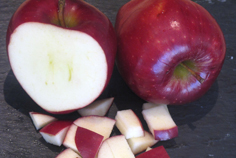
And then we have my second obsession, apples.  Honeycrisp Apples!  Who knew?  Apparently everybody but me.  These apples even have their own facebook page!  These apples hit the market in the fall of 1991.  I just discovered them a few months ago.  Where have I been?  To be fair, I was a little preoccupied in the early 90’s.  By the spring of 1993 I had a 3 year old, a 19 month old and a newborn to care for.  All three were in diapers, so cut me some slack.  But still, my kids are now 21, 19 and 17.  I pride myself on being knowledgeable about new food trends and products, (I’m hot on the trail of cacoa nibs  right now, but that’s a story for another time) but somehow, I missed the boat on this one.

In September, my daughter returned from a a farmer’s market with a big bag of Honeycrisp Apples.  She was positively gushing over them.  Gushing over apples?  This is my child whose first word was “Chocolate.”  I took one bite and suddenly I understood.  This is an explosively crisp apple. It snaps when you bite it.   It is crunchy and juicy all at the same time.  It is so refreshing to eat.  Sorry, was I gushing there?  You will too when you try one.  Oh, maybe you already know about them.  Maybe I really have been living under a rock.  If so, forgive me.

My curiosity led me to a search on where these apples came from.  It’s actually a pretty funny story.  The University of Minnesota has egg on it’s face over this one.  As is the case of most modern hybrid apples, the final product is the result of a lengthy breeding process, experimenting with cross after cross to get the optimal result.  When they finally had an apple they were pleased with, they sent it to market under the Honeycrisp name.  They believed that the parents were  “Honeygold” and  “Macoun”.  However, genetic fingerprinting revealed the shocking truth that neither of these apples were Honeycrisp’s parents.  They knew for certain that one parent was “Keepsake” but the other parent has not yet been identified.  If you know who it is, please advise the University of Minnesota.  Inquiring minds want to know.

I will admit that Honeycrisp apples are best in the fall.  They lose a bit of their “refreshing” nature as they mature.  However, that being said, I boutght a big bag at Costco this week and they were still pretty fantastic.  I decided to combine my two new loves, Honeycrisp and Farro, into one fabulous dish.

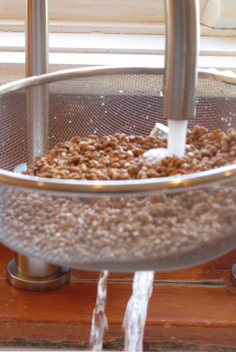
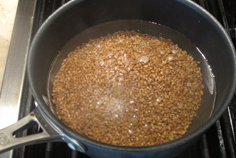
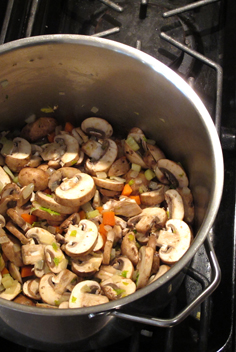
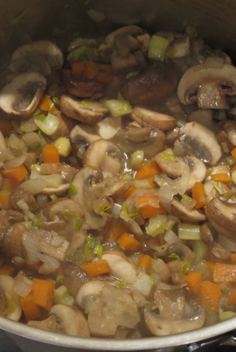
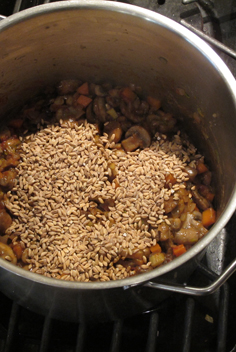
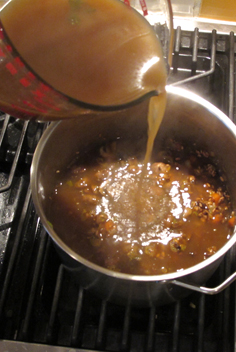
Farro can be cooked like pasta, where you boil it in a large quantity of water and then drain it and add it to all the other ingredients.  Or it can be cooked like a rice pilaf, where you saute some onions in oil or butter, then add the farro to coat it in the fat and then add stock and simmer until all the liquid is absorbed and the farro is tender.  I used the pilaf method.  I decided to add apples and raisins for their delicious sweetness and then I finished the dish with some freshly chopped Italian parsley.  It is absent from the photo as I forgot to add it!  But it really finishes the dish with a fresh note.

To print this recipe, click here.
I’d love to hear from you!

Pomegranate Chicken


Now here’s something you don’t hear everyday.  My children are blessed with 23 first cousins!  My husband and I each have 5 siblings.  He has 4 brothers and a sister and I have 4 sisters and a brother.  (Didn’t they made a movie about that??)  Every year, over the Christmas holidays, we take a vacation with his side of the family.  Over the years the numbers have ebbed and flowed.  This year we numbered 24.  We spent 11 glorious days on the island of Anguilla.  Going on holiday is joyful.  Coming home, not quite as wonderful.  I managed to avoid cooking for the first 2 days we were back but by the third day, the family was demanding to be fed.  And sadly, room service was no longer an option.  My go-to dish, when I can’t think of what else to make, is Pomegranate Chicken.

You may be wondering what is going on here?  Why is she not feeding her family cookies or bread you may be asking yourself.  Regular readers of this blog know that they can count on Salt and Serenity for all things baked.  However, for the next little while, we may have to lay off the baking.  If you followed me through my 8 days of holiday baking and then the Almond Berry Shortbread Torte , followed by 11 days of tropical cocktails, you may have guessed that we have put on a few pounds here.  Or perhaps as my delusional  husband said, “I think the scale is broken!”  So with a little resolve and willpower, we hope to take off those excess pounds this month. Hence, today’s post for Pomegranate Chicken.  Besides, I had to use up that wrinkled pomegranate that somehow missed the pre-holiday fridge cleaning.

Begin with grating some garlic and dicing a few onions.  I usually use a jalapeno pepper in this recipe, but only had a Serrano pepper, so I used half of that.  You may notice in the photos below that my fingers look like they have developed some scaly disease.  Fear not, I am just wearing gloves for seeding and dicing the peppers.  I once worked for a chef who told me that he went to the bathroom after chopping jalapeno and suffered mightily afterwards for many hours.  I am an eye rubber and have been burned on more than one occasion so I always wear latex gloves when handling peppers.

When I was dicing the onions, my daughter asked me to make  a video, showing the proper way to do it.  She said that she tried to describe how to do it over the phone to her girlfriend, but couldn’t properly explain it, so Christina, this video is for you!

I like to use boneless skinless chicken thighs for this recipe.  I find they have way more flavour than breasts and overcooking them is very difficult to do.  The chicken gets seasoned with salt, pepper and paprika.  Then it is browned on both sides and removed from the pan.  With the remaining fat in the pan, saute the onions, garlic and jalapeno.

A can of plum tomatoes and some pomegranate concentrate are added next.  This is different from pomegranate juice.  It is essentially a boiled down concentrated pomegranate syrup.  It is usually available at Middle Eastern stores.  Then the chicken gets added back in and the whole thing simmers, covered for about 40 minutes.

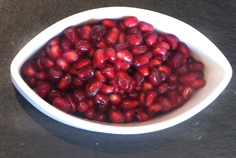
I was very excited to try Nigella Lawson’s method for removing seeds from a pomegranate.  I am happy to report, that while I do not look as gorgeous as her while removing my seeds, her method works quite well and is an excellent stress reliever!

Garnish with fresh pomegranate seeds.

To print the recipe, click here.
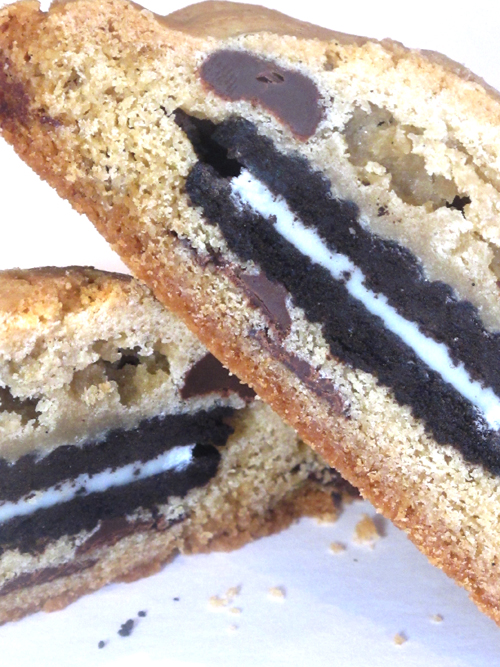
P.S.  I was at the bookstore today and bought this.  I know I should be feeling guilty, but I managed to convince myself that it is for research purposes and bedtime reading only.  (And I call my husband delusional.)

Almond Berry Shortbread Torte


This post is wrong, so wrong, for many reasons.  I apologize.  In the first place, hot on the heels of 8 days of cookies, I should be coming to you with healthy and good for you recipes like cauliflower salad, in order to attone for the gluttony that preceeded. In the second place, this is not berry season, for goodness sake.  The berries in the supermarket now are pale and insipid and have had to travel many miles to get to me.  I am certainly creating a huge carbon footprint with this one, and for that, I apologize again.

However, in my defense, I had to make this cake or there would be hurt feelings in my house.  This is the cake my first born requests every year for his birthday.  It’s his favourite cake and it’s not his fault he was born in December.  Blame the mother. (we get blamed for everything else!!)  This year he is turning 21.  A very big birthday which deserves a very special cake.  And this cake, while perhaps off-season now, is nothing short of spectacular.

I found this recipe many years ago in Chatelaine magazine.  I make it twice a year now, once in September, for my husband’s birthday and once in December for my son.  Some traditions you just don’t mess with.

This is a simple cake to make, essentially you make 4 giant shortbread cookies and then layer them with whipped cream and berries.  Start with creaming the butter and sugar, add the egg yolks, then add cake and pastry flour and ground almonds.

The dough gets chilled for about 30 minutes, then divided into 4 and pressed into large discs.  The wonderful thing about this cake is that the layers can be pressed into shape by with your fingers and palms, just using a rolling pin at the end to smooth out the round.  Here is a video showing how to form the layers.

While the layers are baking, get the berries ready.  I found golden raspberries, red raspberries and strawberries in the supermarket that day.  Feel free to use whatever is in season, or looks good.  This is awesome with little wild blueberries in August.

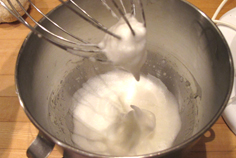
While cake layers are cooling, whip the cream.  The original recipe called for adding a few tablespoons of icing sugar to the cream but I prefer the cream unsweetened.  You get enough sweetness from the cake layers and berries.

After slicing strawberries, assemble the cake.  To keep things tidy, cut 4 layers of waxed paper and lay around the edges of the cake plate.  Put a blob of whipped cream in the center to hold the cake in place so it does not slide across the plate when carrying it into the dining room (not that this ever happened to me!).  Spread 1/4 of the cream on the first layer.  I made an orderly boarder of strawberries and then dumped more berries, haphazardly in the middle.     Continue with 2 more layers and then finish the top layer, taking care to place the berries in a decorative fashion.


The cake should be made several hours in advance.  Leave it in the fridge for the layers to soften a bit, so cutting it will be easier.  It is not the prettiest cake when sliced, but it is the most delicious.

To print the recipe, click here.

Day 8: Packaging

On the eighth day of holiday baking, my true love threatened to leave me if I didn’t stop tempting him with cookies everyday.  Good thing my baking was all done.  Now for the fun part, packaging and labelling.  I am always on the lookout for interesting containers to pack up the treats in.  I found these containers at IKEA in June.  I got a lot of strange looks as I wheeled my cart to the checkout, overflowing with 40 sets of these cookie tins.  Several people wanted to know what I was going to do with them.  When I told them I was using them for holiday gifts, to be filled with home-made cookies, I was besieged with “Friend” requests. 

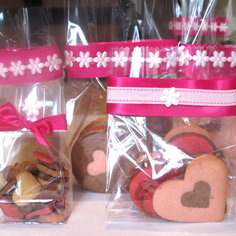
I like to package each type of cookie in a separate bag and label them so people know what they are eating.  I use clear heavy-duty flat bottom candy bags.  They are quite durable and the cookies look tidy packaged in them. The cookies can also be frozen in these bags for a few weeks and they do a good job keeping them fresh until you are ready to give them away.   I invested in a professional bag sealer a few years ago.  I used to tie each bag with ribbon but that took too much time.  I figure the bag sealer has paid for itself already in the money I  am saving on ribbon.  Plus, it looks so professional. And, when the bags are tied with ribbon, it’s way too easy to break into a bag and sneak a cookie or two. 

I make my own labels with a program called Print Shop.  I have been using it for years and it is very easy to use and quite versatile.  This year I decided to do square labelsOnlinelabels.com has a huge selection of all sorts of shapes.  My daughter had the brilliant idea of photographing the cookies for the label.  I decided to shoot them on a wooden tray I painted with chalkboard paint several years ago.  I arranged the cookies on the tray and then wrote the name in chalk.   I was not thrilled with how it looked.  I decided to import the photo into my Print Shop program and add text.  I found the perfect font called “Chalk Dust.”  I have a bit of an obsession with fonts. 

Here are the rest of the labels for this year.

Ribbons and boxes all ready to go.

Bottom box held white chocolate macadamia, caramel corn and peanut butter bark.  Middle box held lemon coconut, chocolate peppermint and toblerone.  And the gingerbread snowflakes fit snugly into the top box.

And now, I rest!! 

Day Seven: Chocolate Peppermint Cookies


On the seventh day of  holiday baking , my true love brought to me: a heating pad and thermometer. No, I’m not sick with fever and chills.  Those are just some essential tools to temper chocolate.  The recipe for these cookies comes from the December 2008 issue of Martha Stewart Living.  I dreamed about these cookies for over a year, not quite trusting myself to make them without having a clear plan of where to deliver them.  I finally made them for my holiday gifts last December and they were so amazing, I had to bake them again this year.

I have adapted this recipe somewhat.  Martha asks you to roll the chocolate dough, chill it, cut out circles, with a 2 inch cookie cutter, chill the cut-out cookies and then bake them.  I simplified things by rolling the dough into a cylinder, freezing it and then slicing and baking.  Faster and easier.  Although Martha does not suggest tempering the chocolate before dipping, I highly recommend it.  It gives the chocolate a beautiful shiny coat and the white chocolate will not melt in your hand when you eat them.  I am warning you, it is a time consuming and highly exacting process, but I think it’s worth it.  Should you decide to forgo the tempering, they will still taste just as delicious but the appearance will not be as spectacular.

Begin with creaming the butter and sugar.  Sift the dry ingredients.  Usually when a recipe calls for sifting, I just ignore those instructions, but when cocoa powder is involved, it’s a good idea as it always has lumps.  Divide dough into two, roll it into a cylinder, wrap in waxed paper, and freeze.  Then slice and bake.  The bottom of each slice becomes a bit flat when you slice them.  You can reshape them quickly back into a perfect circle with your fingers if you want, and then you will have perfectly round cookies.


After the cookies have cooled,  get ready to temper the white chocolate.  DO NOT USE CHOCOLATE CHIPS FOR DIPPING!  I can not emphasize this enough.  Chocolate chips are made with certain stabilizers in them to help them hold their shape and not melt completely.  That is not what you want here.  Also, do not buy the pure white stuff at the bulk food store that is labelled white chocolate.  It is not real white chocolate, but rather a coating compound.  It will melt beautiufully, but it will taste like crap.  Real white chocolate is ivory coloured.  Buy good quality white chocolate.  I like Callebaut or Lindt.

Many chocolate companies are now manufacturing their chocolate in the form of “Callets“.  While they may look like chocolate chips, they are not.  It is the same as buying a block or bar of good chocolate but saving yourself the time and mess of chopping.  A great source for them is www.qzina.com.  For tempering, it is also a good idea to have some solid blocks or bars of chocolate as well.  Those work well to help cool down the chopcolate in the second step of tempering.  A good quality instant read thermometer is helpful for this project.   I have the Thermapen and I love it and use it for everything.  It was recommended by Alton Brown and Cook’s Illustrated.  Can’t get a better recomendation than those two!  I also just heard about a chocolate thermometer , which looks really cool.  haven’t bought it yet, but I am tempted.

Step 1:  Melt white chocolate over a double boiler of simmering water, to 115º F.

Step 2: Remove from heat and add a block of white chocolate.  Stir to cool chocolate down to 81º (for white and milk chocolate) (86° F for dark chocolate).  This will take about 10-15 minutes.  Be patient.  Remove block of unmelted chocolate.  This unmelted piece can be wrapped up and reused another time once it has cooled.

Step 3:  Then briefly place bowl back over the double boiler for just 10-15 seconds, until it warms up to 86º F (for milk and white chocolate) (89° F for dark chocolate). Congratulations!  You have tempered your chocolate.  Now transfer tempered chocolate to a smaller bowl and place on a foil covered heating pad, set on low.

A fork is the best tool for dipping the cookies into the chocolate.  I was given a fancy set of chocolate dipping tools many years ago and they are fun to use, but a regular fork will suffice.  I saw a less extensive set of these tools on amazon, so if you plan to do a lot of chocolate work, they are a worthwhile investment.


Dip cookies in melted chocolate, and sprinkle with crushed peppermint candies. After you crush the peppermint candies (the Cuisinart does a great job of this), put them through a sieve.  This will separate the finer dust from the crumbs.  It’s nice to sprinkle some of the cookies with the dust and others with the coarser crumbs.  Chill and eat!

To print this recipe, click here.


Day Six: Lemon Coconut Cookies

On the sixth day of holiday baking, my true love brought to me a microplaner to zest lemons.  These lemon coconut cookies may look Plain Jane,  but once you bite into one you will realize they are anything but.  They have a complex depth of flavour.  So tender, they just melt in your mouth.  Betcha can’t eat just one!

This recipe comes from the May 1993 issue of Gourmet magazine.  Gosh every time I even have to type that name I feel bitter.  I am still mourning the loss of that wonderful publication.  I have moved from denial to anger on the grief hierarchy, so I guess that’s progress but I am still a long way off from acceptance.  I am still hoping for a rebirth!

I have adapted the recipe slightly.  The original called for sifting icing sugar on the finished cookies but I found that really took away from the delicate flavour of the lemon and coconut.  The recipe also calls for lemon zest and lemon extract.  I am not a lemon extract fan.  It’s scent reminds me of Lemon Pledge.  However, I have tried it with and without, and in this cookie it adds a zing of flavour that is not overpowering.

It’s a simple slice and bake cookie dough, which I love when I am really strapped for time (like Day 6 of my baking adventure).  They keep well in the freezer for several weeks.

Roll the dough into logs, slice and bake.

To print this recipe, click here.
Double Chocolate Peanut Butter Bark

Double Chocolate Peanut Butter Bark stacked on a dark surface, featuring marbled chocolate swirls and chopped peanuts, with a spoonful of peanut butter beside i

There’s something irresistible about the contrast in this Double Chocolate Peanut Butter Bark: the creaminess of white chocolate and peanut butter, the crunch of salted peanuts, and the crisp snap of dark chocolate. Sweet, salty, smooth, and crunchy — it’s a little symphony of textures in every bite.

But the real magic, for me, happens before the bark even sets. I’ve never been much of an illustrator, so baking became my creative outlet, and this recipe is where that artistic side comes alive. Pulling a knife through layers of melted chocolate to create a marbled swirl feels almost meditative. Even after more than 150 batches over 18 years, it still makes me smile.

Watch it come together:

Keys to Success in making Double Chocolate Peanut Butter Bark

  • Use good-quality chocolate: This is one of those recipes where the chocolate really matters. Avoid chocolate chips — they’re formulated to hold their shape in the oven, which means they contain very little cocoa butter. Because of that, chocolate chips don’t melt smoothly, can turn grainy, and often set with a dull finish. For the best results, use couverture-style chocolate. My favourites are Valrhona and Callebaut (I buy mine from the Vanilla Food Company). For the white chocolate, I love Valrhona White Feves or Callebaut White Callets, and for dark chocolate, Valrhona Manjari 64% is my go-to.
  • Use the right peanut butter: Melt the white chocolate and peanut butter together in a heatproof bowl set over a pot of gently simmering water. And please — don’t use natural or health-food store peanut butter here. You want the classic, creamy, emulsified kind (Kraft or Skippy are perfect) so the mixture stays smooth and stable when it cools. Once melted and silky, stir in salted roasted peanuts for crunch.
  • Line your pan well: Line a jelly roll pan with both foil and parchment. The foil adds structure, and the parchment prevents sticking. Together, they make cleanup almost effortless.
  • Cut the bark cleanly: After the bark has chilled and set, let it sit at room temperature for a few minutes before cutting. Score it gently with a paring knife into roughly 3-inch squares, then use a large, sharp serrated knife to cut through. A brief rest at room temp keeps the bark from shattering and gives you beautifully clean edges.

Double Chocolate Peanut Butter Bark

A creamy, crunchy, sweet-salty bark made with white chocolate, peanut butter, roasted peanuts, and swirled dark chocolate. Beautifully marbled and perfect for gifting.
Servings 18 squares
Calories 519 kcal

Equipment

  • 1 13×18 inch jelly roll pan,

Ingredients
  

Peanut Butter Layer

  • 680 grams white chocolate, coarsely chopped
  • 382 grams smooth or chunky peanut butter, Kraft or Skippy, do not use natural
  • 142 grams roasted, salted peanuts, coarsely chopped

Chocolate Swirl

  • 340 grams bittersweet or semi-sweet chocolate, coarsely chopped
  • 113 grams white chocolate, coarsely chopped

Instructions
 

  • Prepare the pan: Line a 13×18-inch jelly roll pan with foil. Place a sheet of parchment paper on top of the foil.
    (Using both makes removing and cutting the bark much easier.)
  • Make the peanut butter layer: Melt the 680 g white chocolate and peanut butter together in a large heatproof bowl set over a saucepan of gently simmering water.
    Stir occasionally until smooth.
    Stir in the chopped peanuts.
  • Melt the chocolates for swirling: In a separate medium heatproof bowl, melt the bittersweet chocolate over a pot of simmering water, stirring occasionally.
    In a small bowl, melt the remaining 113 g white chocolate over simmering water.
    (Alternatively, you can melt either chocolate in the microwave at 50% power in 1-minute increments, stirring between each.)
  • Assemble and marble bark: Remove all bowls from the saucepans.
    Pour the peanut butter mixture into the prepared pan and spread it evenly to the edges.
    Transfer the melted bittersweet chocolate to a disposable piping bag. Pipe lines or zigzags of dark chocolate across the peanut butter layer.
    Repeat with the 113 g melted white chocolate, piping lines in between the dark chocolate.
    Using the tip of a small sharp knife or tip of a wooden skewer, drag through the piped chocolate to create a marbled swirl pattern.
    Chill the bark until completely firm, at least 2 hours or overnight.
  • Score and cut the bark: Let the chilled bark sit at room temperature for 10 minutes.
    Using the tip of a paring knife, gently score the surface into 18 squares (3 rows by 6).
    Cut along the scored lines with a large sharp serrated knife.
    (Letting it warm slightly prevents the bark from shattering and produces cleaner edges.)
  • Storing: Store in an airtight container in the fridge.
    Keeps for up to 1 month.

Notes

  • For best results, use real white chocolate, not compound coating. Real white chocolate is naturally ivory, not pure white.
  • For the dark chocolate, use a good-quality brand such as Valrhona, Lindt, or Callebaut.
  • Do not use chocolate chips. They contain stabilizers and very little cocoa butter, which prevents smooth melting.

Nutrition

Serving: 1squareCalories: 519kcalCarbohydrates: 42gProtein: 11gFat: 36gSaturated Fat: 15gPolyunsaturated Fat: 5gMonounsaturated Fat: 13gTrans Fat: 0.02gCholesterol: 10mgSodium: 167mgPotassium: 414mgFiber: 3gSugar: 35gVitamin A: 23IUVitamin C: 0.2mgCalcium: 118mgIron: 2mg
Tried this recipe?Let us know how it was!
Close-up of the marbled dark and white chocolate swirl pattern on Double Chocolate Peanut Butter Ba

This bark may be simple, but it delivers every kind of satisfaction: the artistic joy of making those swirls, the sweet-salty flavour combination, and the crunchy-creamy texture that keeps you coming back for “just one more piece.” It’s the kind of holiday treat you’ll make once and immediately add to your yearly lineup — whether for gifting, snacking, or simply admiring how gorgeous it looks. If you try it, let me know… and if you really want to impress someone, slip a few pieces into a cookie box. They’ll think you spent all day.

Day Four: Gingerbread Snowflakes

On the fourth day of my holiday baking adventure, I present to you, Gingerbread Snowflake Cookies.

Just as in nature, where no two snowflakes are identical, here, no two gingerbread snowflakes are alike.  And that, I think, is the beauty of them!  Although I love gingerbread, I seem to associate it with mostly with winter, although this summer, I did bake some to sandwich dulce de leche ice cream.  That was an unbeatable combination.

Baking these cookies makes me very happy and makes my house smell unbelievable.  Should you have any lingering odours in the kitchen (from frying or otherwise), bake these and those nasty smells will disappear.  There are tons of gingerbread recipes out there, but the best one I have tried comes from Cook’s Illustrated.  I follow their recipe exactly, with the exception of ground cloves.  I leave that out.  I find the flavour too overpowering. I also cut back slightly on the ground ginger and ground cinnamon.

It was from Cook’s Illustrated that I learned a clever method for rolling out the dough.  Most recipes recommend chilling the dough before rolling it out. That is very difficult to do.  Cook’s says to roll the dough out , between 2 sheets of parchment paper, while it is still soft.  Then  freeze it in the parchment, for about 30 minutes.  Then cut out the snowflakes while the dough is very cold.  A simple but brilliant idea.

I have 2 snowflake cookie cutters.  The first is a beautiful large copper one made by Old RiverRoad.  I found it on Amazon.  the second is a medium-sized aluminum one I found in my local housewares store.  Another fantastic source for cookie cutters is www.coppergifts.com.  They also have photos of several decorating ideas for every cookie cutter they sell.  It is a fantastic resource!

For those of you familiar with baseball parlance, I had to bring in a “Designated Hitter” to pipe the icing on the snowflakes.  Last year I developed carpal tunnel syndrome from piping over 160 cookies in one day.  I wasn’t taking any chances this year.  Sarah, my old babysitter (and now friend) volunteered to come and pipe.  I think you’ll agree she did a masterful job.

Filling the piping bag is easy if you put it into an empty pitcher, and fold the top edge over so it doesn’t slide down.  I used disposable piping bags and a small plain piping tip.

I really like the look of white icing and clear coarse decorating sugar, but feel free to experiment with different colours.  Spoon on the sugar when the icing is still wet.  Be heavy-handed, you can shake the excess off.  Line cookie sheet with parchment, so you can easily dump leftover sugar into sugar container to reuse.

Who wouldn’t love to receive this perfect mouthful of winter?

To print gingerbread cookie recipe, click here.
To print royal icing recipe, click here.