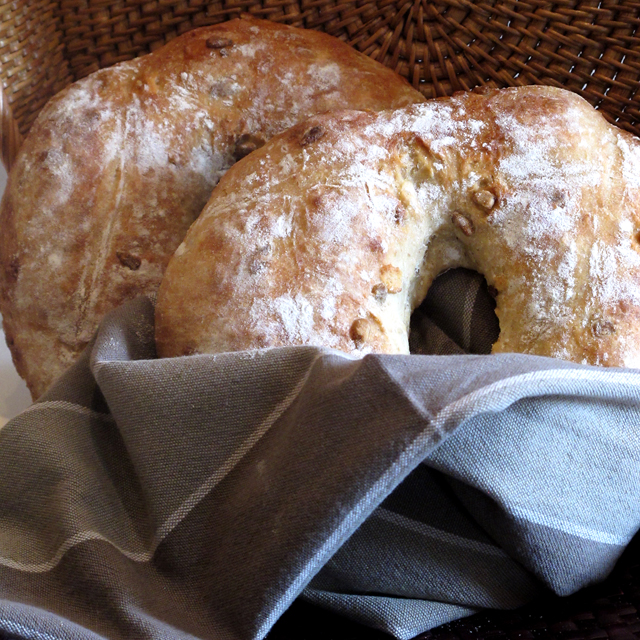
#33. Poilâne-Style Miche

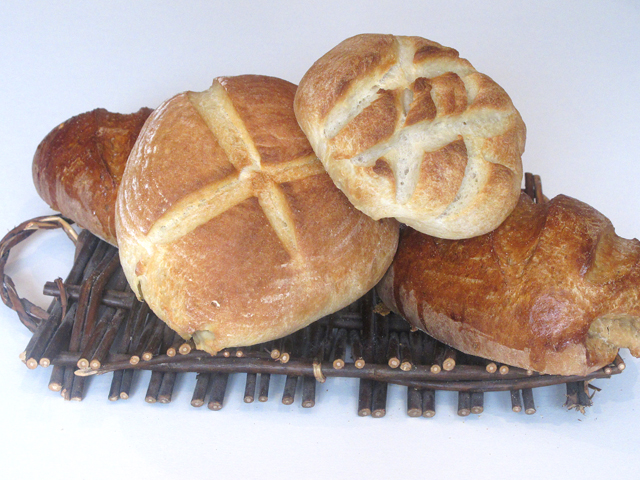
This week in the Bread Baker’s Apprentice Challenge we tackle Poilâine-Style Miche.  When it comes to artisan bread, the name Poilâine is synonomous with excellence.  Bread freaks from all over the world travel to Paris to purchase bread from the Poilâne family.  Pierre Poilâne started a baking business in 1932 in Paris, creating bread using stone-ground flour, natural fermentation and a wood-fired oven. His son, Lionel took over the bakery in 1970, continuing the traditional methods.  Sadly, Lionel died in a plane crash in 2001.  His daughter, Apollonia now runs the business.  Lionel’s brother, Max, branched out on his own and opened his own bakery.  As in all families, there are squabbles about whose bread reigns supreme. 

Poilâine’s most famous bread is a 2 kilogram (about 4.4 pounds) round country sourdough loaf, called Pain Poilâine.  Lionel simply called it a miche.  The bread is made from a sourdough starter, grey stone-ground flour (whole wheat flour with about 10-20% of the bran removed) , water and sea salt from Guérande.  There are about 20 trained bread artisans baking at the family factory in Bievres, outside of Paris.  Although the dough is now machine kneaded, all other aspects of creating the bread are done by hand in the time honored method established by Pierre Poilâne. 

Peter Reinhart gives a wonderful detailed description, in his book, on how the bread is created.  It is indeed a labour of love.  The amazing thing about this bread is that is keeps for about a week, at room temperature.  It is a dense and chewy bread and as Peter Reinhart says, “the flavours change in the mouth with each chew.”  The Poilâne family says that the flavour peaks on day 3. 

If you can’t get to Paris, they will ship you a loaf.  I went to their web site , created an account for myself and put 1 loaf into my shopping basket.  For 37.10 Euros ($52.30 Canadian Dollars) they will send me my very own loaf!  I have not yet clicked on confirm order but I am thinking about it.    If I do go through with it then I really will classify for “Bread Freak ” status.  I’ll keep you posted.

So, onto my attempt at creating this magical miche.  Day 1 we make the firm starter, mixing up some whole wheat flour, some of our sourdough starter and water.  This gets refrigerated overnight.

On Day 2, the final dough is made.  In order to replicate the “grey flour” used at Poilane, Peter Reinhart suggests we put our whole wheat flour through a sieve to extract some of the bran. 
 

I was very excited to finally open up the jar of Grey Sea salt that has been sitting in my cupboard for over a year now.  I’m not quite sure why I hadn’t used it yet, but here was the perfect opportunity.

 The starter is mixed up with the sifted whole wheat flour, grey sea salt and more water.  This is a big mass of dough, way too big for the Kitchenaid, so hand kneading was necessary.  Here is the dough just after I began mixing.

After about 15 minutes of hand kneading, I had a beautiful supple silky dough.

Once the dough is kneaded, it gets placed in an oiled bowl, covered with plastic wrap and ferments at room temperature until it doubles in volume, about 4 hours.  At this point it is formed into a boule and placed into a linen towel lined bowl.  So that the dough will not stick, the towel is sprayed with a bit of oil and then dusted with flour.  The boule should be placed seam side up, then covered with the towel and refrigerated overnight. 

As you can see from the photo below, I screwed up and placed the dough into the bowl, seam side down, so that the smooth side was on top.  You might say, big deal, so what?  The big deal is that the bottom of the dough (where the seam is) becomes the top of the loaf and then your seam turns into some unsightly cracks.


The next morning the dough is removed from the fridge and allowed to sit at room temperature for about 4 hours.  Then the dough is gently turned out onto a baking peel, lined with cornmeal and is scored.  At the Poilaine bakery they score it with the letter P in a gorgeous font.  I wanted to score mine with S&S (for Salt and Serenity) but my fine motor skills are sorely lacking for artistry of that caliber!  I decided to go with a square design with an X in the center.  Unfortunately, I also had the cracks from the seam of the boule to contend with so it looks a bit strange artistic.  But that’s the wonderful thing about Artisan bread – each loaf is hand made and no two are identical. 

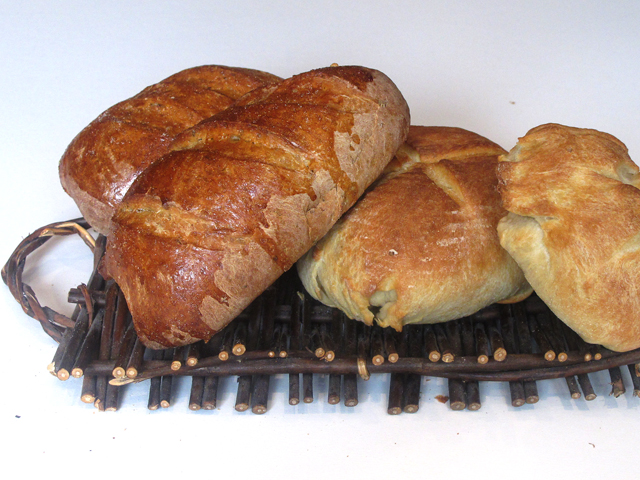
The bread goes onto a baking stone in a hot oven and is baked for about 45 minutes.  Here is is my loaf on and below it the Poilâne loaf.  I can’t tell the difference, can you? (Can you say denial?)

I sliced into the bread after about 2 hours.  I thought the taste was good but a little “whole wheaty”.  I closed my eyes to see if the taste changed with every chew, as Peter Reinhart promised, but I don’t think my palate is that highly developed.   I did notice that I liked the bread a little better on day 2.  It seemed a bit more mellow, and not as earthy.  It lasted very well in a paper bag for almost 5 days and then we sliced what was left and froze it for toast.

I will try this one again, next time using a recipe for Whole Grain Sourdough  passed on to me by Sally of Bewitching Kitchen.  It uses whole wheat flour only in the starter and a mixture of white bread flour, rye flour and spelt in the remainder of the dough.  Sally promises that it is more like the real Poilâne.

32. 100% Sourdough Rye

I KNOW THAT WHEN YOU ARE SHOUTING ONLINE YOU TYPE ALL IN CAPITAL LETTERS.   How do you whisper online?  I need to know because what I’m about to say should be whispered.  “I loved this bread!”  I am whispering it because I am afraid I may be drummed out of the Bread Baker’s Apprentice Challenge.

Most of my bread freak friends who have already made this bread absolutely hated it.  Many of them threw it out.  Some turned it into croutons and others into breadcrumbs. Someone (I won’t mention any names) called it play-doh with caraway seeds.  The main complaint was that it was way too dense and chewy.  This is precisely why I loved it.  This was no spineless bread.  It had guts and personality and wonderful flavour.

The last rye bread we made (New York Deli Rye) was about 1/3 rye flour and 2/3 white bread flour so it had a mild rye flavour.  This bread was 100% rye flour.  The thing you need to know about rye flour is that it contains pentosan, a gum protein that causes the dough to become gummy if mixed for too long.  Extra care has to be taken with kneading this bread.  Rye flour has a very low gluten content so we are warned that a 100% rye bread will not have the same soft and high crumb that a bread made with wheat flour will have.

The bread begins with mixing about 1/2 a cup of Phyl (my starter) with rye flour and water.  It is just mixed until all the flour is hydrated.  No need for it to be smooth.  Then this is left on the counter until it doubles in size and this put in the fridge for an overnight rest.

You also prepare a “soaker”.  This is a mixture of pumpernickel grind flour and water.  it is covered and left out on the counter all night.

 The next day the soaker, the starter, white rye flour, salt, caraway seeds and water are mixed for about 6 minutes to form the dough.  Then the dough is put into an oiled glass container, covered and left to rise for almost 4 hours, until it doubles in size.  Usually this step takes about 1-2 hours.  The longer rising time is due to the lower gluten content in rye flour.

After the dough has doubled, it is gently divided into 2 pieces and then formed into batards (oval shapes).  Since it was quite late by this point, I covered the loaves and refrigerated them overnight.  The next morning  I took them out of the fridge and let them sit on the counter for about 4 hours, covered with plastic wrap.  You can see that they expanded widthwise, but not very much in height.

 Then they were scored and baked in a very hot oven.

Indeed the crumb on this bread is not very open, quite dense.  And true, the bread did not rise very much, so my loaves were quite flat.  But I loved the true rye flavour of this bread and the chewy texture.

The bread was great with Le Blackburn cheese, grapes and a glass of Syrah wine.  I had it again this morning toasted for breakfast and loved it even more.

31. New York Deli Rye

New York Deli Rye“.  Those very words conjure up some pretty powerful images.  For Peter Reinhart, author of  The Bread Baker’s Apprentice, those words bring back the childhood memory of having to make that agonizing decision on visits to Hymie’s Deli; would it be a roast beef, schmaltz  and onion sandwich or a corned beef,  coleslaw and russian dressing sandwich?  But always on onion rye!  Oh, such decisions. 

For me, the memory does not involve rye bread at all.  I know, sacrilege to deli lovers everywhere and I apologize.  My starch of choice was potato chips.  I’d wrap the  pastrami slices around a great big potato chip.  The folded chips were the best.  (We called those wish chips)  Okay, all you cardiologists out there please don’t comment on this post warning me about impending heart disease.  I do not indulge in this on a regular basis any more, but every once in a while…


Bread # 31 in the Bread Baker’s Apprentice Challenge is New York Deli Rye.  The version in the book adds sauteed onions to the dough.  This seemed kind of strange to me.  (I know. … This coming from a woman who wraps her deli meat around potato chips).  I guess it just seems odd because I love rye bread best for breakfast, toasted with salted butter and American Spoon sour cherry preserves.  I ate this for breakfast every day for 2 entire years.  I tend to do that.  These days it’s Oat Squares cereal, with a handful of Fibre First on top and a sliced banana.  I’m just a wild and crazy girl!  All this to say, I decided to leave out the sauteed onions.

This bread is a two day affair.  I was thrilled because I got to use my sourdough starter “Phyl” again in this recipe.  I mixed 1 cup of Phyl with white rye flour and water and it sit on the counter for about 3 hours until bubbly.  Then into the fridge it went for an overnight rest.  The next day the starter is mixed with the rest of the ingredients (bread flour, rye flour, brown sugar, salt, yeast, caraway seeds, buttermilk and vegetable oil). 

Rye flour has a very low gluten content (6-8%) as compared to regular bread flour (12%).  What this means is that you have to be careful and not knead this bread for too long or else the dough becomes very gummy.  I kneaded it by hand for about 6 minutes.  A regular wheat dough recipe normally requires 12 minutes of kneading.  I ended up with a beautiful supple dough.

After the dough rests and doubles in size, it’s time to form the loaves.  This bread could be formed into sandwich loaves and baked in a loaf pan but to me, rye bread should be an oval free form loaf.  So I shaped mine into batards (torpedo shape) so I would have a nice oval rye loaves.  Here’s a video of me forming the dough into batards.  Since no one was home at the time, I managed to figure out how to mount the camera onto a tripod as shaping batards takes 2 hands.  Another new skill mastered!

After about 90 minutes they have grown to about 1 1/2 times their original size and it’s time to slash.  Like this:

And like this: (I think I’m finally getting the hang of this!)

I brushed the loaves with beaten egg white to ensure a shiny finish.  I was not disappointed.  These were some gorgeous burnished loaves.

Slicing into the loaves revealed a fairly tight crumb with just enough holes to make me happy.

 This rye bread made excellent pastrami and dill pickle sandwiches and I threw in a few potato chips for old times sake.


Check out what some of my fellow Bread Freak friends thought of this bread:

Oggi of “I can do that” loved the flavour and chew of this bread.

Sally of “Bewitching Kitchen” was surprised at how much she liked this one.

Mags of “The Other Side of 50” made adorable bread bowls.

Paul of “Yumarama” changed things up a bit and used some dark rye flour.

Katya of “Bread Babes” baked her rye in a clay baker.

#30. Basic Sourdough Bread – My Bread Bat Mitzvah

There is a right of passage in the Jewish religion known as a Bar or Bat Mitzvah.  When a young boy turns 13 he has a Bar Mitzvah and we say “Today you are a man.” For girls the age is 12 and it is called a Bat Mitzvah (we mature faster!).  I feel that making sourdough bread for the first time is a right of passage for a baker.  This was my virgin sourdough.  Although I have created 29 other breads in this challenge, not until I reached the Basic Sourdough did I feel that I had the right to declare myself a bread baker.  However, with my first sourdough under my belt, I am proud to shout, “Today I am a bread baker!”

If your bread knowledge is limited you may be wondering what all the fuss is about?    What exactly is sourdough bread is and what makes it so special?   As Peter Reinhart says, “What we call sourdough bread should more correctly be called wild-yeast breads as it is natural wild yeast that leavens the loaf and not all wild yeast breads taste sour.  By wild yeast we are referring not to commercial yeast that you buy in the supermarket, but a homemade starter, which begins with flour and water.  As this mixture sits at room temperature it picks up natural yeast spores from the air and the mixture begins to ferment and a wild yeast starter is formed.  A portion of this starter is used in the making of sourdough bread and this starter dough acts as the leavener in the dough so you do not have to use any commercial yeast. 

This is a very rudimentary explanation of what sourdough is.  If you are the type that needs a deeper scientific explanation (and you know who you are) check out this web page on the Bread Baker’s Forum.  This wild yeast starter takes about 6 days to make and then you can tuck it in the fridge and basically ignore it, except for a weekly feeding where you add more flour and water to it to refresh it.  When you’re ready to make sourdough bread, just scoop out some starter and go.  Starters can live and thrive for years.  In fact they get better with age (just like women!).  Many people even name their starters. 

 I have named mine Phyl, in honour of a fellow BBA baker.   With his guidance and detailed instructions, I made my own starter.  He has idiot proof instructions on his web site.  I followed the steps, day by day.  When I arrived at day 4, Phyl said to wait until the starter doubles in volume before proceeding.  He said it may take quite a while.  By the next day mine still had not doubled.  I was convinced it was no good and e-mailed Phyl for advice, asking him if I should chuck it out and start again.  He advised me to goose it with a tablespoon of rye flour and see what happens.  Sure enough it doubled within two hours.  Here is a picture of “Phyl”.  He is 4 months old now.

Be sure to use a large enough container to allow the starter to grow and thrive.  If you don’t you will end up with starter all over the inside walls of your fridge when it outgrows it’s home.

 To make the sourdough bread 2/3 of a cup of the starter are mixed with bread flour and water.  This is then left on the counter for several hours until it doubles.


Once it has doubled it, into the fridge it goes overnight to allow further good flavours to develop.  The next day,  this stage 2 starter is mixed with more flour (I used 1/3 whole wheat flour and 2/3 high gluten bread flour), salt and water.  You will notice that commercial yeast has not been added at any point.  Phyl (my wild yeast starter) is going to do all the heavy leavening.  This is a very sticky dough.

Since today is the day I have declared myself a bread baker, I decided to be even more authentic and knead by hand.  I figured out how to add video to my blog, so here is a short video of me kneading by hand.  Please ignore the  music in the background.  It is my son’s “Jazz and Jam” toy and it is the most annoying toy in the world.

Inspired by a sourdough bread I recently ate on my trip to Jerusalem, I added dried blueberries and toasted pecans to my bread.  Additions are best kneaded in during the last 2 minutes of kneading so that they do not get too crushed.


The dough is set aside to rise for about 2 hours until doubled.  Then it is divided in half and shaped into boules (balls) or batards (ovals).  The boules are placed into bannetons (special baskets) or a stainless steel bowl. lined with an oiled and well floured cloth, for their final proofing.  The batards are placed on a stiff cotton or canvas cloth with the sides built up around the dough so that the oval shape holds and does not flatten.  I made one boule and one batard.  After about 3 more hours the loaves had finished their final rise and were ready for the oven.

The loaves are baked on a baking stone in a hot (500 degree F) oven for about 20 minutes.

I had to slice into the bread before the recommended 45 minute cooling waiting period was up because someone was impatient.

The sliced bread was quite beautiful studded with pecans and blueberries.


The bread was even better the next day with butter for breakfast .

#29. Pugliese bread


 Fancy durham flour!!?? Are you kidding me?  As I read through the ingredient list for this 29th bread of the Bread Baker’s Apprentice Challenge, I was stunned to discover that we needed yet another variety of flour to produce the Pugliese Bread.  My freezer already looks like an ad for King Arthur Flour.

In my pantry and freezer I currently have all-purpose flour, bread flour, high gluten bread flour, semolina flour, clear flour, white rye flour, pumpernickel flour, whole wheat flour and pastry flour.  But with a name like “Fancy “, how could I resist?  Of course I caved and bought a bag. 

Pugilese bread hails from the Apulia region of Italy.  It is similar to Ciabatta bread except that it is usually shaped in a round rather than the slipper shape of the ciabatta.  The other distinction is that authentic Pugilese bread uses  golden durham flour, which is finely milled and then packaged as Fancy durham flour.  And of course, I want my Pugilese breead to be authentic.

The making of this breads begins on day one with the preparation of a starter dough known as a biga.  The biga contains flour, yeast and water.  It rests on the counter for several hours and then is put in the fridge overnight to help boost flavour.  The next morning the biga is removed from the fridge and allowed to come to room temperature.  Then the final dough is made.  This is quite a wet dough. 

 I used the Kitchen Aid and mixed for about 6 minutes until the dough was smooth.  The dough cleared the sides of the bowl, but still stuck to the bottom.  This is exactly what you want.


Then the dough is transferred to a heavily floured counter and is stretched and folded 3 times with a 30 minute rest between each session of stretch and fold.  


 Then the dough is placed in a bowl and covered with plastic wrap and covered for 2 hours.  Next, divide the dough in half and form 2 boules.

 Then the dough is set aside for it’s final rise in proofing bowls.  I was quite excited to try out my proofing basket.  I found it in my cupboard a few years ago and had no idea what it was for until I started this challenge.  I only have one of these so I used a small stainless steel bowl as well.

 Each bowl is lined with a clean cotton or linen towel which has been slightly sprayed with pam and dusted with flour.  The boules of dough go in seam side up and are covered with the towel for their final rise.

After about 90 minutes, the boules are placed on a baking peel, scored with a sharp knife and transfered to a baking stone in a very hot (500) oven.

After about 20 minutes the loaves are done.  Scoring skills still need work.

The bread was delicious dipped into olive oil and balsamic vinegar. 

The crumb was a bit tighter than I had imagined it would be, given the high hydration of this dough.

Pugilese bread is perfect for tuna melts the next day!

#28. Potato Rosemary Bread (for Mark)


Forgive me, Cousin Mark, for I have lapsed.  It’s been 24 days since my last post!  I came home from our winter holiday with a renewed sense of vim and vigour, determined to get back to the Bread Baker’s Apprentice Challenge and my once a week baking and blogging schedule. I baked the Potato Rosemary Bread within 3 days of getting home never quite got around to blogging about it.   Life just got in the way.  My daughter was home from school visiting for a week and I began January, spending lots of time doing things for and with her.  Then I went to New York City with friends to celebrate our respective wedding anniversaries.  When I got home from that trip, the last thing I wanted to do was bake, blog or eat bread!  Then it was onto another trip, this time to Israel to visit my daughter, who is studying here for a year, and watch my husband participate in an ice hockey tournament.  Yes, ice hockey in Israel!!  But that’s a story for another time.

I’m writing this post from my hotel room in Jerusalem.  My cousin Mark has shamed me into it.  Thanks Mark!  It’s just the push I needed.

As I read through the ingredient list in Peter Reinhart’s recipe I noticed a few unusual ingredients.  Roasted garlic and mashed potatoes?

Let’s just say, as Renee Zellweger says to Tom Cruise, in Jerry Maguire, “You had me at hello.”,   Peter Reinhart, you had me at mashed potatoes!  Mashed potatoes are my go to comfort food.  When I was pregnant with my first child, it was all I craved.  I was working in a gourmet take-out food shop, and our chef, Karen Barnaby, would make staff lunch every day.   Usually it was some version of Pad Thai.  But for me, she made mashed potatoes with butter, cream and cheddar cheese.  Every day!  No wonder I gained 40 pounds with that pregnancy.  You might think that I would never want to look at mashed potatoes again after eating it every day for lunch for 6 months, but the exact opposite is true.  I still love mashed potatoes.  The recipe called for 1 cup of mashed potatoes.  It was unclear as to whether it should just be plain potatoes, mashed up or actual leftover mashed potatoes, made with salt and butter and cream.  I opted for the latter and made a big batch, saving a cup for the recipe.  The starch in the potatoes adds a tenderness to the bread .  It was a happy day in my house as I inhaled the aroma of an entire head of roasted garlic while eating a big bowl of mashed potatoes. 

The dough begins with a biga (a starter dough, prepared the day before).  The biga is incorporated with flour, salt, pepper, yeast, mashed potatoes, olive oil, rosemary and water to prepare the dough.  Then the dough is flattened out into a rectangle and the roasted garlic is spread on in an even layer.

The dough is then gathered up into a ball and kneaded by hand for an additional minute until the roasted garlic is evenly distributed.  It smells like heaven!  Then the dough is placed in a large container to double in size.  It takes about 2 hours.


Then the dough is divided in half, and formed into round loaves, called “boules”.  It is given a second rise, about 2 more hours, and then a sprig of rosemary is “glued” to the top with water as decoration.

 The loaves go into a hot oven for about 35 minutes.  These were gorgeous loaves, all burnished brown with a very heady aroma of garlic and rosemary. 

Of course we had to wait an hour before slicing into them.  I decided to invite some friends over for drinks and bread.  I prepared a pitcher of lemonade mojitos.  I put out some roasted almonds, dried cherries, dried apricots and a few different cheeses.  The girls came over and we ripped into the bread and mojitos.  Although I have no photos of the sliced bread, I can assure you that it was a tender crumb and the flavour of this bread was intense.  After 2 mojitos, my hand was not really steady enough to hold the camera.  We’ll leave it at that.

#27. No need to dread Portugese Sweet Bread!

Okay, so I’m a little embarrassed to admit that I have been obsessing about this bread for over 3 weeks now.  I baked my last BBA bread (poolish baguette) on December 14 and turned the page to see what was up next.  After I read through the ingredient list I was pretty sure this was not the bread for me.  I have this thing about using lemon and orange extract.  When I open that little bottle I am almost knocked out by the aroma.  To me it smells like furniture polish.

Plus, it was another white sweet bread.  We have already baked so many variations of these.  I was craving something with whole grains and a hefty chew.  However, the rules of our challenge are that we have to bake every bread in the Bread Baker’s Apprentice book,  so I was determined to follow through.  (I know, it’s not like the Bread Police would come and arrest me if I skipped one or went out of order, but I am a stickler for rules!)  I just couldn’t seem to muster up the excitement for this bread.  So I just thought about it every day for 23 days.  I’d wake up in the morning vowing this would be the day I’d tackle it and then go to sleep that night promising myself I’d do it tomorrow.  (Clearly I need to get a life, but that’s a subject for a whole other post!)   I’m not normally a procrastinator, so I’m not quite sure what my problem was and why this weighed so heavily on my mind.  Finally, yesterday morning I decided to get my act in gear and bake this bread.

The process begins with mixing up a sponge of  bread flour, sugar, water and yeast.

This is left on the counter until bubbly and “seeming on the verge of collapse”.  (I love this phrase!)

Next,  sugar, salt, powdered milk, butter and shortening are creamed together until smooth.  When I went to the cupboard to find my powdered skim milk, a big bag caught my eye.  I had purchased some coconut milk powder, several months ago, for coconut cupcakes.  I  decided to substitute the coconut powder for the regular milk powder.  I think when it comes to coconut there is no middle ground. You either love it or hate it.  It’s sort of like that with cilantro.   I am of the belief  that the addition of coconut will improve almost anything.  There!  Just adding coconut milk powder was making me feel better about Portugese Sweet Bread already!

I just couldn’t bring myself to use the extract, so I decided to add orange and lemon zest, instead.


 The smell of fresh lemon and orange zest makes me very happy.  I was feeling really good about this bread now.  My mood turned positively euphoric when I remembered that I had just bought a giant (32 ounce) bottle of vanilla bean paste.  I was excited to crack it open and use it.

I mixed the dough in the machine.  Total mixing time was over 20 minutes.  I still could not get it to register 77º.  I gave up at 22 minutes and 75º.  Close enough!!

Look at those gorgeous vanilla bean flecks and bits of orange and lemon zest.

Next the dough is set aside to double in size.  Then it’s divided into 2 pieces and each if formed into a boule and placed into a greased pie plate for the final rise.  We are instructed to let the dough fully fill the pan.  Mine took almost 4 hours, but it finally almost filled the pan.


It’s given an egg wash and baked for about 40 minutes and it comes out all golden brown.  We waited about 45 minutes and then cut into it.

So after all that agonizing I am happy to report that I did not hate this bread. I can’t say it was my favourite either, but there is definately a time and place for this bread with it’s heady citrus aroma and pillowy softness.  (In case you’re curious,  the coconut milk powder imparted a very faint hint of coconut.)   The second loaf was sliced and put into the freezer to be used for french toast.

P.S.  I’ve had several people ask me how they can be noitified by e-mail every time I post a new entry.  If you go to my home page (www.saltandserenity.com), just above the little monthly calendar is a small line that says, “Subscribe to SaltandSerenity’s blog by e-mail”.  Just click on that and you can enter your e-mail address and be notified that way.

I’m still baking, just not baking bread!


 It’s been 16 days since my last post and lest you think I’ve been slacking off, my fellow bread freaks, I have been quite busy with some other baking projects. As a way of saying thanks to all those who are important to me in my life, I bake sweets for them around the holidays.  It started when I was in my 20’s when my girlfriend Marla and I would become Chocolatiers, turning my kitchen into an artisan chocolate shop, making about 6 different varieties of truffles (including Grand Marnier, Mint, Peanut Butter, Espresso, Milk Chocolate with Almond and Praline).  At the end of about 4 days we’d have turned out over 2000 handmade truffles, hand dipped and decorated.  We’d be covered in chocolate, weigh 5 pounds more than when we started and be thoroughly disgusted by the sight and smell of all that chocolate. We swore we would not do it again next year.  But of course we did!

 Then in 1993 I moved to Ottawa so I had to fly solo.  Without Marla beside me I didn’t have the heart to do truffles so I turned to cookies.  In those early years the main beneficiaries of those treats were my kid’s teachers and the staff at the pediatrician’s office.  You’d be amazed how effective a big basket of cookies is in getting your sick child in to see the doctor before 10 other screaming, sneezing, coughing kids in the waiting room!  Each year I’d add a few more people to my list and now I have about 45 people I send to each year.

This year I made:

 Gingerbread Snowflake Cookies.  I piped white royal icing and sprinkled them with clear coarse sugar.  I made about 280 of these and by the time I was finished I had carpal tunnel syndrome in my piping hand.  My children thought it was quite funny that I injured myself baking!

I also made Lemon Coconut Cookies, Macadamia Butterscotch Chip Skor Bar Cookies and  Oatmeal Lace Cookies (sandwiched with chocolate ganache).

I made White Chocolate Dipped Peppermint Cookies.  I loved making these.  Here’s my chocolate dipping fork that I bought many years ago when I was heavily into truffle making.  It holds the flat cookies perfectly.

The crushed candy canes are sprinkled on before the chocolate has set.  I tempered the white chocolate.  I found a great site with step-by-step tempering directions.

A heating pad, set on low, keeps the chocolate at the perfect temperature after tempering.  Don’t forget to cover the heating pad in foil to avoid chocolate stains!

Here are the finished cookies. 

 I also made Double Chocolate Peanut Butter Bark.  I have been making this for about 10 years now and am kind of sick of it but I can’t delete it from the roster as the receptionist at my doctor’s office, my yoga teacher and my hairdresser tell me that they wait for it all year.  So it’s become a staple.  It keeps well in the fridge for several weeks.

The last treat I made was Chocolate Caramel Truffles with Fleur de Sel.


 While cookie baking is my passion, the real creative fun begins when I gather all my packaging material and design the labels.  I use a great graphics program called Print Shop and print out all the labels on glossy labels from www.onlinelabels.com.   Most of my ribbons and bags and boxes I get from www.pritchardpackaging.com, a wholesale outlet here in Ottawa where I live.

 I decided on a pink, black and white theme this year.

Here are the gift boxes all packaged up and ready to go:


 Next week I’m back to the Bread Baker’s Apprentice Challenge, I promise!

# 26. Poolish Baguette Interruptus


Last week my sister Bo asked me how the bread baking was going and what loaf I was working on.  I told her that this week’s bread was “Poolish baguette.”  She responded that “poolish” sounded like what might result from eating such a baguette.  That got me to thinking.  I am so deeply immersed in this bread project that I am bandying about all this new baking terminology. So , for my sister Bo , and all others reading the blog, and not familiar with “Poolish”, a little clarification.

Poolish is a mixture made of equal weights of flour and water with a small amount of yeast.  In other words, it’s a wet messy goo.  This mixture is made and refrigerated, usually overnight, and then incorporated into the final bread dough the following day.  Poolish is one of several “Pre-ferments”, bakers use.  (Other pre-ferments include biga, pâte fermentée and sponge)  A pre-ferment extends the fermentation time which allows for more time for flavour to be developed in the final loaf.

Polish bakers, are credited with inventing this preferment in Poland at the end of the 19th century.  The process then was adapted in Austria and later in France.  The French coined the term “Poolish” to honour the Polish bakers who created this technique for improving bread.

I made my poolish on Friday and planned to make the final baguette dough on Saturday.  Saturday morning I took the poolish out of the fridge and let it come to room temperature. For this baguette, I decided not to knead the bread but use a technique I have been reading a lot about lately, called “Stretch and Fold”. 

In my research I came across a very interesting post by Martha and Tom, where they do an experiment and bake 3 loaves side by side for comparison.  The first uses the no-knead method, the second, traditional kneading  and the third is the stretch and fold technique.  They concluded that while all the breads tasted quite similar, the stretch and fold had the best open crumb and lofty structure.  Stretch and fold rose the highest and had the most evenly distributed open holes of the three loaves.  They concluded that stretch and fold is best for “rustic” types of breads.

I mixed my dough up briefly in the stand mixer, just until everything came together.  Then I dumped it out onto the back of an oiled baking sheet.  As you can see, the initial dough is quite shaggy.


I found a wonderful video on You Tube, with Peter Reinhart demonstrating the stretch and fold method, and I followed his technique and instructions.

Stretch and fold is exactly what it sounds like.  You pull the dough to stretch it and then fold it back on itself.  This is done 4 times, with 10 minute rests between each stretch and fold session.  Wetting your hands with cold water really helps the dough not stick to them.  Here is photo of me stretching the dough.

I had to set my camera on timer as I was home alone.  That in itself was a neat trick for me as I had not used the timer function in quite a while and forgot how to do it.  I had to get my reading glasses and manual out and it was quite a production but now I know how, so look for more timer photos in future posts.  It’s opened up a whole world of photographic opportunities for me.

 I took a photo of the dough after the first stretch and fold so you can see how the dough is becoming smoother.

After the fourth stretch and fold I set the dough into an oiled container for the first rise.  The recipe said to allow the dough to ferment at room temperature for about 2 hours.  

Here is where the bread making got interrupted.  I had to drive my son to his afternoon program, do a few errands and pick him up again.  I figured I could just stick the dough in the fridge and take it out and resume when I got home.  From my previous experiences with fermentation, I knew that the cold fridge would slow the dough rising annd I could finish later.  However, something went terribly wrong,  as when I pulled the dough from the fridge 4 hours later, this is what greeted me.

Clearly the dough was hard at work in the fridge while I was away.  It would seem that it had over-proofed.  Note to self;  the interruptus method of bread baking is not fool proof!  I decided to proceed and take my chances with the overproofed dough.  I formed the dough into baguettes and set them in my homemade couche for a final rise.  The couche (an old cotton apron) allows the baguettes to hold their shape and grow without touching each other. 

After about an hour they were ready for the oven.

I carefully transferred the baguettes to a semolina dusted peel and slid them onto a baking stone in a very hot oven.  Unfortunately there are no photos of this process as I could not co-ordinate my sliding motion with the timer function on the camera.  My technical prowess still needs a bit of finessing!  However, the sliding went without incident and my loaves stayed relatively straight.  here they are fresh out of the oven.

I would have liked them a bit darker but they were registering done (205º F) with the instant read thermometer, and I did not want dry bread.  I was quite pleased with the crackly crust.

The true test, for all bread freaks out there is looking inside at the “holes” (the crumb structure).  Bread freaks want holes, dentists do not!

This is the third baguette we have made in the Challenge.  I thought the taste and open crumb structure of the Poolish baguette was quite good, but not nearly as good as the Pain à l’Ancienne baguettes we made in week 21 of our challenge.  Here is a photo of my holes from my Pain à l’Ancienne.  Much more open than the Poolish. 

 If I am going to make baguettes again, it will be the Pain à l’Ancienne recipe for sure.

#25. Holy Pizza!


In week #25 of the Bread Baker’s Apprentice Challenge we make pizza. When I first bought this book, in May, I was flipping through it, looking at the pictures.  My heart skipped a beat when I got to page 208 and saw our bread guru, Peter Reinhart, tossing pizza dough in the air.  I have always wanted to do this and was so excited to learn how. 

I frequently make pizza and my go-to dough recipe comes from a little book titled, “Pizza” by James McNair.  The ingredients are fairly similar to Peter Reinhart’s recipe.  The main difference between the two recipes is that James McNair’s recipe follows the traditional route of dissolving the yeast in warm water, whereas Peter Reinhart has us using ice-cold water.  James’ dough rises for 1 1/2 hours and then you are ready to make pizza.  Peter has us refrigerate the dough overnight.  This supposedly gives the dough better flavour as well as relaxing the gluten in the dough so that it is not too elastic to work with.

After my resounding success  using ice water and an overnight fridge rest with Peter’s Pain a l’Ancienne, I was sold on the concept of “cold” as a method to develop flavour.  Peter describes the process as “delayed fermentation.”  So even though this pizza would take 2 days to make, I was excited to discover a new flavourful dough.  Most people think that pizza is all about the toppings.  In fact, the reverse is true.  If you have a cardboard crust,  even the most wonderful toppings in the world won’t save it.

This pizza dough can be made with either unbleached all-purpose flour or unbleached bread flour. The bread flour has a higher gluten content, thus making the dough a little tougher and more elastic.  Peter recommends adding a bit of olive oil if you opt for the higher gluten bread flour.  He says it helps to tenderize the dough.  Never one to pass up the opportunity to add more fat to my diet, I opted for bread flour with olive oil!

The dough came together very quickly.  The texture is silky and supple.  I refrigerated it overnight and took it out the next day, about 2 hours before we were planning to have dinner. Once the dough came to room temperature I got my camera all set up on the tripod and set it to the timer mode.  I was planing to have a shot of me flipping the dough into the air.  The timer was set to catch the flip in the air at just the right moment.  I was so excited to capture this moment on film.

I dipped both hands in flour to coat them so the dough would not stick.

I got ready to toss.  I placed the  disc of dough over my fists, not my fingertips, as instructed in the book.  It became clear, immediately, that this dough was not going to be airborne.  It was such a soft dough that it slumped over my wrists and continued to make a downward slide over my arms.

I quickly transferred the dough to my pizza peel, which I had coated with semolina flour, to facilitate sliding the pizza off the peel and onto the baking stone which I had heating in a 550 degree oven.

Using my hands, as gently as I could, I managed to spread it out into a very rustic circle.

Then I added the toppings.  I decided to forgo tomato sauce.  I sprinkled it with Monterey Jack, Asiago and Parmesan cheese.

Next came slices of fresh tomato.

Finally I topped it off with chunks of fresh buffalo mozzarella.

I planned to top it off with fresh basil once it came out of the oven.

It slid quite easily into the oven.

I snapped a quick picture after it had been baking for 5 minutes.  Almost ready!

And then it all began to go horribly wrong.  I ran into a problem when I tried to remove the pizza from the oven.  I guess the dough had stretched a bit too thin in some spots, because when I tried to slide my pizza peel under it, to remove it from the oven, it wouldn’t budge.  The cheese had melted through a hole in the crust and was now stuck to the baking stone.  I finally wrestled it from the stone and here is what we ate for dinner.

The crust was light and crispy.  It was delicious.  I may try this one again as I am determined to get my dough airborne.  To be honest, I didn’t notice that much difference between my usual crust and this cold fermented one.  Maybe I should do a side by side comparison to see if it’s really worth the extra fermenting time for this dough.