Savoury Brunch Galette

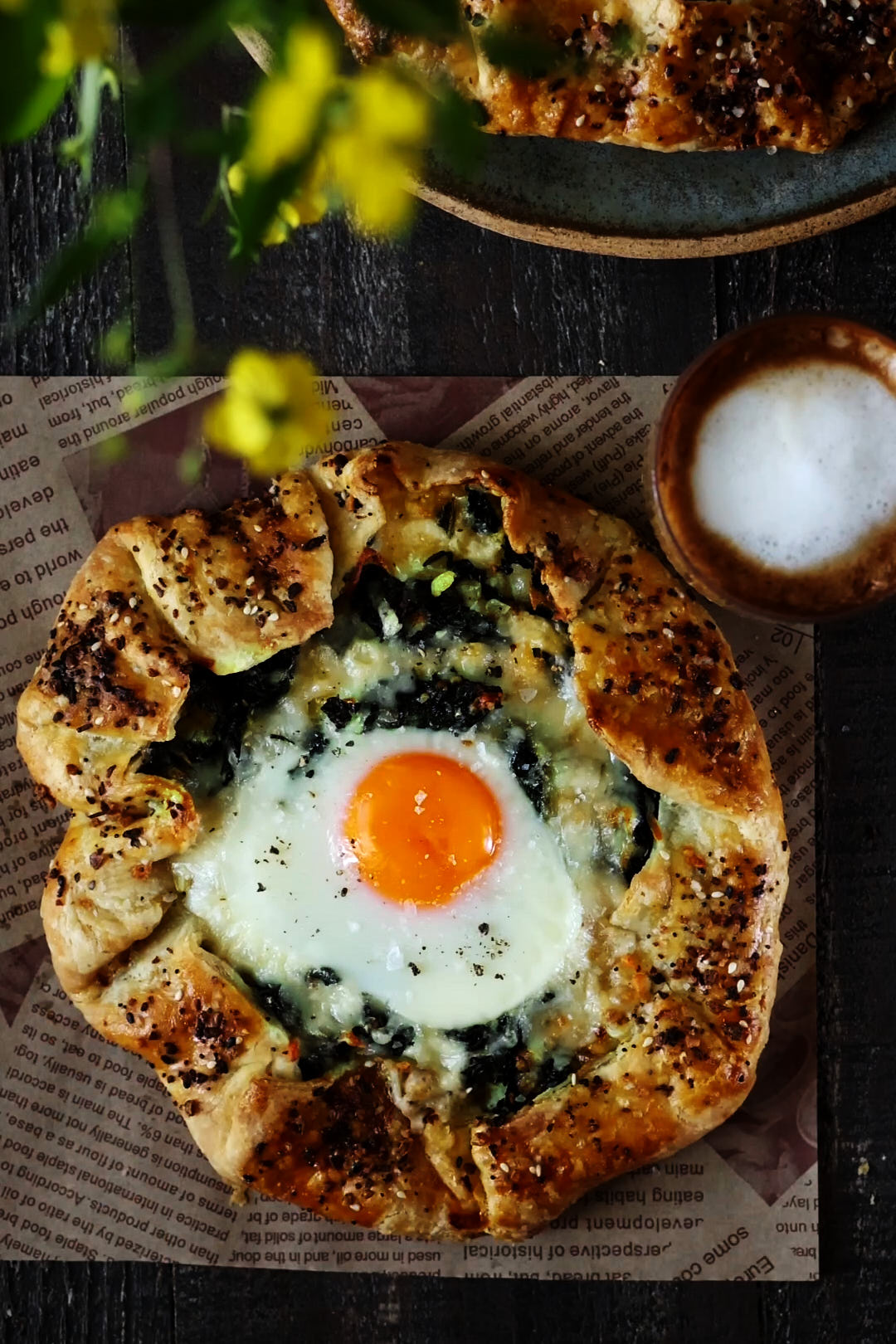
Flaky AF crust. Creamy ricotta. Sweet corn. Wilted kale. A golden yolk on top. This is the ultimate savoury brunch galette.


If pie is the perfectionist’s dessert, galettes are its chill, effortlessly stylish cousin. I like to think of them as lazy-ass pies, but in the very best way. No pie dish. No crimping. Just flaky, golden pastry folded casually over whatever filling you’re in the mood for.

And if there’s only one recipe you try from my blog, make it this galette dough. It delivers maximum results for minimal effort. Made in seconds in the food processor, it’s flaky AF thanks to cold butter, sour cream, and a touch of cornmeal. I can’t overstate how special this dough is, it’s foolproof, flexible, and bakes up like a dream.

Sweet or savoury, galettes are endlessly versatile, and this one leans fully into brunch territory. Sautéed kale and onions meet sweet corn and creamy ricotta, all nestled into that golden crust. A runny yolk on top seals the deal.

Keys to Success:

  • Cold butter + cold water = flaky crust. Chill everything before you start.
  • Roll the dough while it’s still soft—between two sheets of parchment. Then chill the rounds before assembling for easy handling.
  • Par-cook your veg. Raw vegetables release water. Sautéed greens and onions are flavourful and galette-friendly.
  • Use a hot oven. 400°F ensures the bottom crust sets while the edges brown.
  • Add the egg later. Crack it on when the galette is nearly done so the white sets and the yolk stays runny.
  • Don’t skimp on seasoning. Salt the filling. Salt the crust. Add a hit of hot sauce if you like.
Savoury Brunch Galette

Savoury Brunch Galette

Makes four 8-inch galettes
Servings 4 servings
Calories 1479 kcal

Ingredients
  

Galette Dough

  • 80 grams sour cream, full fat or light but not fat free
  • 150 grams ice cold water
  • 360 grams all-purpose flour
  • 70 grams cornmeal
  • 5 grams sugar
  • 1 teaspoon Diamond Crystal Kosher salt, or 1/2 teaspoon Morton's Kosher salt
  • 200 grams unsalted butter, cold cut into 1/2 inch pieces

Galette Filling

  • 1 bunch Lacinato Kale, also called Tuscan kale, black kale, dinosaur kale
  • 1 Tablespoon olive oil
  • 1 small onion, finely diced
  • 1/2 teaspoon Diamond Crystal Kosher salt, or 1/4 teaspoon Morton's Kosher salt
  • 170 grams whole milk ricotta cheese
  • 2 Tablespoons milk (1 % or 2% is fine, whatever you have on hand)
  • 120 grams fontina cheese, grated
  • 175 grams Monterey Jack cheese, grated
  • 1/2 teaspoon Diamond Crystal Kosher salt, or 1/4 teaspoon Morton's Kosher salt
  • 4 large ears of corn, shucked and corn cut off the cob or 3 cups frozen corn, thawed
  • 4 large eggs

Assembly

  • 1 large egg, beaten with 1 Tablespoon water

Garnish

  • 2 Tablespoons Everything Bagel Spice

Instructions
 

Galette Dough

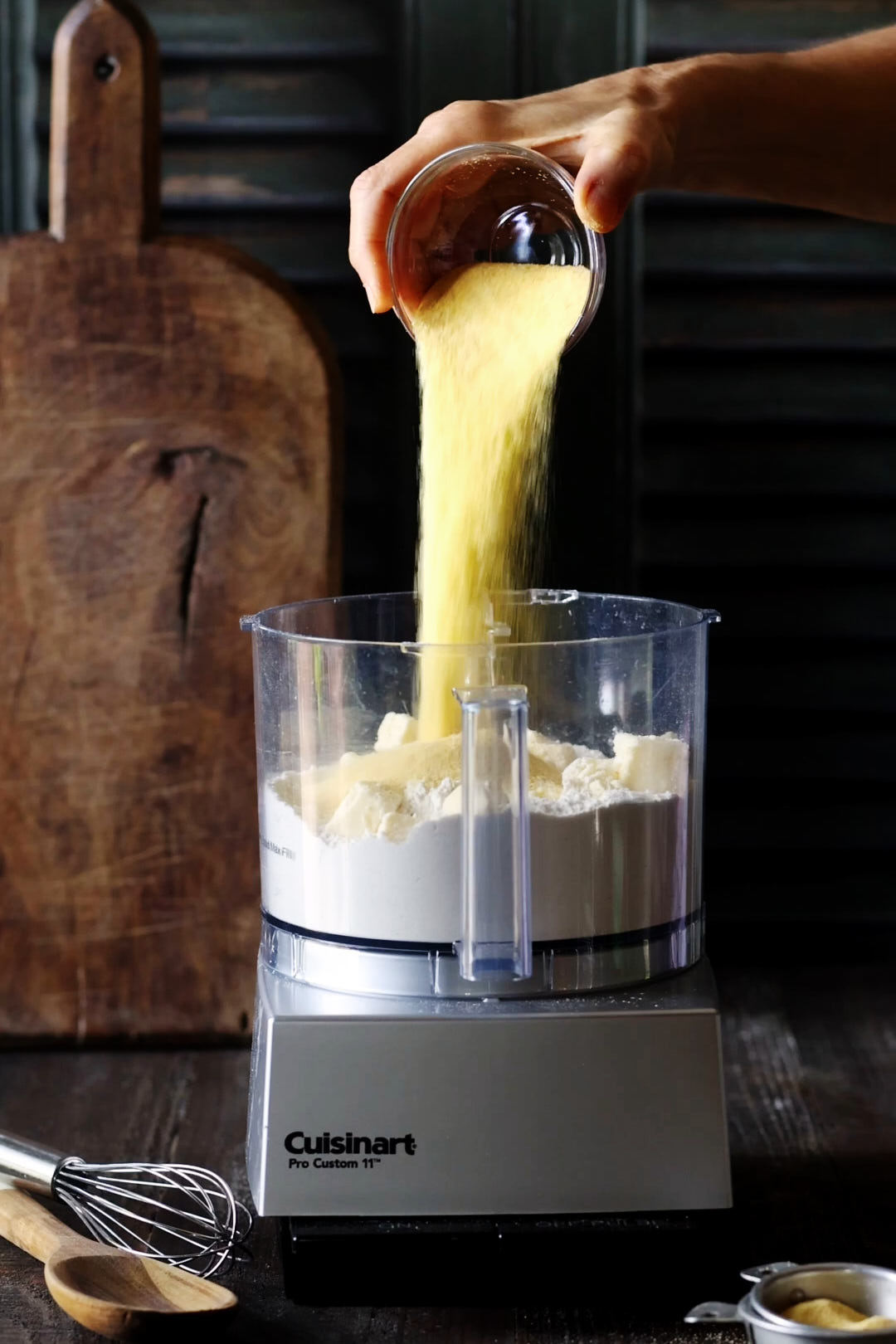
  • Whisk sour cream and ice water together in a small bowl; set aside. In a food processor fitted with the metal blade, combine flour, cornmeal, sugar, and salt. Pulse to mix.
  • Add the cold butter and pulse 8 to 10 times, until the mixture resembles coarse crumbs with butter pieces ranging from breadcrumbs to small peas.
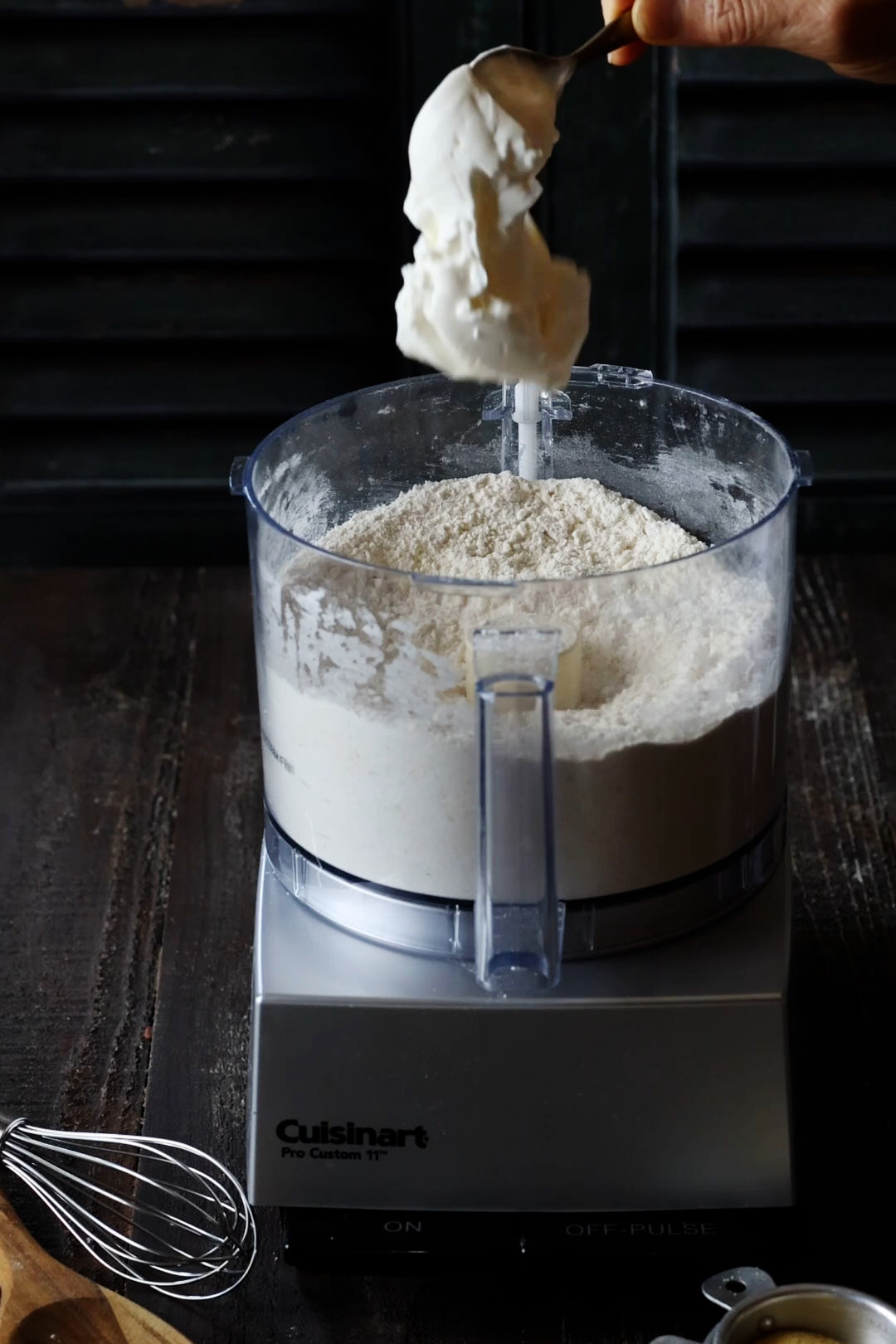
  • With the machine running, slowly pour in the sour cream mixture. Process just until the dough comes together in soft, moist curds. Turn the dough out of the food processor onto the counter. Divide dough in 4 equal pieces and shape each piece into a round disc.
  • Lightly dust one disc with flour, and roll between 2 sheets of parchment paper, into a 10 inch circle. No need for a perfect circle—just aim for a rough 10-inch round. Repeat with the other 3 discs. Chill dough rounds in fridge, still between their sheets of parchment paper, for about 30 minutes.
  • To freeze, wrap each rolled dough round tightly in plastic and store flat for up to 1 month.

Cheese filling

  • Wash the kale leaves and strip them from the stems. (Tip: The tip of a paring knife works great for this.) Discard the stems. Stack the leaves and slice across them into ¼-inch ribbons using a sharp chef’s knife.
  • Heat a large sauté pan over medium heat. Add olive oil and diced onions. Sauté for 4–5 minutes, until onions are soft and translucent. If they begin to brown too quickly, add about ¼ cup water to slow things down.
  • Add the kale and toss for 1–2 minutes, just until wilted. Stir in the corn and remove the pan from the heat. Let the mixture cool slightly.
  • Reserve 1/4 cup each of fontina and Monterey Jack cheeses. In a large mixing bowl, stir together the ricotta, milk, remaining fontina, and Monterey Jack, and salt until well combined.

Assemble galette

  • Arrange two racks in the oven—one in the top-middle position, the other in the bottom-middle. Preheat the oven to 400°F.
  • Remove the chilled dough rounds from the fridge. Peel off the top sheet of parchment from each one. Flip the dough over onto the counter or a baking sheet, then peel off the second sheet. Line two rimmed baking sheets with some of the parchment you just removed. Place two dough rounds on each sheet.
  • Spread each dough round with about 1/4 of the cheese mixture, leaving a 1-inch border around the edges. Top each with 1/4 of the kale–onion–corn mixture.
  • Fold the border of dough up and over the filling, pleating gently as you work your way around each galette.
  • Brush the dough border with egg wash. Sprinkle with Everything Bagel spice (or another topping of your choice).
  • Bake for 15 minutes. Then switch the trays—move the one from the bottom rack to the top, and vice versa. Bake for another 15 minutes.
  • Remove the pans from the oven and sprinkle each galette with the reserved fontina and Monterey Jack. Use a spoon to create a small well in the centre of each galette, then carefully crack an egg into each one. Return the pans to the oven and bake for 5–8 minutes more, until the whites are set but the yolks remain soft.
  • Just before serving, sprinkle each galette with salt, pepper, and a few dashes of hot sauce if desired.

Nutrition

Calories: 1479kcalCarbohydrates: 117gProtein: 53gFat: 91gSaturated Fat: 50gPolyunsaturated Fat: 8gMonounsaturated Fat: 27gTrans Fat: 2gCholesterol: 541mgSodium: 2198mgPotassium: 958mgFiber: 10gSugar: 11gVitamin A: 9713IUVitamin C: 71mgCalcium: 904mgIron: 9mg
Tried this recipe?Let us know how it was!

What makes this galette crust so good?

This dough is flaky, but it’s not just because of the butter (though yes, there’s a lot of that too).

  • Cornmeal adds a delicate but rustic crunch. It gives the crust a bit more structure and texture, so it feels hearty without being heavy.
  • Sour cream brings subtle tang and helps tenderize the dough. It keeps the crust soft enough to bite through, even at the thick, pleated edges.

Together, these ingredients strike that perfect balance: crisp, tender, golden, and just a little bit special. It’s the kind of dough you’ll want to keep in your freezer at all times, for sweet and savoury galettes alike.

More Galette Inspiration

If this is your first foray into galette life, welcome. If it’s not—welcome back.

Here’s a roundup of all the galettes I’ve made over the years—sweet, savoury, and in between:

Israeli Salad with Punchy Lemon Garlic Vinaigrette

This vinaigrette has a secret weapon—and it’s not what you think.

I’m really excited about this salad. Israeli Salad with Punchy Lemon Garlic Vinaigrette is one of those dishes that looks simple—but the flavour kind of sneaks up on you. It’s crisp, juicy, herby, and bright, with a vinaigrette that’s lemony, garlicky, and just… next level. There’s a secret ingredient in there that gives it that savoury “wow” factor. (Spoiler: it’s anchovies. But trust me—even if you think you hate them, you won’t taste them the way you expect.)

I test a lot of salads in my kitchen, and most of the time my husband politely eats them, says “that’s good,” and moves on. But this one? He actually stopped mid-bite, looked at me, and said, “This salad is amazing.” I knew then it was blog-worthy.

Anchovies: The Umami You Didn’t Know You Needed

What gives this vinaigrette its magic isn’t just the lemon or garlic—it’s the anchovies. They dissolve right into the dressing, leaving behind zero fishiness and all the savoury depth you didn’t know you needed. They add that elusive, can’t-put-your-finger-on-it flavour that makes everything else shine. Even if you’ve sworn off anchovies in the past, I really think this dressing will change your mind.

What Makes This Salad So Good

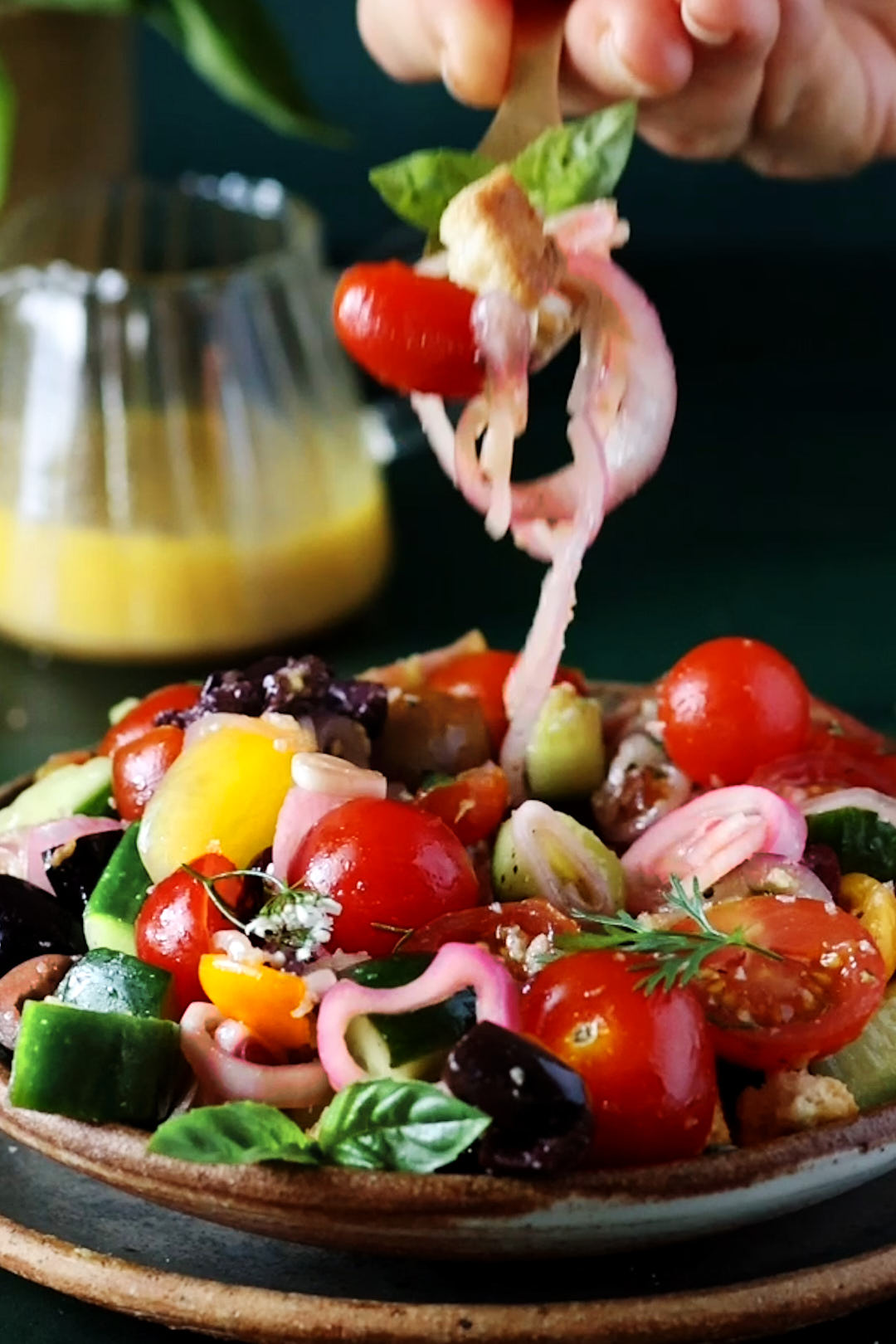
What I love most about this salad—besides the vinaigrette I want to put on literally everything—is how easy it is to make and how versatile it is. At its core, it’s just chopped tomatoes and cucumbers, but here I’ve loosened things up a bit. I use sweet cherry tomatoes, crunchy Persian or Lebanese cucumbers, lots of fresh herbs, and a handful of briny olives. It’s bright and crunchy and just so satisfying. You can serve it with grilled fish or falafel, pile it onto toast with a swipe of whipped feta, or just eat it straight from the bowl like I do. It’s the kind of salad you make once… and then again two days later because you’re still thinking about it.

Keys to Salad Success

  • 1. Trust the anchovies.
    I know. But hear me out—anchovies aren’t the enemy. They melt right into the vinaigrette, leaving behind zero fishiness and all the savoury magic. You won’t even know they’re there… until you realize the dressing tastes like something from your favourite restaurant. That’s the anchovy power.
    2. Use the best tomatoes you can find.
    This salad is raw and fresh, so every ingredient matters—especially the tomatoes. Sweet, ripe cherry tomatoes are perfect. If yours are a little bland (it happens!), a pinch of salt or a sprinkle of freeze-dried tomato powder can really boost their flavour.
    3. Give the shallots a little soak.
    Toss them in a spoonful of the dressing while you prep the rest. It takes the edge off their sharp bite and turns them into something silky and tangy and delicious. Don’t skip this—it’s a tiny step that makes the salad way better.
    4. Don’t be shy with the herbs.
    The fresh dill and basil are more than just a garnish—they bring a ton of brightness and personality. Use a good handful of each. It’s what makes the whole thing feel alive.
    5. Save the croutons for last.
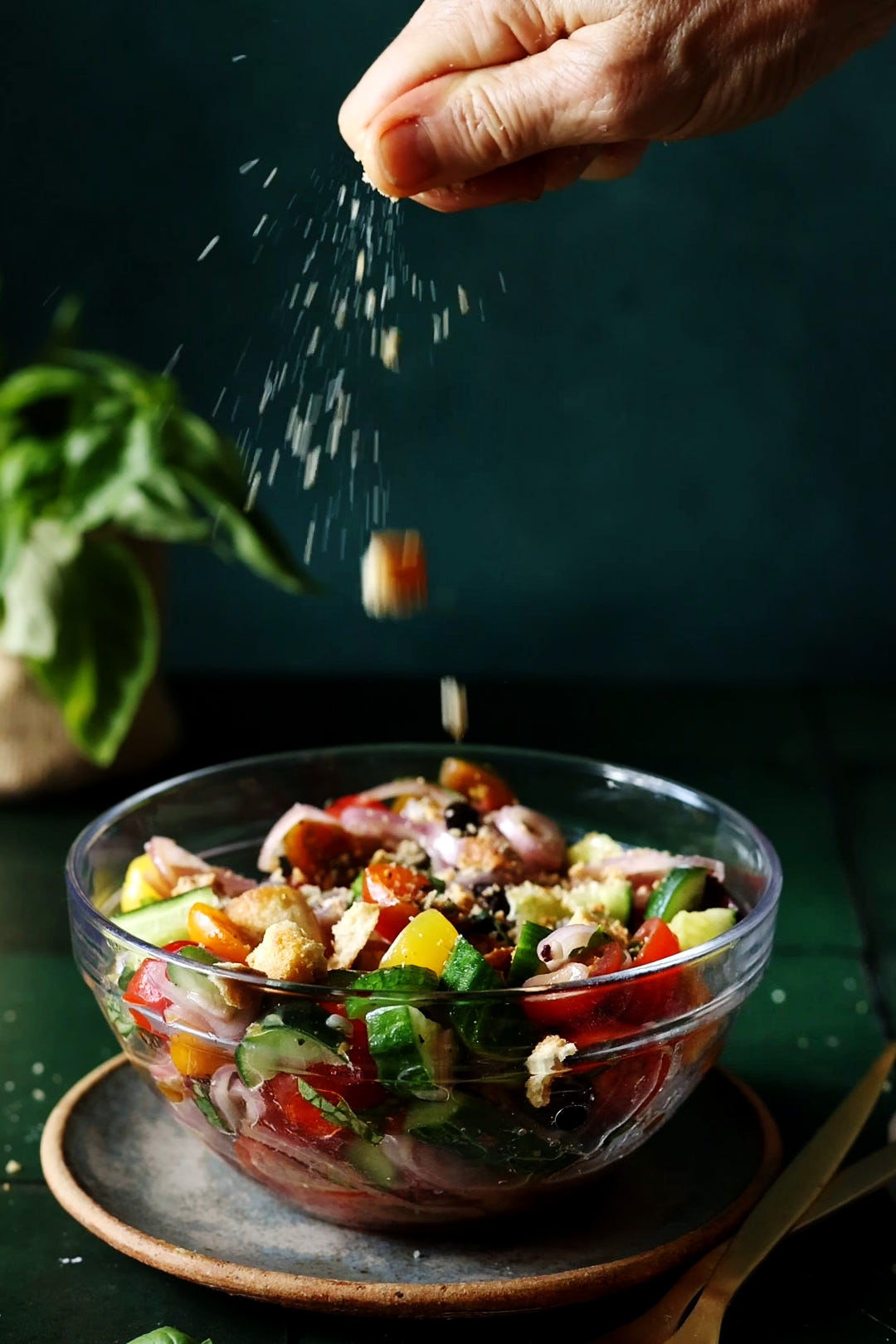
    Wait until you’re ready to serve, then shower the top with crushed croutons. They add the crunch this salad needs. Yes, it’s a healthy salad—but we’re not monsters. Crunch is essential. #teamtexture

Let’s Talk Texture

Between the juicy tomatoes, crisp cucumbers, and crunchy crouton topping, this salad has all the texture I crave. The vinaigrette brings it all together, coating every bite without weighing anything down. It’s the kind of salad you actually want to eat—not because you should, but because it’s just that good.

Israeli Salad with Punchy Lemon Garlic Vinaigrette

Servings 4 servings
Calories 221 kcal

Equipment

  • 1 blender

Ingredients
  

Anchovy Garlic Dressing

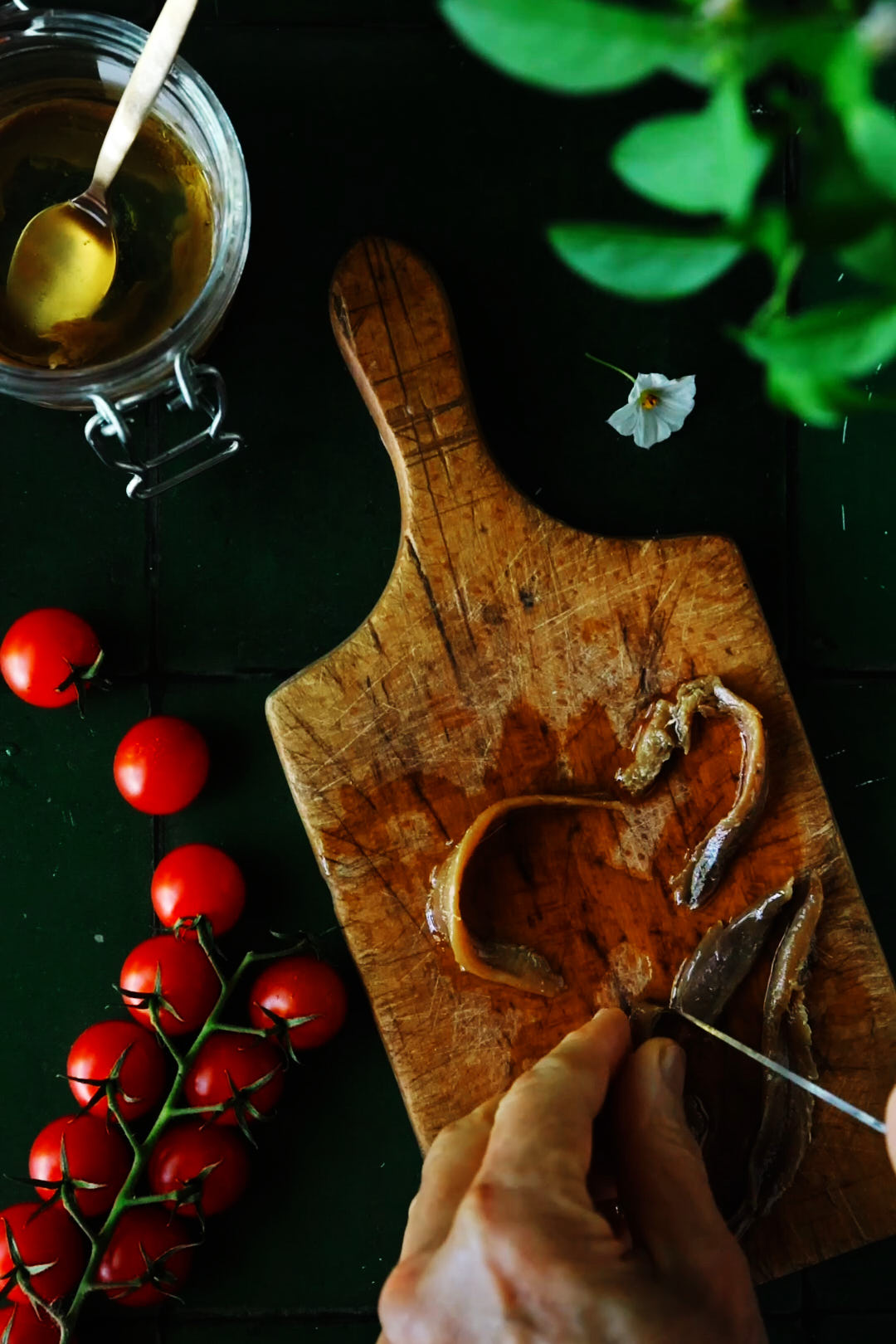
  • 6 anchovies, packed in olive oil, drained and coarsely chopped
  • 2 small garlic cloves, grated on microplane or pressed through garlic press
  • 2 Tablespoons white wine vinegar
  • 2 Tablespoons lemon juice, freshly squeezed
  • 1 Tablespoon honey
  • 1/2 teaspoon Diamond Crystal Kosher salt, or 1/4 teaspoon Morton's Kosher salt
  • 1/2 cup extra virgin olive oil

Salad

  • 2 small shallots, peeled and thinly sliced
  • 2 cups cherry tomatoes,
  • 1 Tablespoon freeze dried tomato powder, optional
  • 1/2 teaspoon Diamond Crystal Kosher salt, or 1/4 teaspoon Morton's Kosher salt
  • 6 small Israeli or Lebanese cucumbers,
  • 1/3 cup Kalalmata olives,
  • 1/4 cup fresh dill, loosely packed
  • 1/4 cup fresh basil, loosely packed
  • 1/2 cup croutons

Instructions
 

Anchovy Garlic Dressing

  • Place chopped anchovies, grated garlic, vinegar, lemon juice, honey and salt into blender jar. Blend on high speed until the anchovies are fully pureed and the mixture is smooth. Stop and scrape down the sides of the blender as needed.
  • With the blender running, slowly drizzle in the olive oil, until thick and fully emulsified. Transfer to small jar. Dressing can be made in advance and stored in the fridge for about a week.

Salad

  • Peel and thinly slice shallots into rings. Place in a small bowl and toss with 2 tablespoons of the dressing. Let them sit and marinate while you prepare the rest of the salad—this step softens their sharpness and adds flavour.
  • Place croutons in a zip-top bag and crush them with a rolling pin or the bottom of a heavy pan until coarsely crumbled. Set aside to sprinkle just before serving for maximum crunch.
  • While the shallots are marinating, halve the cherry tomatoes and place into a large mixing bowl.
  • Quarter the cucumbers lengthwise and cut into 1/4 inch slices. Add to mixing bowl with tomatoes.
  • Place Kalamata olives on a cutting board and use the flat side of a large knife to gently press until they split. Remove pits and coarsely chop. Add to mixing bowl.
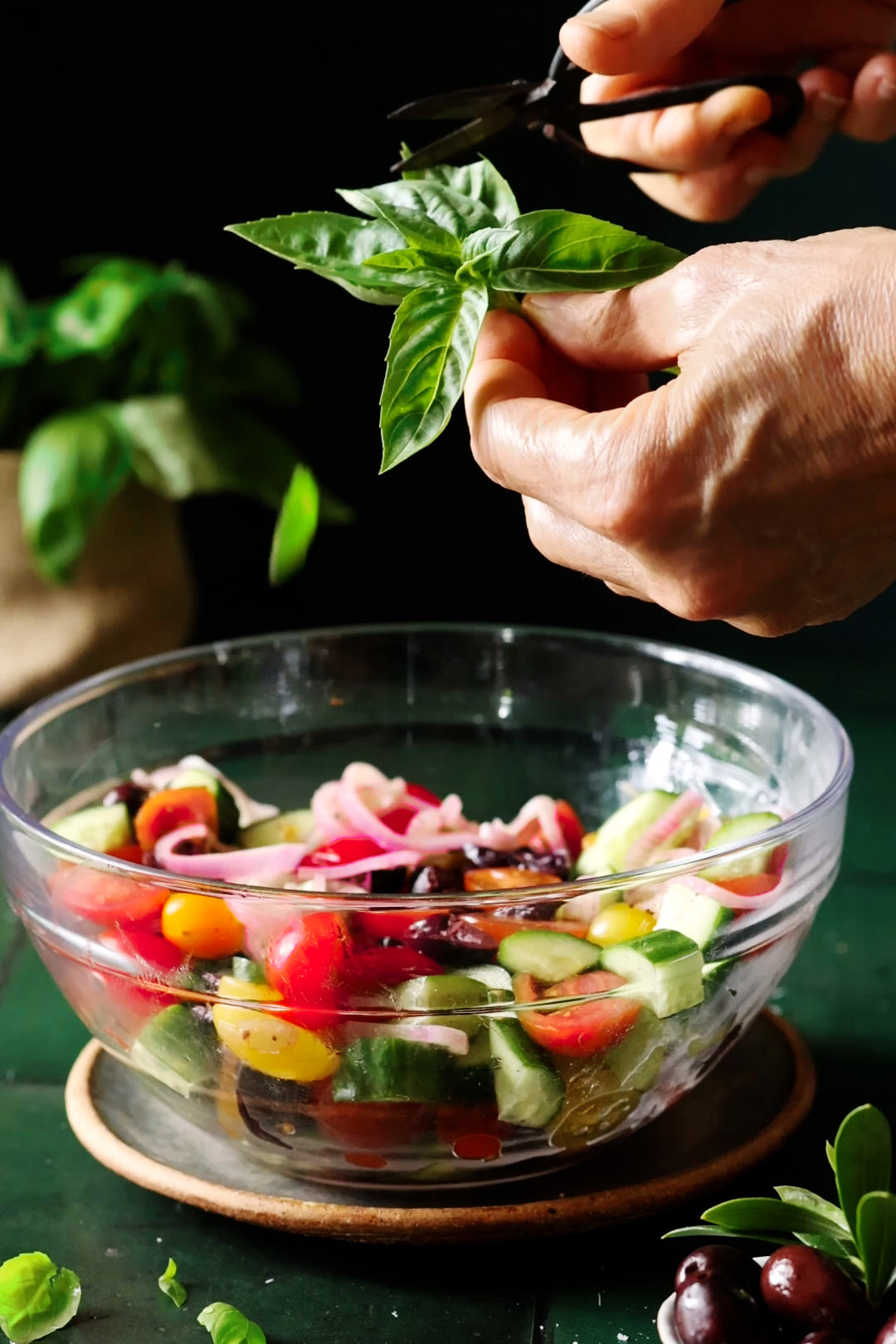
  • Coarsely chop dill and basil and add to mixing bowl. Add the marinated shallots to the bowl. Drizzle with 2-3 more tablespoons of dressing and toss to combine. Taste and adjust seasonings. Add more salt and pepper if needed. Salad can be made ahead and left at room temperature for 1-2 hours before serving.
  • Just before serving, sprinkle crushed croutons over salad.

Notes

The recipe makes more dressing than you will need. It keeps well in the fridge for about 2 weeks. It makes a delicious dip for crudités.

Nutrition

Calories: 221kcalCarbohydrates: 17gProtein: 4gFat: 16gSaturated Fat: 2gPolyunsaturated Fat: 2gMonounsaturated Fat: 12gCholesterol: 5mgSodium: 727mgPotassium: 415mgFiber: 2gSugar: 9gVitamin A: 806IUVitamin C: 27mgCalcium: 62mgIron: 2mg
Tried this recipe?Let us know how it was!

Ready to Make It?

If you’ve made it this far, I hope I’ve convinced you to give this salad a shot—anchovies and all. It’s the kind of dish that feels fresh and effortless, but still delivers serious flavour. Whether you’re serving it alongside something grilled, piling it onto toast, or just digging in with a fork straight from the bowl, I think you’re going to love it. And if someone at your table stops mid-bite and says, “This salad is amazing”? Well, now you know why.

Coffee Crunch Ice Cream Bars

Coffee Crunch Ice Cream Bars

Fun fact about me: I’ve always loved coffee-flavoured foods (hello, Coffee Crisp—one of the many perks of being Canadian!). But I didn’t actually start drinking coffee until I was almost 40.

These Coffee Crunch Ice Cream Bars are layered with flavour and texture—chocolate-covered espresso beans, toasted almonds, and crushed cookies form a crackly center, nestled between layers of smooth coffee ice cream. Dipped in chocolate and finished with a sprinkle of almonds and crushed chocolate covered espresso beans, they’re chilled, crunchy, and fully caffeinated.

The crunch layer consists of almonds, chocolate covered espresso beans and Digestive biscuits. Melted butter holds it all together.

We start with store-bought coffee ice cream—I used Haagen-Dazs, but any rich, smooth brand will do. If shaping bars feels like too much effort, you can absolutely skip the molding and just sprinkle the crunch layer over a scoop of ice cream. Still decadent. Still delicious.

But if you’re up for a little layering magic, the payoff is so worth it.

Keys to Success for Coffee Crunch Ice Cream Bars

  • Start with good ice cream. Use a high-quality store-bought coffee ice cream. You want something ultra-creamy with bold flavour—Haagen-Dazs is my go-to.
  • Don’t over-process the crunch layer. Pulse just until the mixture holds together. You want distinct bits of almond and cookie in every bite—not dust. Texture is the goal here.
  • Press firmly. Once you’ve added the crunch layer over the first ice cream layer, press it down firmly so it sticks. I like to use the bottom of a measuring cup to compact it evenly.
  • Smooth the layers. For clean, defined bars, take the time to smooth each ice cream layer evenly. Cover the pan with parchment and press gently with the back of that same measuring cup to level things out.
  • Freeze fully before cutting. Patience pays off. Give the bars plenty of time to firm up—at least 4 hours, ideally overnight—before unmolding and slicing.
  • Use a deep container for dipping. Pour your melted chocolate into a narrow, deep vessel like a 4.5” x 2.5” deli container. It makes for a clean, even dip with minimal waste.
  • Keep bars frozen until dipping. Work quickly. If the bars start to soften while dipping, just return them to the freezer for 10–15 minutes before continuing.
  • Make it fancy. A drizzle of milk chocolate, a sprinkle of chopped almonds, and a few crushed chocolate-covered espresso beans take these from homemade to heroic. Don’t skip the final flair.
A sprinkle of toasted almonds and crushed chocolate covered espresso beans takes these Coffee Crunch Ice Cream Bars from simple to sublime.

Storage & Make-Ahead Tips

These bars are freezer-friendly and ideal for making ahead. Once dipped and fully set, wrap each bar in plastic wrap and then transfer them to an airtight container or ziploc freezer bag. They’ll keep beautifully in the freezer for up to 4 weeks.

For best texture, let them sit at room temperature for 2–3 minutes before serving—just long enough to soften slightly for that perfect bite: creamy, crunchy, and snappy all at once.

Coffee Crunch Ice Cream Bars

These Coffee Crunch Ice Cream Bars are layered with flavour and texture—chocolate-covered espresso beans, toasted almonds, and crushed cookies form a crackly center, nestled between layers of smooth coffee ice cream. Dipped in chocolate and finished with a sprinkle of almonds and chocolate covered espresso beans, they’re chilled, crunchy, and fully caffeinated.
Servings 9 bars
Calories 827 kcal

Equipment

  • 1 8 inch square baking pan
  • 1 disposable piping bag
  • 1 digital thermometer
  • 1 offset spatula

Ingredients
  

For Coffee Crunch Filling

  • 130 grams Digestive biscuits
  • 20 grams roasted salted almonds
  • 20 grams chocolate covered espresso beans
  • 25 grams malted milk powder, such as Ovaltine
  • 1/4 teaspoon Diamond Crystal Kosher salt
  • 15 grams granulated sugar
  • 75 grams unsalted butter, melted

For Ice Cream Bars

  • 2 pints coffee ice cream, I used Haagen Dazs

For Dipping

  • 200 grams milk chocolate, finely chopped
  • 200 grams bittersweet or semi sweet chocolate, finely chopped
  • 100 grams refined coconut oil
  • 55 grams roasted salted almonds, coarsely chopped

For Decorating (optional)

  • 56 grams milk chocolate finely chopped
  • 30 grams roasted salted almonds toasted and coarsely chopped
  • 30 grams chocolate covered espresso beans coarsely chopped

Instructions
 

Coffee Crunch Layer

  • Preheat oven to 300°F. Line a rimmed baking sheet with parchment paper and set aside. Place Digestive cookies, chocolate covered espresso beans and almonds in food processor. Pulse 3-4 times. Add malted milk powder, sugar and salt and pulse a few more times to combine everything. Add melted butter and pulse 3-4 times until clumps form. Scatter clumps on baking sheet in a single layer. Bake for about 12-14 minutes, until fragrant and browned. Let cool completely. Break up into small clusters.

Ice Cream Bars

  • Line an 8-inch square baking pan with two 8×14-inch sheets of parchment, leaving excess on all sides to help lift the bars later. Avoid using wax paper or foil.
  • Scoop 1 pint of ice cream into the pan. Use an off-set spatula to start spreading it into an even layer. Cover with a square of parchment and use the back of a measuring cup to finish smoothing it into an even layer. Freeze until firm, about 1 hour.
  • Remove the pan from the freezer and spread coffee crunch mixture evenly over the ice cream. Press gently with a spatula. Return to freezer for 30 minutes.
  • Spread the remaining pint of ice cream over the coffee crunch layer. Cover with a square of parchment and use the back of a measuring cup to finish smoothing it into an even layer. Cover with plastic wrap, and freeze until completely firm — at least 4 hours, preferably overnight.
  • Place a cutting board in the freezer to chill. Once the ice cream is frozen, line the chilled board with parchment. Use parchment flaps to lift the slab out of the pan. Invert onto cutting board, peel off parchment, and cut into 9 squares using a large, sharp knife. Wipe the blade clean between slices. Return bars to freezer, wrapped in plastic if freezing for more than 1 hour.

For Coating Ice Cream Bars

  • Melt milk chocolate and bittersweet chocolate in a microwave-safe bowl at 50% power for 60 seconds. Stir, then continue in 30-second bursts at 50% power until smooth. Add coconut oil and stir to combine. If needed, rewarm briefly to smooth. Mix in chopped almonds.
  • Pour about one-third of the chocolate mixture into a bowl or container measuring approximately 4½" wide x 2½"deep, and let cool to 80°F.
  • Line a baking sheet with parchment paper. Remove ice cream bars from freezer. Working one at a time, loosen a bar with a spatula, dip in chocolate, let excess drip off, and place on the parchment.
  • Continue until all bars are dipped, adding reserved chocolate as needed. Pause to return bars to freezer if they begin to soften.
  • Freeze the bars until the chocolate coating has fully set, about 15 minutes.

Decorate Coated Bars

  • Melt milk chocolate in microwave safe container at 50% power for 1 minute. Stir well until smooth. Transfer to disposable piping bag.
  • Drizzle frozen bars with chocolate and sprinkle with chopped almonds and chopped chocolate covered espresso beans, Return to freezer until firm. Wrap each bar in plastic and store in a zip-top freezer bag for longer storage.

Nutrition

Calories: 827kcalCarbohydrates: 75gProtein: 11gFat: 57gSaturated Fat: 33gPolyunsaturated Fat: 4gMonounsaturated Fat: 15gTrans Fat: 0.3gCholesterol: 67mgSodium: 244mgPotassium: 574mgFiber: 7gSugar: 55gVitamin A: 669IUVitamin C: 1mgCalcium: 215mgIron: 3mg
Tried this recipe?Let us know how it was!


If you’re looking for a frozen summer treat that’s as satisfying to make as it is to eat, these Coffee Crunch Ice Cream Bars deliver. They’re simple, textural, and wildly delicious—no ice cream machine required. Whether you go all in with the layers or just sprinkle that crunch on top, this recipe is pure summer magic. Share them with friends… or keep the stash hidden in the back of your freezer. No judgement here.

Salami Babka

Sweet babkas seem to get all the love — but savoury babka absolutely deserves its moment in the spotlight. This one takes inspiration from the best kind of salami sandwich — only better, because it’s all wrapped up in tender, pillowy challah dough. The filling layers sweet fig jam with spicy salami and a brush of Dijon mustard for tang, twisted into a loaf that bakes up bronzed and glossy, with those irresistible crispy edges of salami peeking through.

The inspiration for this babka goes back to when I first started dating my husband. He brought me to Ottawa to meet his family, and one night, we ended up at his youngest uncle’s place for a backyard BBQ. As an appetizer, he sliced up salami, threw it straight on the grill, and served it sizzling and crispy, ready to dunk into yellow mustard. I was blown away. At the time, I thought this was the absolute height of culinary sophistication. Grilled salami? With mustard? I’d never seen anything like it — and I was thoroughly impressed. Crispy, salty, greasy in the best way… it totally hit the spot.

That memory stuck with me, and years later it became the inspiration for this Salami Babka — a more refined, but no less delicious, tribute to that backyard bite.

Think of it as the ultimate salami sandwich — all dressed up.

Keys to Success to Salami Babka Perfection

  • Chill the logs before slicing. After shaping, freezing the filled logs for 10–15 minutes makes slicing and twisting much easier — the firm dough holds its shape cleanly.
  • Don’t skip the egg wash and bagel spice. Brushing with egg wash gives the babka a beautiful sheen, while Everything Bagel spice adds a crunchy, savoury finish that complements the filling perfectly.
  • Use an instant-read thermometer. For best texture, bake until the internal temperature reaches 195°F (91°C). This ensures the centre is fully cooked without overbaking the crust.
  • Play with flavour. Once you’ve tried this give my Fig, Olive and Halloiumi Babka a try.
    Harissa and olives or sun-dried tomato and za’atar would also be stellar combos.

Serving and Storage Tips

Salami Babka is at its best slightly warm or at room temperature. Serve it as a savoury alternative to traditional challah on a Friday night Shabbat table — it’s sure to spark conversation. It also makes an excellent snack with a glass of wine and a bowl of spiced olives as an aperitivo.

Wrap cooled loaves tightly in foil or an airtight container and store at room temperature for up to 2 days.

For longer storage, you can freeze the shaped, unbaked babka logs after the chilling step — wrap well in plastic and foil, and freeze for up to 1 month. When ready to bake, thaw overnight in the refrigerator, then proceed with final rise and baking.

Baked loaves also freeze beautifully. Wrap tightly and freeze for up to 1 month. Reheat slices in a 300°F (150°C) oven for 5–10 minutes to refresh.

Salami Babka

A savoury twist on babka! This Salami Babka is made with soft challah dough layered with fig jam and spicy salami. Perfect for a Shabbat table, brunch, or as an impressive appetizer loaf. Freezer-friendly too!
Servings 16 slices
Calories 255 kcal

Ingredients
  

Challah Babka Dough

  • 4 grams sugar
  • 1 cup warm water, 115°-120°F
  • 8 grams traditional yeast, (also called active dry yeast)
  • 360 grams all-purpose flour
  • 113 grams honey
  • 6 grams Diamond Crystal Kosher salt
  • 1 large egg, lightly beaten
  • 49 grams vegetable oil
  • 120 grams whole wheat flour

Babka Filling

  • 1/2 cup fig jam
  • 2 Tablespoons Dijon mustard
  • 240 grams thinly sliced salami

Babka Topping

  • 1 large egg, lightly beaten
  • 2 Tablespoons everything bagel spice

Instructions
 

Challah Babka Dough

  • In a 2-cup liquid measuring cup, dissolve 1 teaspoon sugar in 1 cup warm (115° -120°F) water. Sprinkle yeast on top and let stand for about 5 minutes, until yeast gets all bubbly.
  • Make the dough in a stand mixer: Place all-purpose flour, honey and salt in the stand mixer bowl, fitted with the paddle attachment.  Mix briefly to combine.  Pour dissolved yeast mixture into machine and mix for about 1 minute.  Add egg and oil and mix again for about 30 seconds.  Add whole wheat flour and mix on medium-low speed for about 1 minute. Remove paddle attachment and switch to the dough hook. Mix on lowest speed for 10 minutes, until dough is smooth and satiny.
  • Turn dough out onto a lightly floured surface. Knead for a minute and then form the dough into a ball and transfer it to a large oiled mixing bowl. Turn dough until all sides are coated. Cover the bowl with plastic wrap and set aside. Let rise at room temperature for about 60-90 minutes, or until doubled in bulk.  A good test to see if the dough has risen enough is to insert your lightly floured finger to a depth of 1 inch into the dough and see how it springs back. If it springs back quickly and almost entirely the dough is underproofed and needs more time. If the indentation holds its shape the dough is likely overproofed. What you're aiming for is an indentation that springs back slowly and not all of the way.
  • Spray two 8×4 inch loaf pans with cooking spray. Line pans with parchment paper. If you are unsure of the best way to do this, check out this video:

Shape and Bake the Babkas

  • Turn the risen dough out onto a lightly floured counter and divide it in half. Work with one piece of dough at a time; keep the other half loosely covered.
  • Roll out one piece of dough into a 10 x 16 inch rectangle. Spread half of the fig jam evenly over the surface, leaving a 1-inch border along the long edges. Layer half of the salami slices over the jam, overlapping slightly. Spread half the Dijon mustard over the salami slices.
  • Starting with the short edge closest to you, roll the dough into a tight log, pressing gently as you go. Use both hands to even out the roll into a perfect thick cigar. Place the rolled log on a parchment-lined baking sheet, seam side down, and transfer to the freezer for 10–15 minutes to firm up.
  • Repeat the rolling filling and freezing process with the second piece of dough, using the remaining fig jam, salami and mustard.
  • Working with one chilled log at a time, use a sharp knife to cut the log in half lengthwise. With the cut sides facing up, twist the two halves together to form a braid. Carefully transfer the twisted dough to a parchment-lined 8×4 inch loaf pan. Repeat the cutting, twisting, and shaping process with the second chilled log. Cover both pans loosely and let rise until puffy, about 45–60 minutes.
  • Preheat the oven to 350°F (180°C). Brush the tops of the loaves with beaten egg and sprinkle generously with Everything Bagel spice. Bake for 20 minutes minutes and check to see how quickly the top is browning. If it is getting too dark, cover loosely with foil until the loaves are deep golden brown and the internal temperature reaches 195°-200°F. (91°-93°C) Cool in the pans for 15 minutes, then transfer to a wire rack to cool completely before slicing.

Notes

I like to bake these in a smaller loaf pan, measuring 8×4 inches. If you only have 9×5 inch pans, that will also work, but your loaves will not rise as high.
Salami Babka is at its best slightly warm or at room temperature. 
Wrap cooled loaves tightly in foil or an airtight container and store at room temperature for up to 2 days.
For longer storage, you can freeze the shaped, unbaked babka logs after the chilling step — wrap well in plastic and foil, and freeze for up to 1 month. When ready to bake, thaw overnight in the refrigerator, then proceed with final rise and baking.
Baked loaves also freeze beautifully. Wrap tightly and freeze for up to 1 month. Reheat slices in a 300°F (150°C) oven for 5–10 minutes to refresh.

Nutrition

Calories: 255kcalCarbohydrates: 34gProtein: 8gFat: 10gSaturated Fat: 3gPolyunsaturated Fat: 3gMonounsaturated Fat: 4gTrans Fat: 0.02gCholesterol: 35mgSodium: 518mgPotassium: 138mgFiber: 2gSugar: 10gVitamin A: 36IUVitamin C: 1mgCalcium: 25mgIron: 2mg
Tried this recipe?Let us know how it was!

And here’s a little bonus I discovered: leftover slices of Salami Babka are absolutely incredible toasted. Just pop a slice into the toaster or throw it on the grill for a minute or two. The edges get crispy, the fig jam caramelizes a little, and the salami takes on that same irresistible sizzle I first fell in love with. It’s the ultimate snack upgrade — and proof that this babka is just as good the next day (if you’re lucky enough to have leftovers).

Maple Aleppo Glazed Salmon & Crispy Sheet Pan Rice

I’ve watched enough episodes of Beat Bobby Flay to know one thing: if he adds crispy rice to a dish, he wins. Every. Time. There’s just something irresistible about those golden, crunchy bits that steal the spotlight. I’ve always been firmly on Team Potato, but crispy rice has always held a certain magic. The only problem? Making it on the stovetop means babysitting it—carefully adjusting the heat, listening for the sizzle, hoping you don’t burn it.

Enter this Maple Aleppo Glazed Salmon with Crispy Sheet Pan Rice. The oven does the work, and the result is pure sheet pan sorcery. Sweet and spicy maple Aleppo glazed salmon, cooked until tender and flaky, nestled into a bed of crispy, golden rice. No stirring. No stress.

Why You’ll Love This Recipe

Weeknight-friendly, but elegant enough for guests

Sweet-spicy glaze with mellow heat from Aleppo pepper

Golden crispy rice, no stovetop required

One pan = easy cleanup

Keys to Crispy Rice Success

  • Use medium or short grain rice. Sushi rice or Calrose work beautifully. Long grain tends to separate and dry out too much.
    Start with cold, cooked rice. Fresh rice is too wet and will steam instead of crisp. Leftover rice from the fridge is ideal.
  • Balance the flavours in the rice. A little soy sauce adds salt, lime juice brings brightness, and green onions add a fresh bite. Seasoned rice = crave-worthy rice.
  • Heat your sheet pan in the oven until it’s smoking hot. This jumpstarts the crisping process as soon as the rice hits the pan.
  • Crisp the rice before adding salmon. The rice needs about 15–20 minutes to get golden and crunchy. Add the salmon after that for perfect timing.
  • Don’t let the glaze hit the pan. Maple syrup burns easily, so spoon the glaze directly onto the salmon, not the rice or pan.

Sticky Maple. Slow Heat. Crispy Rice.

This isn’t just salmon—it’s sheet pan sorcery. The kind of dinner that feels like a spell: no stovetop, no stress, just golden crackle and sweet heat. The kind of dinner that lingers—quietly impressive and deeply satisfying.

Grab the full printable recipe below.

Maple Aleppo Glazed Salmon and Crispy Sheet Pan Rice

Sticky maple, slow heat, and golden, crispy rice—this sweet and spicy sheet pan salmon is simple to make, yet quietly spectacular.
Servings 4
Calories 541 kcal

Equipment

  • 1 9×13 inch sheet pan

Ingredients
  

For the Crispy Rice

  • 1 Tablespoon avocado or vegetable oil, for pan
  • 3 cups cold, cooked short grain rice, like sushi rice
  • 1 Tablespoon avocado or vegetable oil, for rice
  • 2 Tablespoons soy sauce
  • 2 Tablespoons fresh lime juice
  • 3 green onions

For the Salmon

  • 780 grams skin on salmon fillet, cut into 4 portions
  • 2 Tablespoons soy sauce
  • 4 Tablespoons maple syrup
  • 1 teaspoon Aleppo pepper

For Garnish

  • 2 wedges fresh lime
  • 2 Tablespoons cilantro, chopped
  • reserved sliced dark green onion tops
  • 1 Tablespoon toasted sesame seeds

Instructions
 

For Crispy Rice

  • Pour 1 Tablespoon of avocado oil onto a 9×13 rimmed sheet pan and place on lower rack of your oven. Preheat oven to 425°F.
  • Thinly slice green onions, separating the dark green tops for garnish.
  • In a large bowl, combine the cooked rice, white and light green onion parts, 1 tablespoon avocado oil, soy sauce, and lime juice. Wet hands with cold water and mix until well combined.
  • Once oven is preheated, remove sheet pan and spread rice mixture into an even layer. Return pan to oven and bake for 15–20 minutes, until rice begins to crisp and turn golden around the edges.

For the Salmon

  • In a small skillet, combine soy sauce, maple syrup, and Aleppo pepper. Cook over medium heat for 2–3 minutes, until mixture thickens slightly. Remove from heat.
  • After rice has baked for 15–20 minutes, remove sheet pan from oven. Place salmon fillets, skin-side down, on top of the rice. Spoon glaze over the salmon.
  • Return sheet pan to oven and bake for another 10–12 minutes, until salmon is cooked through.
  • Garnish with lime wedges, chopped cilantro, reserved sliced green onion tops and toasted sesame seeds.

Notes

It is important to start with cold, cooked rice for this recipe as it has had time to dry out and will resist clumping .It will crisp up perfectly  on the hot sheet pan.
Sushi, or any short grain rice, works best for this recipe as long grain rice can dry out more quickly than it’s short grained sister. For 3 cups cooked leftover cold rice, you will need to start with 1.5 cups of dry rice. 

Nutrition

Calories: 541kcalCarbohydrates: 42gProtein: 43gFat: 21gSaturated Fat: 3gPolyunsaturated Fat: 7gMonounsaturated Fat: 9gTrans Fat: 0.03gCholesterol: 107mgSodium: 601mgPotassium: 1084mgFiber: 1gSugar: 6gVitamin A: 330IUVitamin C: 2mgCalcium: 76mgIron: 3mg
Tried this recipe?Let us know how it was!

More Easy Weeknight Dinners to Love

I’d love to hear from you if you try this!

Pistachio Crunch Ice Cream Bars

Pistachio Crunch Ice Cream Bars.


If you’re as obsessed with pistachio desserts as I am, you’re in for a treat. These Pistachio Crunch Ice Cream Bars are inspired by the luxurious flavours and textures of the viral Dubai Pistachio chocolate bar — but reimagined as a frozen summer dessert. Two layers of creamy pistachio ice cream sandwich a crunchy, buttery kataifi-pistachio filling, all enrobed in a thick shell of chocolate and topped with a white chocolate drizzle, toasted pistachios and gold sprinkles. They look extra (and taste like it), but they’re surprisingly easy to make — no churning required. Most of the time is hands-off while everything chills and sets. Trust me: this is the kind of dessert you’ll want to keep stashed in your freezer all summer long.

Watch me make them:

Keys to Success when making Pistachio Crunch Ice Cream Bars

  • 1. Use store-bought ice cream — but let it soften first. You don’t need an ice cream maker for this recipe. Just use your favourite pistachio ice cream, but let it soften in the fridge for about 30 minutes before spreading. It’ll glide into the pan much more easily and create smooth, even layers.
  • 2.Start with good quality ice cream. I bought Baskin Robbins Pistachio- Almond ice cream.
  • 3. Toast the kataifi gently. Kataifi is shredded phyllo and burns quickly. Keep the heat at medium and stir constantly until it’s evenly golden and crisp. You’re aiming for toasty, not smoky.
  • 4. Press the filling firmly and evenly. After toasting the kataifi and mixing in the pistachio paste, spread it gently over the first ice cream layer and press it down. This helps the layers stay neat when slicing later. Use the back of a measuring cup to help get everything smooth.
  • 5. Freeze in stages. Let each layer freeze before adding the next — this helps keep them distinct and prevents melting during assembly. The final freeze (at least 4 hours or overnight) is essential for clean slicing and smooth dipping.
  • 6. Use a deep container for dipping. Pour your melted chocolate into a narrow, deep container (a 4.5” x 2.5” deli container works well). It gives you a clean, even dip and minimizes waste.
  • 7. Work quickly when dipping. Keep your bars frozen until just before dipping. If they start to soften, pop them back in the freezer for 10–15 minutes before continuing.
  • 8. Make it fancy. A drizzle of white chocolate, a sprinkle of pistachios (and maybe a touch of edible gold) elevates these from simple frozen treats to showstoppers.
  • 9. Pistachio Paste vs. Pistachio Butter vs. Pistachio Cream.
    This recipe calls for pistachio cream. Pistachio paste, pistachio butter, and pistachio cream may sound similar, but they’re quite different. Pistachio paste is made from finely ground pistachios, often roasted, with no added sugar—just pure, intense pistachio flavour. Pistachio butter is also made from ground pistachios but is usually raw or lightly roasted and may be slightly looser in texture; like other nut butters, it’s meant for spreading and eating on its own. Pistachio cream, on the other hand, is a sweet spread made with pistachios, sugar, and often milk or white chocolate. It has a smooth, dessert-like consistency—think of it as pistachio’s answer to Nutella.

Pistachio Crunch Ice Cream Bars

Servings 9 bars
Calories 754 kcal

Equipment

  • 1 8 inch square baking pan
  • 1 disposable piping bag
  • 1 digital thermometer
  • 1 offset spatula

Ingredients
  

For Ice Cream Bars

  • 2 pints pistachio ice cream
  • 112 grams unsalted butter
  • 140 grams kataifi if frozen, thaw overnight in fridge before starting recipe
  • 224 grams pistachio cream
  • 1/4 teaspoon Diamond Crystal Kosher salt

For Dipping

  • 100 grams milk chocolate, finely chopped
  • 100 grams bittersweet or semi sweet chocolate, finely chopped
  • 100 grams refined coconut oil

For Decorating (optional)

  • 56 grams white chocolate, finely chopped
  • 30 grams shelled pistachios, toasted and finely chopped toasted and coarsely chopped
  • 10 grams gold sprinkles, optional

Instructions
 

For Ice Cream Bars

  • Place 1 pint of pistachio ice cream in the fridge for 30 minutes to soften for easier scooping and spreading
  • Line an 8-inch square baking pan with two 8×14-inch sheets of parchment, leaving excess on all sides to help lift the bars later. Avoid using wax paper or foil.
  • Scoop the softened ice cream into the pan. Use an off-set spatula to start spreading it into an even layer. Cover with a square of parchment and use the back of a measuring cup to finish smoothing it into an even layer. Freeze until firm, about 1 hour.
  • Finely chop thawed kataifi with a serrated knife. In a large skillet, melt butter over medium heat. Add kataifi and cook, stirring frequently, for about 8 minutes, until golden and crisp. Avoid high heat—kataifi burns easily.
  • Transfer kataifi to bowl and let cool for a few minutes. Stir in pistachio cream.
  • Remove the pan from the freezer and spread kataifi mixture evenly over the ice cream. Press gently with a spatula. Return to freezer for 30 minutes. Place second pint of ice cream in fridge to soften.
  • Spread the remaining softened ice cream over the kataifi layer. Cover with a square of parchment and use the back of a measuring cup to finish smoothing it into an even layer. Cover with plastic wrap, and freeze until completely firm — at least 4 hours, preferably overnight.
  • Place a cutting board in the freezer to chill. Once the ice cream is frozen, line the chilled board with parchment. Use parchment flaps to lift the slab out of the pan. Invert onto cutting board, peel off parchment, and cut into 9 squares using a large, sharp knife. Wipe the blade clean between slices. Return bars to freezer, wrapped in plastic if freezing for more than 1 hour.

For Coating Ice Cream Bars

  • Melt chocolate in a microwave-safe bowl at 50% power for 60 seconds. Stir, then continue in 30-second bursts at 50% power until smooth. Add coconut oil and stir to combine. If needed, rewarm briefly to smooth.
  • Pour about two-thirds of the chocolate mixture into a bowl or container measuring approximately 4½" wide x 2½"deep, and let cool to 80°F.
  • Line a baking sheet with parchment paper. Remove ice cream bars from freezer. Working one at a time, loosen a bar with a spatula, dip in chocolate, let excess drip off, and place on the parchment.
  • Continue until all bars are dipped, adding reserved chocolate as needed. Pause to return bars to freezer if they begin to soften.
  • Freeze the bars until the chocolate coating has fully set, about 15 minutes.

Decorate Coated Bars

  • Melt white chocolate in microwave safe container at 50% power for 1 minute. Stir well until smooth. Transfer to disposable piping bag.
  • Drizzle frozen bars with white chocolate and sprinkle with chopped pistachios and gold sprinkles (if using). Return to freezer until firm. Wrap each bar in plastic and store in a zip-top freezer bag for longer storage.

Notes

Pistachio Paste vs. Pistachio Butter vs. Pistachio Cream.
This recipe calls for pistachio cream. Pistachio paste, pistachio butter, and pistachio cream may sound similar, but they’re quite different. Pistachio paste is made from finely ground pistachios, often roasted, with no added sugar—just pure, intense pistachio flavour. Pistachio butter is also made from ground pistachios but is usually raw or lightly roasted and may be slightly looser in texture; like other nut butters, it’s meant for spreading and eating on its own. Pistachio cream, on the other hand, is a sweet spread made with pistachios, sugar, and often milk or white chocolate. It has a smooth, dessert-like consistency—think of it as pistachio’s answer to Nutella.
Frozen kataifi is the most affordable option. A 454g package is  about $2.79 — thaw overnight in the fridge before using. Dried kataifi is available online (e.g., $24 for 500g on Amazon), but much pricier.
The coating recipe and procedure were developed by Stella Parks over at Serious Eats. 

Nutrition

Calories: 754kcalCarbohydrates: 62gProtein: 12gFat: 55gSaturated Fat: 30gPolyunsaturated Fat: 5gMonounsaturated Fat: 16gTrans Fat: 0.4gCholesterol: 64mgSodium: 230mgPotassium: 644mgFiber: 6gSugar: 43gVitamin A: 859IUVitamin C: 2mgCalcium: 168mgIron: 3mg
Tried this recipe?Let us know how it was!

Nibble Board

A board built for slow sips and small bites. Nothing rushed here.

There’s something quietly magical about building a board—one tiny bite at a time. This isn’t your usual cheese board. It’s a nibble board: slower, more tactile, and filled with small surprises that invite your guests to pause and play. One of my favourites? A nest of tiny, hard-boiled quail eggs to peel and dip in fleur de sel. Paired with unexpected flavour combinations—like cheddar or manchego cheese, honey, and coffee—it’s an experience that’s as thoughtful as it is delicious.

Watch me assemble the board.

KEYS TO SUCCESS (HARD-BOILED QUAIL EGGS)

I was inspired by an episode of The Lost Kitchen to add Quail Eggs to my nibble board. They may look delicate, but they’re surprisingly easy to prep with the right method:

  • Skip the boiling. Boiling often cracks the shells. Instead, steam them in a steamer basket.
  • Steam for 3 minutes for hard-boiled perfection.
  • Immediately plunge into an ice water bath to stop the cooking and make peeling easier.
  • Unpeeled, hard-boiled quail eggs will last up to a week in the fridge.
  • I found mine locally at Farm Boy, but you can often spot them at specialty or Asian grocers.

The result is a gently firm, creamy little egg—perfect for serving in a soft nest of straw with a pinch bowl of salt nearby.

Cheddar meets honey and coffee. Strange? Maybe. Surprising? Absolutely.

UNEXPECTED PAIRING FOR YOUR NIBBLR BOARD: CHEESE, HONEY & COFFEE

If cheddar or manchego cheese and coffee sound like strange bedfellows, you’re not alone. The first time I saw Jamie Oliver dip cheese into honey and coffee, my brain said: “Wait—what?” But curiosity won out—and I’ve never looked back.

Here’s why it works:

  • The sweetness of the honey balances the bitterness of the coffee.
  • Together, they soften the sharp, astringent edge of hard cheeses like aged cheddar or manchego.
  • It’s layered, earthy, and a little bit wild—especially when paired with something nutty or a glass of wine.

A nibble board like this isn’t just about the food—it’s about the experience. The small, curious moments. The sound of a quail egg cracking, the surprise of honey and coffee on a slice of cheese. It’s an invitation to gather slowly, eat thoughtfully, and linger a little longer around the table. Whether you’re hosting friends or simply treating yourself, building a board this way adds warmth and wonder to even the simplest evening.

Layering slow. Every piece an invitation to pause.

Shakshuka in a a Hurry.

Shakshuka in a Hurry

There’s something magical about a meal that feels slow and nourishing—but comes together in minutes. That’s exactly what drew me to this recipe for Shakshuka in a Hurry by Vancouver creator Rachel Halldorson. I don’t usually share recipes from other creators, but this one was too good not to pass along. I have adapted it very slightly. It’s everything I want in a solo dinner: quick, comforting, deeply flavourful, and made with pantry staples. One pan, a handful of fresh ingredients, and a few minutes later… dinner is done.

Keys to success for Shakshuka in a Hurry

  • Perfume the oil with garlic. Start by sautéing a crushed garlic clove in olive oil for just a minute. Then remove it. This infuses the oil with mellow garlic flavour without any harsh bite—just warm, subtle depth.
  • Use cherry tomatoes, not grape. Cherry tomatoes are juicier and break down more easily, creating a silky sauce that’s perfect for poaching eggs. Grape tomatoes tend to be firmer and less saucy.
  •  Ricotta + cottage cheese = creamy magic. A blend of ricotta and cottage cheese adds luxurious texture and a protein boost. Use a fork to mash the cottage cheese a bit—it smooths out the curds and helps it melt into the sauce.
  •  Make a little nest before adding eggs. Use the back of a spoon to create small wells in the tomato sauce before cracking in your eggs. This helps them stay put and cook evenly.
  • Don’t be shy with the salt and chili flakes. Tomatoes love salt—and this dish comes alive with a bit of heat. Red pepper flakes are great, or try Burlap & Barrel’s Silk Chili Flakes for a subtle, smoky warmth I’m currently obsessed with.
  • Finish with fresh herbs and a sprinkle of Everything Bagel Spice. Dill, cilantro or parsley add freshness and the everything bagel spice adds some crunch.

Serving Suggestions

  • This dish was made for crusty bread. A slice of sourdough or a warm hunk of baguette is perfect for scooping and swiping—don’t let that rich tomato sauce go to waste.
  • Add greens if you’d like. A handful of baby spinach or arugula stirred into the tomato base before adding the eggs can bump up the veg factor. Or serve with a simple green salad on the side.
  • Perfect for solo dinners… but easily doubled. This recipe is ideal for one, but it scales up beautifully. Add an extra egg or two and invite someone to join you.
  • A cozy brunch option. Serve in the pan with a pot of coffee or a mimosa and pretend you’re at a café in Tel Aviv. Bonus points for serving it straight from the skillet.

Shakshuka in a Hurry

This quick and easy Shakshuka recipe is perfect for solo dinners—juicy cherry tomatoes, gently poached eggs, and a creamy twist. Comfort food in under 20 minutes.
Servings 1 serving
Calories 407 kcal

Equipment

  • 8 inch skillet with lid

Ingredients
  

  • 2 Tablespoons ricotta cheese
  • 2 Tablespoons cottage cheese
  • 1 large garlic clove
  • 1 teaspoon olive oil
  • 1 1/2 cups cherry tomatoes
  • 1/2 teaspoon Diamond Crystal Kosher salt, or 1/4 teaspoon Morton's Kosher salt
  • 1/8- 1/4 teaspoon red pepper flakes
  • 1-2 Tablespoons water
  • 2 large eggs
  • 1 slice crusty bread or toast

For Garnish

  • 2 Tablespoons chopped fresh herbs, dill, cilantro or parsley
  • 2 teaspoons Everything Bagel Spice

Instructions
 

  • In a small bowl, combine the ricotta and cottage cheese. Use a fork to mash and blend until mostly smooth. Set aside.
  • Smash the garlic clove with the side of a large knife and peel away the skin. Heat the olive oil in an 8-inch nonstick skillet over medium heat. Add the garlic and sauté for 1–2 minutes, just until lightly golden. Remove and discard the garlic.
  • Add the cherry tomatoes to the skillet. Season with salt and red pepper flakes. Cover and cook for 5 minutes to help the tomatoes burst and soften.
  • Uncover the pan and use a potato masher or fork to gently crush the tomatoes into a chunky sauce. If the mixture looks too dry, add 1–2 tablespoons of water. Let it cook for another 1–2 minutes, until the sauce is thick and jammy.
  • Use a spoon to make two small wells in the sauce. Crack an egg into each well. Dollop spoonfuls of the cheese mixture around the eggs.
  • Cover the skillet and cook for 2–3 minutes, or until the egg whites are set but the yolks are still runny.
  • Garnish with chopped herbs and a sprinkle of everything bagel spice, if using. Serve immediately with crusty bread or toast for dipping.

Nutrition

Calories: 407kcalCarbohydrates: 27gProtein: 26gFat: 22gSaturated Fat: 7gPolyunsaturated Fat: 4gMonounsaturated Fat: 9gTrans Fat: 0.1gCholesterol: 392mgSodium: 1596mgPotassium: 785mgFiber: 4gSugar: 9gVitamin A: 2243IUVitamin C: 53mgCalcium: 258mgIron: 5mg
Tried this recipe?Let us know how it was!


Whether you’re cooking for yourself or sharing with someone else, this quick Shakshuka is proof that simple ingredients can still deliver big comfort. I don’t often repost other people’s recipes, but this one from Rachel Haldorsen really is something special—and too good to keep to myself. If you give it a try, I’d love to hear what you think. Leave a comment, tag me on Instagram, or tell me what kind of bread you used to soak up that glorious sauce.

My Perfect Vinaigrette

Perfect vinaigrette. Stays emulsified for a week.

We’re going back to basics today. After years of sharing recipes, I realized I’ve never posted the one I make the most—my perfect vinaigrette. I mix up a batch of this every week, and it never gets old. It’s tangy, balanced, and endlessly customizable. Once you start making your own salad dressing, you’ll never look at bottled the same way again.

Why Make Your Own?

It boggles my mind that people still buy bottled dressing. Homemade tastes better, costs less, and doesn’t contain preservatives or weird thickeners. It takes just minutes to make and keeps in the fridge for up to two weeks.

The Formula for My Perfect Vinaigrette

Classic vinaigrette follows a 3:1 oil-to-vinegar ratio—but I prefer a punchier 2:1.

Mustard acts as an emulsifier, bonding the oil with the vinegar so that the dressing does not separate. Honey acts to temper the acid, bringing the dressing into perfect balance. I do not season the dressing with either salt or pepper. I prefer to season the salad itself, rather than the dressing.

No blender? No problem. Use a whisk and a mixing bowl—set the bowl on a rolled-up damp towel to keep it steady while you whisk and pour.

My Perfect Vinaigrette

This easy vinaigrette recipe comes together in minutes and stays creamy and emulsified for about two weeks. When refrigerated, the olive oil will solidify—just take it out 30 minutes before using. 
Servings 12 servings
Calories 167 kcal

Ingredients
  

  • 1 Tablespoon Dijon mustard
  • 1-2 Tablespoons Honey
  • 1/2 cup Sherry or Red Wine Vinegar
  • 1 cup Extra Virgin Olive Oil

Instructions
 

  • Add mustard, honey, and vinegar to a blender.
  • Blend on high speed for about 10 seconds.
  • With the blender still running, slowly drizzle in the olive oil until fully emulsified.
  • Pour into a jar and refrigerate. Shake gently before using.

Nutrition

Serving: 2TablespoonsCalories: 167kcalCarbohydrates: 2gProtein: 0.1gFat: 18gSaturated Fat: 2gPolyunsaturated Fat: 2gMonounsaturated Fat: 13gSodium: 15mgPotassium: 7mgFiber: 0.1gSugar: 1gVitamin A: 1IUVitamin C: 0.1mgCalcium: 2mgIron: 0.2mg
Tried this recipe?Let us know how it was!

Storage Tips

This dressing stays emulsified in the fridge for at least a week (often longer). The olive oil may solidify—just take it out 30 minutes before using.

Bonus tip: Clean your blender by filling it one-third full with hot water and a squirt of dish soap, then blend for 30 seconds.

Use Good Ingredients

Quality matters.

Make It Your Own.

If you stick to the basic ratio (2 parts oil:1 part acid), you can switch up the ingredients endlessly.

Oil Options:

  • Olive oil
  • Sunflower or avocado oil (lighter)
  • Walnut, hazelnut, or sesame oil (for depth)

Acid Options:

  • Sherry, red wine, or champagne vinegar
  • Lemon juice or a lemon-vinegar combo
  • Apple cider or balsamic vinegar

Sweeteners (1–2 tbsp per 1 cup oil):

  • Honey
  • Maple syrup
  • Date syrup
  • A spoonful of jam or marmalade for something unexpected

Emulsifiers (1 tbsp per 1 cup oil):

  • Dijon mustard (classic)
  • Whole grain or honey mustard
  • Mayonnaise

Always Add Crunch

This is a non-negotiable in my opinion. A great salad needs texture. Here are some of my go-to toppers:

  • Homemade croutons
  • Toasted panko (with or without anchovy + garlic)
  • Roasted nuts (almonds, pecans, hazelnuts)
  • Pumpkin, sunflower, or sesame seeds
  • Crispy chickpeas
  • Fried shallots or garlic chips

My Favourite Lettuce Blend

When it comes to salad greens, I like to mix it up. I always start with something sweet and crisp, like romaine or Cos. Then I add something peppery—usually arugula—and finish with something bitter, like radicchio, Belgian endive, or frisée.

I’ll be honest: I didn’t always love bitter greens. But as I’ve gotten older, I’ve come to appreciate those sharp, bracing flavours. Without the bitter, you miss the beauty of the sweet.

That’s salad… and also a little life lesson I’ve come to believe.

Primavera Orzotto

There’s something magical about the first green vegetables of spring. After months of stews and root vegetables, the sight of leeks, asparagus, and peas at the market feels like a deep breath of fresh air. It’s the culinary equivalent of throwing off a heavy winter blanket and stepping into the sunshine. This Primavera Orzotto is my celebration of that moment—bright, comforting, and full of life. It’s a riff on spring risotto, but with a laid-back twist: orzo. Unlike risotto, which demands constant stirring and your full attention, orzo is much more forgiving, letting you ease into spring with a dish that’s as relaxed as the season should be.

Watch how this vibrant, cozy dish comes together—no constant stirring required.

fresh spring leeks


Why I Love Leeks (and How to Clean Them)

There’s something so elegant about leeks—their deep green tops fading into pale, creamy stems, still glistening with dew. They’re one of the first signs of spring in the market, and one of my favourite ingredients to cook with this time of year.

Leeks have a gentle, sweet onion flavour that turns beautifully mellow when sautéed. They’re the quiet hero of this dish, forming a rich, savoury base without overpowering the other vegetables.

But as gorgeous as they are, leeks are notorious for hiding grit and sand between their tightly packed layers. To clean them properly, I slice them into rounds, then submerge them in a big bowl of cold water. Swish them around with your hands to loosen any trapped dirt, then let them sit for a moment. The grit will sink to the bottom—just be sure to lift the clean leeks out with your hands or a slotted spoon. Don’t drain the bowl, or you risk pouring the sand right back over them.

A little extra care at the beginning goes a long way—and ensures every bite of this Primavera Orzotto is silky, clean, and full of spring flavour.

Fresh asparagus and peas for Primavera Orzotto.


Choosing Asparagus (Yes, Size Matters)

I have some pretty strong opinions about asparagus—especially in spring. I never rush to buy the first pencil-thin stalks that show up early in the season. They might look dainty, but they’re often grassy and underwhelming in flavour. I wait patiently for the thicker spears to appear. They’re sweeter, more tender, and have a lovely meaty texture that stands up beautifully in a dish like this.

If I’m not cooking them the same day, I store the bunch upright in a jar or glass with a couple inches of cold water in the bottom—just like a bouquet. I loosely drape a plastic bag over the top and pop it in the fridge. This keeps the ends from drying out and helps the asparagus stay crisp and fresh for a few extra days.

One more tip: I always peel the bottom inch or two of each spear with a vegetable peeler. It’s a small step, but it makes a big difference in tenderness—and gives the asparagus a polished look that feels just a little extra special.


Fresh or Frozen Peas? Here’s the Deal

Unless you’re at the farmers’ market buying freshly shelled peas that were picked that morning (or maybe the day before)… don’t bother. Truly fresh peas are a delight—but they’re rare and fleeting.

For this recipe (and most recipes, honestly), frozen peas are the way to go. They’re flash-frozen at peak ripeness, which means they keep their bright colour, sweet flavour, and that perfect little pop. Best of all, you don’t even need to thaw them—just stir them in at the very end, and they’ll warm through in seconds.

Keys to Success for Primavera Orzotto

  • Start with a flavourful stock. Since the orzo absorbs so much liquid, the broth you use will make or break the dish. Homemade or high-quality store-bought stock is ideal—chicken or veggie both work beautifully.
  • Add asparagus later. To keep it tender and bright green (not mushy or dull), stir in chopped asparagus partway through cooking, not at the beginning.
  • Save the peas for last. Whether fresh or frozen, peas only need a minute or two of heat to warm through. Add them at the very end to preserve their sweet flavour and signature pop.
  • Frozen peas are perfect. Don’t stress about shelling fresh ones—frozen peas are harvested at peak ripeness and flash-frozen. They thaw in seconds and keep their lovely texture.
  • Let orzo do the work. Unlike traditional risotto, which needs near-constant stirring, orzo is much more hands-off. Stir occasionally and enjoy the relaxed pace.
Primavera orzotto, a riff on springtime risotto. Put an egg on it!

Primavera Orzotto

Welcome spring with a bowl of Primavera Orzotto—where velvety orzo takes the place of rice in this light yet creamy twist on risotto. 
Servings 4 people
Calories 512 kcal

Ingredients
  

Green Stock

  • 30 grams Italian parsley leaves about 1/2 cup
  • 170 grams frozen green peas, about 1 cup, no need to thaw
  • 1 tablespoon lemon juice
  • 113 grams chicken or vegetable stock, about 1/2 cup
  • 1 Tablespoon olive oil

Orzotto

  • 1 large leek, white and light green part, thinly sliced
  • 1 teaspoon unsalted butter
  • 1 teaspoon olive oil
  • 280 grams dried orzo, about 1 1/2 cups
  • 450 grams chicken or vegetable stock about 2 cups
  • 340 grams asparagus, trimmed and cut into 2 inch pieces, about 1 bunch
  • 225 grams chicken or vegetable stock about 1 cup
  • 170 grams thawed frozen peas about 1 cup

Garnish

  • 28 grams grated Parmesan cheese

Instructions
 

Make Green Stock

  • Place parsley leaves, frozen peas, lemon juice, vegetable or chicken stock to blender. Puree until smooth. Stream in olive oil at very end of blending time. Set green stock aside.

Make Orzotto

  • Fill a medium sized bowl with cold water. Place sliced leeks into bowl and use your hands to swish the leeks around. Remove leeks from bowl and discard sandy water.
  • Heat a large, high sided skillet or pot over medium heat. Add butter and olive oil. Add leeks and saute over medium heat for 3-4 minutes. If they start to burn, add a few Tablespoons of water.
  • Add orzo and saute for 1 minute until all the grains are coated in oil. Add 2 cups of stock and reduce the heat to medium-low to maintain a gentle simmer. Cook, stirring occasionally so the orzo doesn’t stick to the bottom of the skillet, until most of the liquid is absorbed, about 6 minutes.
  • Add asparagus and an additional cup of stock and continue cooking for another 4 minutes, stirring every minute or so.
  • Add green stock and peas and continue cooking for another 2 minutes.
  • Top with grated cheese and serve.

Nutrition

Calories: 512kcalCarbohydrates: 80gProtein: 23gFat: 11gSaturated Fat: 3gPolyunsaturated Fat: 2gMonounsaturated Fat: 5gTrans Fat: 0.04gCholesterol: 15mgSodium: 423mgPotassium: 841mgFiber: 10gSugar: 12gVitamin A: 2393IUVitamin C: 53mgCalcium: 148mgIron: 5mg
Tried this recipe?Let us know how it was!